Sim
Open-source visual platform to build, deploy, and manage AI agent workflows
Last reviewed 2026-06-19
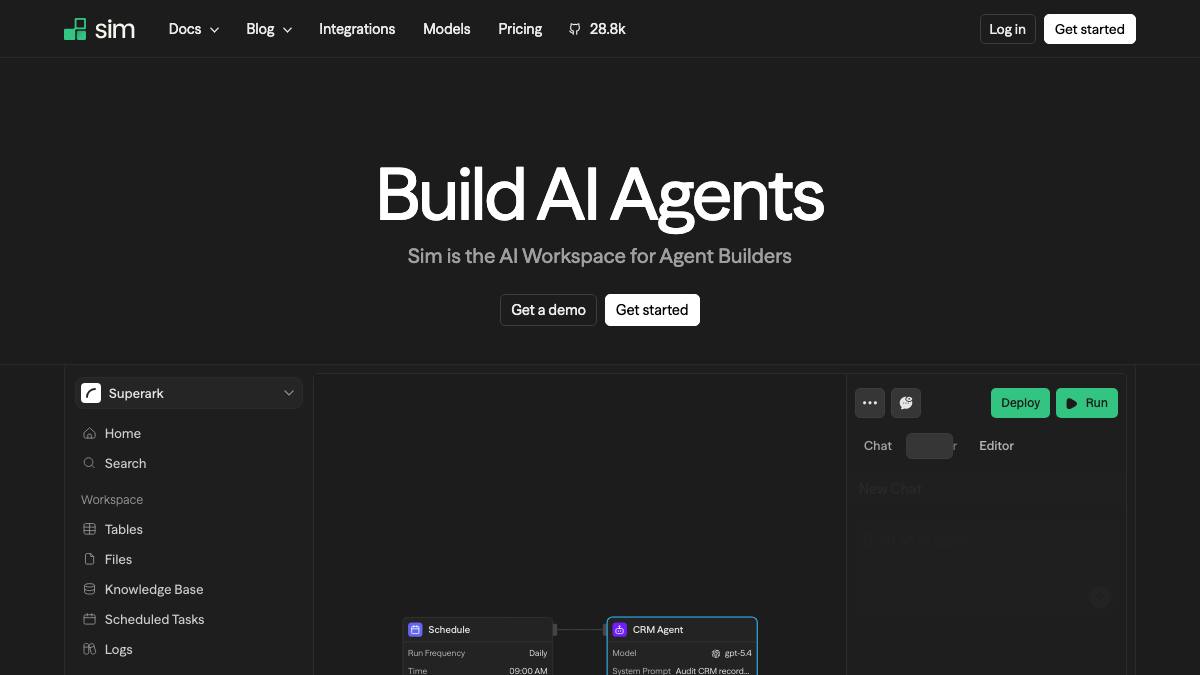
Sim (formerly Sim Studio) is an open-source platform for building, deploying, and orchestrating AI agents and agent workflows. Its core interface is a Figma-like visual canvas where users drag and drop blocks to connect LLMs, tools, and external services into runnable workflows; users can build conversationally, visually, or with code. The platform also includes a built-in database, file storage, knowledge bases for retrieval grounding, execution logs, and real-time multiplayer collaboration. Workflows can be deployed and triggered as an API endpoint, a chat interface, a scheduled task, a webhook responder, or an MCP server. Sim advertises support for major LLM providers and a large catalog of integrations, and can run hosted models or local models via Ollama and vLLM. It is Apache 2.0 licensed and self-hostable, and targets developers and technical teams building agentic automation.
What it can do
Build agent workflows on a visual canvas
SupervisedDrag-and-drop blocks connect LLMs, tools, and logic on a Figma-like canvas into runnable workflows.
sourceDeploy workflows as API, chat, or MCP server
SupervisedPublish a workflow as an HTTP API, a chatbot, or an MCP server for other clients to call.
sourceTrigger workflows on schedules and webhooks
SupervisedRun workflows automatically on a schedule or in response to webhooks and events.
sourceConnect external integrations as agent tools
SupervisedWire agents to third-party apps such as Slack, Gmail, GitHub, and Notion to read and write data.
source
Strengths
- +Genuinely open-source (Apache 2.0) with first-class self-hosting via Docker, npm, and local models (Ollama, vLLM)
- +Broad model and integration coverage plus multiple deployment modes (API, chat, schedule, webhook, MCP server)
- +Strong momentum: YC-backed with a Series A and tens of thousands of GitHub stars
Limitations
- −Young company (founded 2025) with a small team and limited enterprise support track record
- −Paid cloud tiers are credit-metered, making costs harder to predict for heavy workloads
- −Vendor-reported adoption numbers vary across sources, so headline traction should be treated cautiously
Overview
Sim, formerly Sim Studio, is an open-source platform for building, deploying, and orchestrating AI agents and workflows. Its core is a Figma-like visual canvas of drag-and-drop blocks, and it can also be driven conversationally or with code. It is Apache 2.0 licensed, self-hostable, and YC-backed.
What it does
Users connect LLMs, tools, and external services into runnable workflows, then deploy them as an API, chat interface, scheduled task, webhook responder, or MCP server. The platform includes a built-in database (Tables), file storage, knowledge bases for retrieval grounding, execution logs, and real-time multiplayer collaboration with role-based access.
Integrations & setup
It advertises support for 15+ LLM providers (OpenAI, Anthropic, Gemini, and more) plus local models via Ollama and vLLM, and a large catalog of integrations (Slack, Gmail, GitHub, Notion, and others). Self-host via Docker Compose, npm, or manual setup with PostgreSQL.
Pricing
Freemium with credit metering: a free Community tier, Pro at $25/mo, Max at $100/mo, and custom Enterprise (SSO, SCIM, SOC 2, self-hosting). Self-hosting the open-source build is free.
Best for / not for
Best for developers and technical teams that want an open, self-hostable agent builder with broad model and integration support. Less suited to non-technical teams needing turnkey enterprise support.
Traction
Sim raised a reported $7M Series A in November 2025 (led by Standard Capital), out of Y Combinator's 2025 batch. GitHub stars and user counts are vendor-reported and have grown over time.
Alternatives
Dify, Flowise, and Langflow are the closest open-source agent and workflow builders; n8n overlaps on general automation.
What people are saying
We aggregate real LinkedIn discussion into sentiment for the agents people search most. Sim isn't tracked yet, want it added? Request tracking.
Used this agent?
Sign in to upvote, rate, follow, or leave a comment.
FAQ
Is Sim open source?+
Yes. Sim is Apache 2.0 licensed and self-hostable via Docker, npm, or manual setup with PostgreSQL, alongside a hosted cloud option with paid tiers.
How do you run a Sim workflow?+
A workflow can be deployed and triggered as an HTTP API endpoint, a chat interface, a scheduled task, a webhook responder, or an MCP server.
Sources
- Sim (official site) · accessed 2026-06-19
- Sim (GitHub) · accessed 2026-06-19
- Introduction (Sim docs) · accessed 2026-06-19
- Sim.ai Series A led by Standard Capital · accessed 2026-06-19
Last reviewed 2026-06-19