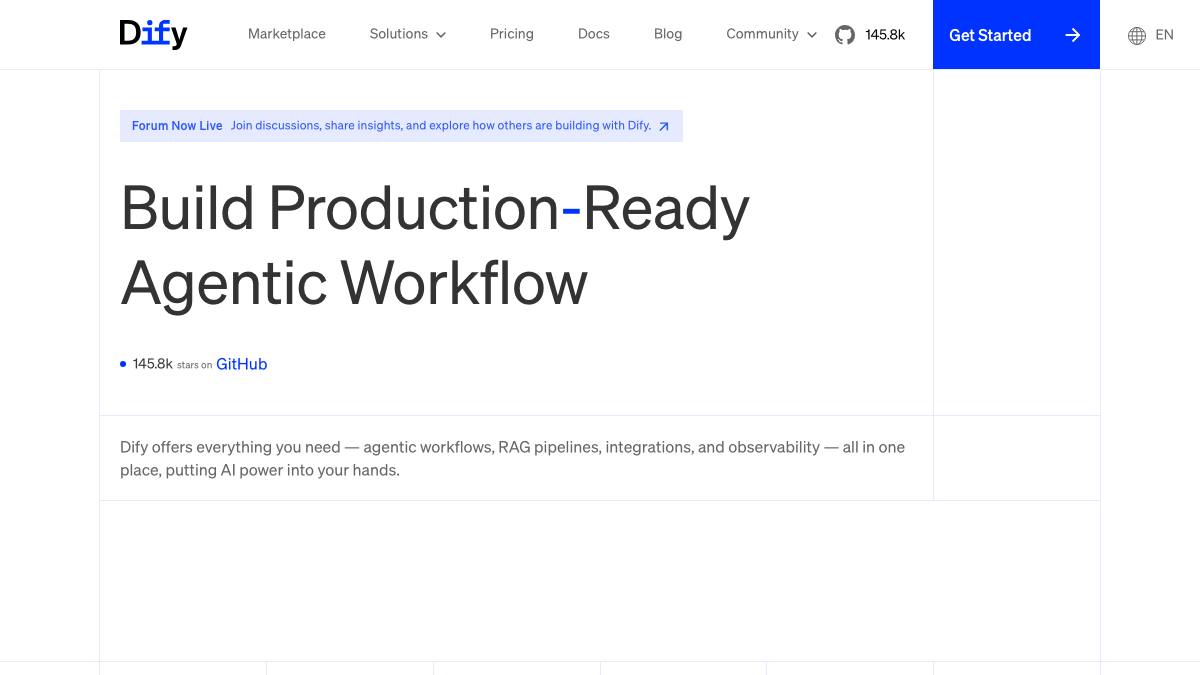
Dify
by LangGenius
Open-source platform for building LLM apps and agentic workflows
Open-source platform for building LLM apps and agentic workflows
What it can do
Build AI workflows on a visual canvas
SupervisedDesign and test multi-step AI workflows visually, combining prompts, models, logic, and tools.
sourceBuild agents with tools
SupervisedBuild autonomous agents that use function calling and 50+ built-in tools to complete tasks.
sourceRun RAG pipelines
AssistantProvides RAG capabilities from document ingestion (PDF, PPT, and more) through retrieval to ground responses in knowledge bases.
sourceManage models and observability
AssistantIntegrates hundreds of models across providers (including OpenAI-API-compatible endpoints) and monitors logs and performance over time.
source
Overview
Dify is an open-source platform for building LLM applications and agentic workflows, combining workflow design, RAG, agents, model management, and observability in one self-hostable stack.
What it does
On a visual canvas you build AI workflows, RAG pipelines, and agents that use function calling and 50+ built-in tools. It integrates hundreds of models across providers (including any OpenAI-API-compatible endpoint), provides prompt tooling, and monitors logs and performance. Apps can be published as chat UIs or APIs.
Classification note
Dify is a building platform, not an end-user agent. The autonomy of any app you create is configured by you, so we list it as supervised-agent conservatively.
Integrations & setup
Self-host via Docker or Kubernetes (Helm charts), or use Dify Cloud. Broad model and provider support, with MCP and function calling.
Pricing
Self-hosting is free and open source. Dify Cloud offers a free sandbox plan plus paid tiers.
Best for / not for
Best for teams that want an open, self-hostable stack to ship LLM apps and agents to production. Less suited to those wanting a fully managed, no-ops product or guaranteed autonomous behavior out of the box.
Alternatives
Flowise and Langflow are open-source visual agent/LLM builders; Stack AI targets enterprise no-code; n8n is automation-first with agent features.
What people are saying
We aggregate real LinkedIn discussion into sentiment for the agents people search most. Dify isn't tracked yet, want it added? Request tracking.
Used this agent?
Sign in to upvote, rate, follow, or leave a comment.