Langflow
by IBM (DataStax)
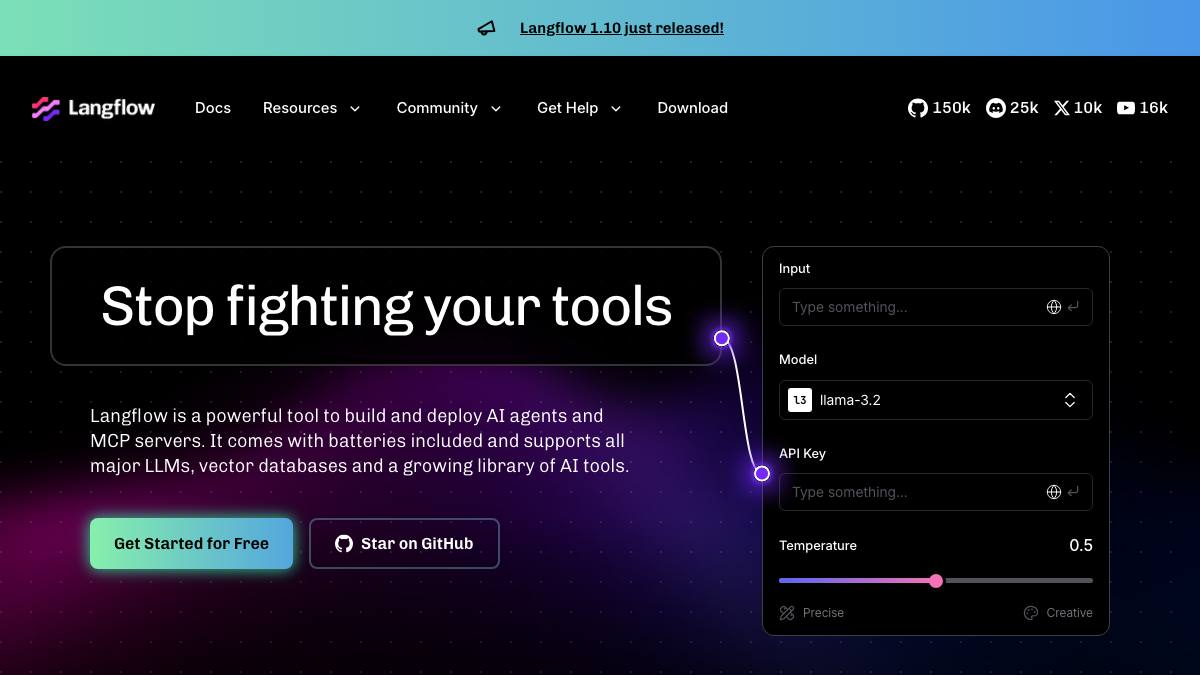
Open-source visual low-code builder for AI agents and RAG apps
Open-source visual low-code builder for AI agents and RAG apps
What it can do
Build flows on a visual canvas
SupervisedArrange components (prompts, models, data connectors, tools) on a drag-and-drop canvas to define agent and RAG logic.
sourceDeploy flows as API and MCP servers
SupervisedBuilt-in API and MCP servers turn every flow into a tool that can be integrated into apps built on any framework or stack.
sourceBuild RAG and multi-agent applications
SupervisedSupports major LLMs and vector databases to prototype, build, and deploy RAG and multi-agent applications.
source
Overview
Langflow is an open-source, low-code visual builder for AI agents and RAG applications. It began at Logspace, was acquired by DataStax, and is now under IBM after IBM acquired DataStax; it remains open source with a large GitHub following.
What it does
Developers arrange components (prompts, models, data connectors, tools) on a drag-and-drop canvas to define logic, then deploy each flow with built-in API and MCP servers so it becomes a tool callable from any stack. It supports major LLMs, vector databases, and a growing tool library.
Classification note
Langflow is a building platform, not an end-user agent. The autonomy of any app you create is configured by you, so we list it as supervised-agent conservatively.
Integrations & setup
Self-host the open-source project, or use managed/cloud options. Model-agnostic, with MCP and API servers built in.
Pricing
Self-hosting is free and open source; managed and cloud options are available.
Best for / not for
Best for developers and teams who want to visually prototype and deploy agents and RAG apps and expose them as APIs/MCP tools. Less suited to those wanting a fully managed product or guaranteed autonomous behavior out of the box.
Alternatives
Flowise is the closest visual builder; Dify adds model management; Stack AI targets enterprise no-code; LangChain is the code-first library.
What people are saying
We aggregate real LinkedIn discussion into sentiment for the agents people search most. Langflow isn't tracked yet, want it added? Request tracking.
Used this agent?
Sign in to upvote, rate, follow, or leave a comment.