Pixlr
by Inmagine Group (Pixlr Pte Ltd)
Browser-based AI photo editor and image generator for the web, desktop, and mobile
Last reviewed 2026-06-20
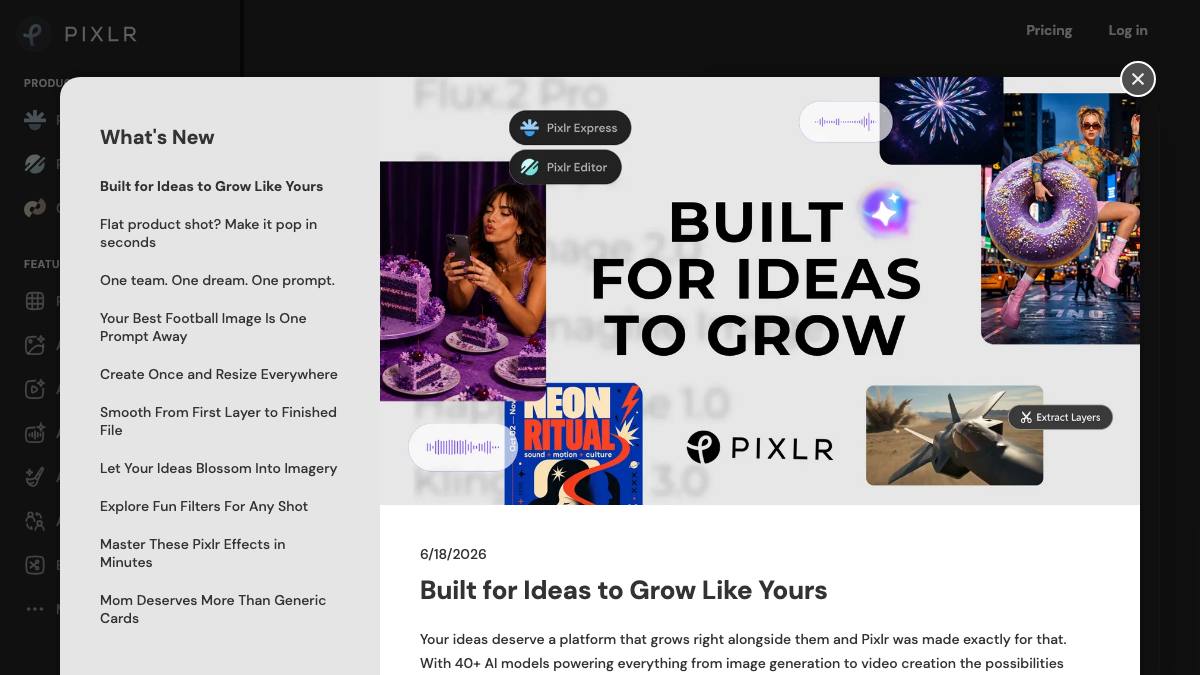
Pixlr is a browser-based suite of photo editors, design tools, and generative AI features aimed at casual creators, social media users, small businesses, and designers who want professional-grade editing without installing Photoshop. It bundles two classic editors (Pixlr X, a simplified editor, and Pixlr E, an advanced layer-based editor) with a growing set of AI tools: text-to-image generation, generative fill and expand, background removal, AI upscaling, object removal, face swap, and chat-based instruct editing where a user describes an edit in natural language and the tool applies it. Pixlr is a copilot, not an autonomous agent. It generates and edits images on request and a person selects, refines, and approves every step, including in its multi-turn conversational editor (branded Nano Banana), which keeps a visual edit history but still acts only on each user prompt. It also offers text-to-video and AI audio (speech, transcription, music) features. Pixlr was created by Ola Sevandersson in 2008, acquired by Autodesk in 2011, and has been owned by Malaysia-based Inmagine Group since around 2017; the company reports over 500 million users to date (vendor-reported).
What it can do
Generate images from text
AssistantText-to-image generation in the editor, reportedly backed by third-party models including Flux, Recraft, and Stable Diffusion.
sourceGenerative editing (fill, expand, transform)
CopilotAI generative fill, expand/outpaint, and object removal applied to a selected region or the whole image on request.
sourceChat-based instruct editing
CopilotConversational editor (branded Nano Banana) where a user describes an edit in plain language and the tool applies it across multi-turn iterations, saving a visual edit history; each step still acts only on a user prompt.
sourceOne-click background removal and enhancement
AssistantAI background removal, upscaling, noise removal, and face swap as single-action tools on uploaded or generated images.
sourceText-to-video and AI audio
AssistantText and image-to-video generation plus AI speech synthesis, transcription, and music, reportedly using third-party models such as Kling, Google Veo, and ElevenLabs.
source
Strengths
- +Runs entirely in the browser (plus desktop and mobile) with no Photoshop-class install
- +Bundles classic layer-based editing with many generative AI tools in one place
- +Low entry price and a free tier with limited AI credits
Limitations
- −A copilot, not an agent; a person directs and approves every edit
- −AI features run on a credit system that can be consumed quickly at higher tiers
- −Leans on third-party generation models, so output quality tracks those models rather than a proprietary edge
- −Free tier is limited and functions largely as a trial/conversion funnel
Overview
Pixlr is a browser-based suite of photo editors and generative AI tools, positioned as an accessible alternative to heavy desktop software. It pairs two classic editors (Pixlr X for quick edits, Pixlr E for advanced layer-based work) with AI features for generation and editing, and runs on web, desktop, and mobile. It was created by Ola Sevandersson in 2008, acquired by Autodesk in 2011, and has been owned by Malaysia-based Inmagine Group since around 2017.
What it does
Pixlr generates images from text (reportedly using Flux, Recraft, and Stable Diffusion), and applies generative fill, expand/outpaint, and object removal to selected regions. Its chat-based instruct editor (branded Nano Banana) lets a user describe an edit in plain language and applies it across multi-turn iterations while keeping a visual edit history. Single-action tools cover AI background removal, upscaling, noise removal, and face swap. It also offers text-to-video and AI audio (speech, transcription, music) via third-party models. Every step is user-directed and approved, so Pixlr operates as a copilot.
Integrations & setup
Pixlr is a self-serve web app (also packaged as desktop and mobile apps); there is no required install for the core editors. A single subscription reportedly unlocks the same access across web, desktop, and mobile. There is no published public agent/automation API or protocol support (MCP/A2A) as of this review.
Pricing
Freemium. A free tier offers limited monthly AI credits with no credit card required, but is restricted and works largely as a trial. Paid plans (vendor-listed) are Plus (around $1.99/month billed annually, 80 monthly AI credits), Premium ($7.99/month annually, 1,000 credits), Ultra ($19.99/month annually, up to 10,000 credits), and Ultra MAX ($39.99/month annually, doubled credits). AI tools consume credits per generation.
Best for / not for
Best for casual creators, social media users, and small businesses who want browser-based editing plus a broad set of AI tools at a low price. Less suited to teams wanting an autonomous creative agent, a proprietary best-in-class generation model, or programmatic/API-driven batch generation (see Recraft for an API-first option).
Alternatives
Recraft targets designers with true-vector generation and an API; Photoroom focuses on product/background editing; Canva bundles AI generation inside a broader design suite; Adobe Firefly offers generative features inside Adobe's ecosystem.
What people are saying
We aggregate real LinkedIn discussion into sentiment for the agents people search most. Pixlr isn't tracked yet, want it added? Request tracking.
Used this agent?
Sign in to upvote, rate, follow, or leave a comment.
FAQ
Is Pixlr an AI agent?+
No. Pixlr is a photo editor with generative AI features. It generates and edits images on request, and a person selects and approves each step, even in its chat-based instruct editor. It operates at the copilot level, not as an autonomous agent.
Is Pixlr free?+
Pixlr has a free tier with a limited monthly AI credit allowance and no credit card required, but it is restricted and functions largely as a trial; paid plans start around $1.99/month (billed annually) and add more AI credits and features.
What AI models does Pixlr use?+
Pixlr is model-agnostic and reportedly routes to third-party models for generation, including Flux, Recraft, and Stable Diffusion for images, Kling and Google Veo for video, and ElevenLabs for audio, rather than relying on a single proprietary model.
Sources
- Pixlr (official site) · accessed 2026-06-20
- Pixlr pricing · accessed 2026-06-20
- Pixlr Nano Banana / instruct editor · accessed 2026-06-20
- Pixlr Creator Joins Inmagine Group (Media OutReach Newswire) · accessed 2026-06-20
Last reviewed 2026-06-20