Kiro
by Amazon Web Services
AWS's spec-driven agentic IDE for structured software engineering
Last reviewed 2026-06-19
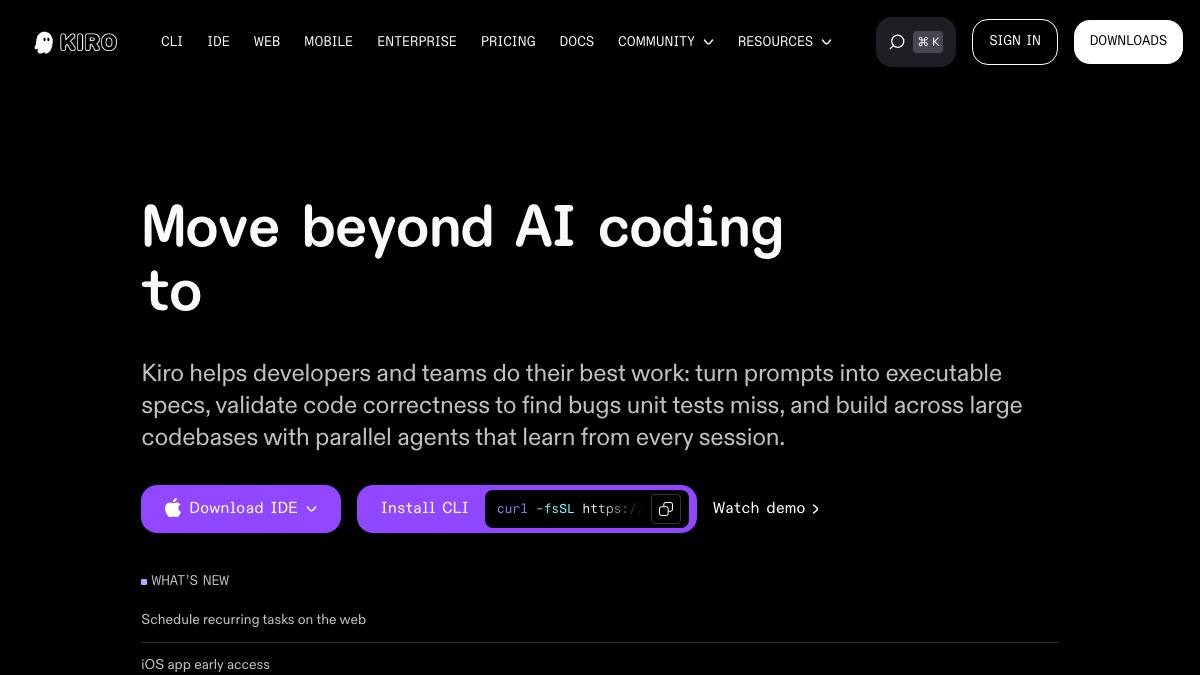
Kiro is AWS's agentic development environment built around spec-driven development: instead of free-form prompting, the unit of work is a natural-language specification that Kiro expands into structured requirements, an architectural design, and a sequenced task list before any code is written, then implements against and keeps in sync with that spec. It ships as an IDE, a CLI, and a web interface with cloud sandboxes, and is built on Amazon Bedrock. Kiro targets professional developers and engineering teams who want more structure, reviewability, and governance than free-form "vibe coding" tools provide. Its four core constructs are steering, specs, hooks, and MCP. It is positioned as AWS's successor to Amazon Q Developer, and is model-flexible, routing across Claude, DeepSeek, MiniMax, and open-weight models by task complexity.
What it can do
Generate executable specs from prompts
SupervisedTurns a natural-language prompt into structured requirements, an architectural design, and a sequenced task list before any code is written.
sourceImplement code against the spec
SupervisedExecutes the approved task list to write code aligned to the spec and keeps the two in sync.
sourceRun agent hooks on repo events
AutonomousEvent-driven hooks fire on actions such as file save or PR open to run tests, update docs, or regenerate fixtures.
sourceValidate via property-based testing
SupervisedChecks code against general properties across many inputs to catch edge cases that example-based unit tests miss.
source
Strengths
- +Spec-first workflow makes AI output more reviewable, auditable, and team-ownable than free-form prompting
- +Model-flexible via Amazon Bedrock (Claude, DeepSeek, MiniMax, open-weight) with task-based routing
- +Backed by AWS with enterprise auth (SAML/SCIM SSO) and a migration path from Amazon Q Developer
Limitations
- −Credit-based usage can get expensive and unpredictable at scale, and unused credits do not roll over
- −The requirements/design/tasks process adds overhead versus lightweight assistants for quick edits
- −Early pricing and metering history drew criticism (AWS acknowledged a metering bug in August 2025)
Overview
Kiro is AWS's agentic IDE, built around spec-driven development. The unit of work is a natural-language specification rather than a raw prompt: Kiro expands it into requirements, a design, and a task list before writing code. It launched in public preview on July 14, 2025 and is now generally available across IDE, CLI, and web interfaces, with cloud sandboxes and enterprise governance.
What it does
Kiro's four core constructs are steering (project context and rules), specs (the requirements/design/tasks documents), hooks (event-driven agents that fire on actions like file save or PR open), and MCP (for connecting external tools and data). It implements code against the approved spec and keeps them in sync, and it can validate with property-based testing. Parallel agents can work across large codebases.
Integrations & setup
Built on Amazon Bedrock, with native MCP support and function-calling for agent hooks. Enterprise auth uses AWS IAM Identity Center (SAML/SCIM SSO). It offers a migration path from the Amazon Q Developer CLI. Models are routed by task complexity across Claude (Opus/Sonnet/Haiku), DeepSeek, MiniMax, and open-weight models.
Pricing
Freemium with usage overage. Free is $0/mo with 50 credits; Pro is $20/mo with 1,000 credits; higher Pro+, Pro Max, and Power tiers add more credits, with overage billed per credit. Team plans add centralized billing, usage analytics, and SSO. Unused credits do not roll over.
Best for / not for
Best for teams that want structured, reviewable AI engineering and already live in AWS. Less suited to developers who want lightweight, low-overhead inline assistance for quick edits.
Notable history
Kiro proved popular quickly after launch, prompting AWS to add usage caps and a waitlist within a week. August 2025 pricing changes drew criticism over cost, and AWS later acknowledged a metering bug that over-consumed some users' request limits, pausing affected charges. It is positioned as the successor to Amazon Q Developer.
Alternatives
Cursor and Windsurf target inline AI coding; Devin targets delegated ticket-level engineering.
What people are saying
We aggregate real LinkedIn discussion into sentiment for the agents people search most. Kiro isn't tracked yet, want it added? Request tracking.
Used this agent?
Sign in to upvote, rate, follow, or leave a comment.
FAQ
What is spec-driven development in Kiro?+
Rather than prompting for code directly, Kiro first generates structured requirements, an architectural design, and a sequenced task list from your intent, has you review them, then implements against that spec and keeps code and spec aligned.
Is Kiro fully autonomous?+
No. It plans and implements multi-step work but the spec and key changes are reviewed by a human, so it operates as a supervised agent. Configured event-driven hooks run automatically within their guardrails.
Sources
- Kiro (official site) · accessed 2026-06-19
- Kiro pricing · accessed 2026-06-19
- AWS imposes caps on Kiro usage, introduces waitlist (InfoWorld) · accessed 2026-06-19
- AWS blames bug for Kiro pricing glitch that drained developer limits (InfoWorld) · accessed 2026-06-19
Last reviewed 2026-06-19