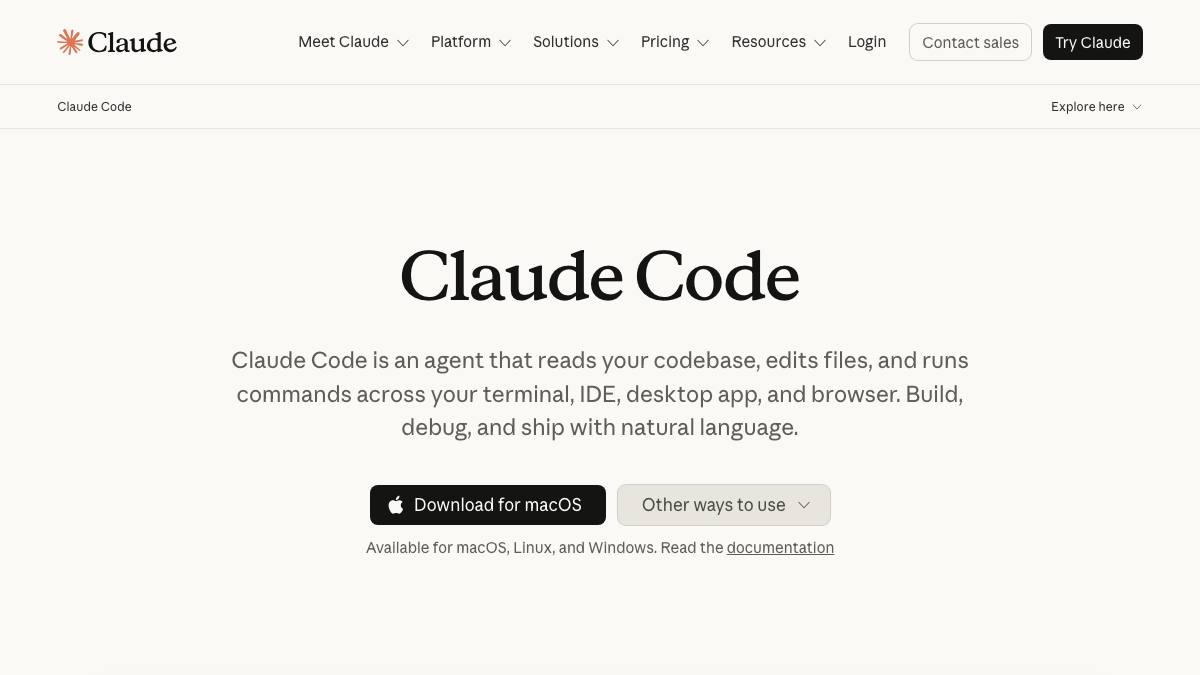
Claude Code
by Anthropic
Anthropic's agentic coding agent that lives in your terminal
Last reviewed 2026-06-18
Claude Code is Anthropic's agentic coding tool that runs in the terminal (with IDE and GitHub integrations) and works at the task level rather than autocompleting lines. You describe a task in natural language and Claude reads the codebase, edits files across the project, runs shell commands and tests, and handles git workflows, asking for permission on consequential actions by default. It reached general availability on May 22, 2025 alongside the Claude 4 model generation. By default it is human-supervised: it proposes edits and commands that you approve. It also supports lower-friction modes (auto-accept for file edits, an auto mode that uses model-based classifiers to approve actions, and a fully headless mode via the -p flag plus --dangerously-skip-permissions) that let it run scoped tasks end to end inside CI or automated pipelines. It is powered by Anthropic's own Claude models (Sonnet and Opus).
What it can do
Edit code across files and run commands in the terminal
SupervisedReads the codebase via agentic search, plans a change, edits multiple files, runs shell commands and tests, and handles git workflows, asking permission on consequential actions by default.
sourceRun scoped tasks headlessly for automation
AutonomousThe -p flag accepts a prompt from the command line and executes without interaction; combined with auto mode or --dangerously-skip-permissions it runs scoped tasks end to end in CI or scheduled pipelines.
sourceAuto-approve actions with model-based guardrails (auto mode)
SupervisedAuto mode delegates approvals to model-based classifiers (a prompt-injection probe on inputs and a transcript classifier on actions) as a middle ground between manual review and skipping permissions entirely.
sourceAnswer questions about an unfamiliar codebase
AssistantExplains complex code and project structure on request without taking independent action.
source
Strengths
- +True terminal-native agent: reads, edits, runs, and commits across a whole codebase rather than autocompleting lines
- +Flexible autonomy, from per-action approval to auto mode to fully headless runs for CI
- +Deep ecosystem: MCP support, subagents, plugins, GitHub Actions, and IDE extensions, plus a public Agent SDK
Limitations
- −API-token usage on heavy tasks can get expensive and hard to predict
- −Locked to Anthropic's own Claude models (no model choice)
- −Headless and skip-permissions modes shift real risk onto the operator if guardrails are not configured
Overview
Claude Code is Anthropic's agentic coding tool. It lives in the terminal (with VS Code, JetBrains, and GitHub integrations), understands a codebase through agentic search, and works at the task level: reading files, editing across the project, running commands and tests, and handling git. It reached general availability on May 22, 2025, the same day Claude Opus 4 and Sonnet 4 launched.
What it does
You describe a task in natural language. Claude plans, edits multiple files, runs shell commands and tests, and can open or work against pull requests. By default it asks permission on consequential actions, so it operates as a supervised agent. It can also run with less friction: auto-accept for file edits, an auto mode that uses model-based classifiers to approve actions, or a fully headless mode (the -p flag plus --dangerously-skip-permissions) for scoped tasks in CI and scheduled pipelines. On request it also just explains unfamiliar code without acting.
Integrations & setup
Installs as a CLI, with extensions for VS Code and JetBrains and direct GitHub integration including @claude mentions on issues and PRs and GitHub Actions support. It consumes MCP servers, supports subagents and a plugins directory, and exposes a public Agent SDK for building on top of it.
Pricing
Available to Claude Pro, Max, Team, and Enterprise subscribers (Pro starts at $20/mo), and also usable pay-as-you-go against standard Claude API token pricing when run with a Claude Console account. Heavy agentic runs consume tokens quickly, so usage cost scales with workload.
Best for / not for
Best for developers and teams who want an agent that operates on real repositories from the terminal and can be wired into automation. Less ideal for those who want model choice or a fixed, predictable cost on heavy workloads.
Alternatives
Cursor and GitHub Copilot target the in-IDE coding experience; Cognition's Devin targets async, delegated tickets; Windsurf is an agentic IDE in the same space.
What people are saying
Loved for
- +model
- +data
- +models
Common gripes
- −human
- −model
- −content
Recent mentions
“i just wrote a winning cold email script in 9 minutes using Claude Cowork. (AI copy that books 40+ calls/mo) cold email writing is the bottleneck for most cold emailers i talk to now. the rest of the stack is automated.”
“Here's a TLDR of the Data + AI Summit with my top 4 announcements and favorite momments: 1. An open source meta-harness that lets you combine and control coding agents like Claude Code and Codex under on”
“Hours after Anthropic filed its pre-IPO paperwork, OpenAI CEO Sam Altman told CNBC that corporate concern over AI costs is "the most fair criticism of AI so far." Bain published a survey of nearly 1,000 companies showing”
“92 % less tokens? Same quality. Sounds too good? Then try this... A Netflix engineer just dropped a massive game changer for (local/hybrid) AI and coding agents. If you use tools like Claude Code, Cursor, or Aider, you k”
“Anthropic launched Claude for Small Business and nobody's talking about it on LinkedIn. Which is insane. Because it does in 1 command what used to take a VA or massive n8n workflows. 31 ready-to-run skills, including: -”
Used this agent?
Sign in to upvote, rate, follow, or leave a comment.
FAQ
Is Claude Code fully autonomous?+
Not by default. It proposes edits and commands that a human approves, so the default posture is a supervised agent. With auto-accept, auto mode, or headless --dangerously-skip-permissions it can run scoped tasks end to end without per-action approval, which makes it autonomous for well-defined work, but the operator owns the guardrails.
What models power Claude Code?+
Anthropic's own Claude models (Sonnet and Opus). It does not support third-party models.
Sources
- Claude Code by Anthropic (official product page) · accessed 2026-06-18
- anthropics/claude-code (GitHub) · accessed 2026-06-18
- How we built Claude Code auto mode (Anthropic Engineering) · accessed 2026-06-18
- What Is Claude Code Headless Mode (MindStudio) · accessed 2026-06-18
Last reviewed 2026-06-18