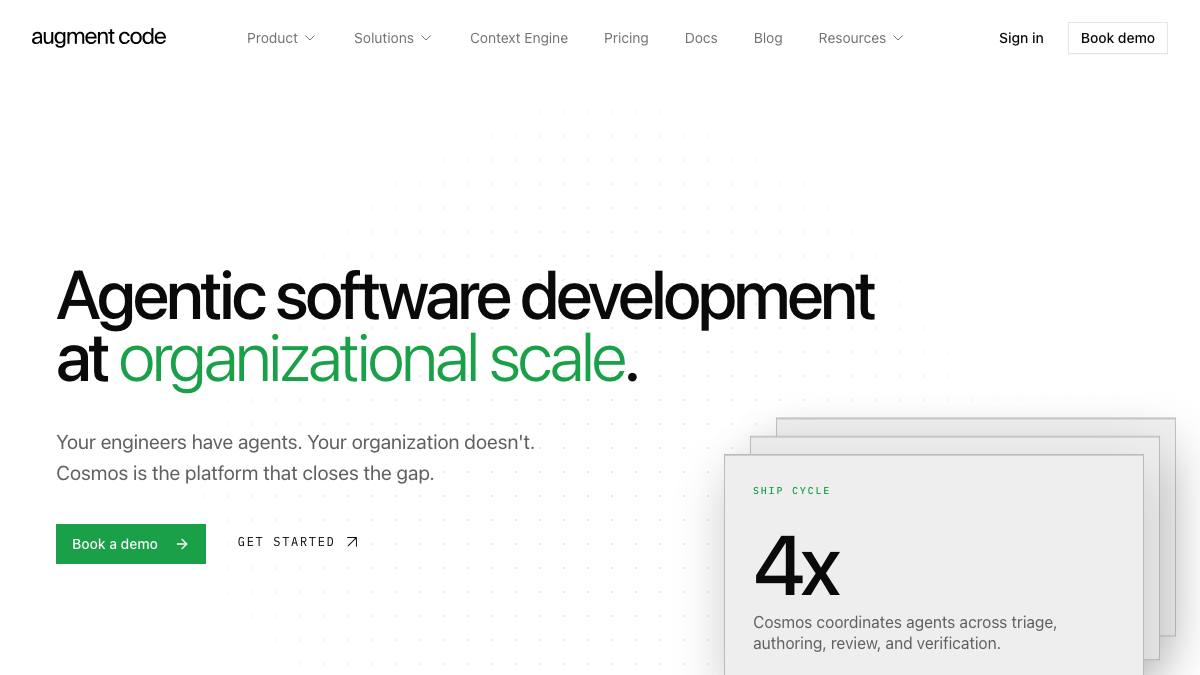
Augment Code
AI coding agent built for large, complex enterprise codebases
Last reviewed 2026-06-18
Augment Code is an AI coding agent aimed at large, complex codebases. Its core is a Context Engine that indexes code across many repositories (the company cites up to 500,000 files) and understands cross-file dependencies, API contracts, and architectural patterns, so its agent pulls only the slice of context a task touches. Agent mode can implement multi-file changes, write tests, and handle refactors with awareness of system-wide implications, while keeping a human in the loop on consequential edits. Augment targets enterprise engineering teams whose codebases are too big for file-level context tools. It adds workspace-level context sharing, SOC 2 Type II, ISO 42001, SSO/SCIM, and compliance options, with custom enterprise pricing.
What it can do
Index and understand large codebases
AssistantA Context Engine indexes code across many repos (the company cites up to 500,000 files), mapping structure and cross-file dependencies so the agent retrieves only relevant context.
sourceImplement multi-file changes in agent mode
SupervisedAgent mode makes multi-file changes, writes tests, and handles complex refactors with system-wide awareness, for human review.
sourceShare context across a workspace
AssistantWorkspace-level context sharing lets the agent understand how microservices and systems connect across an organization.
source
Strengths
- +Context engine designed for very large, multi-repo codebases
- +Agent mode handles multi-file changes and refactors with system-wide awareness
- +Enterprise security: SOC 2 Type II, ISO 42001, SSO/SCIM
Limitations
- −Strongest value is at enterprise scale; overkill for small projects
- −Enterprise pricing is custom and reportedly high
- −Agent changes require human review; not autonomous merging
Overview
Augment Code is an AI coding agent built for large, complex enterprise codebases, founded by former Microsoft and Google engineers. Its central asset is a Context Engine that scales to multi-repo, enterprise-size code.
What it does
The Context Engine indexes code across repositories (the company cites up to 500,000 files), mapping structure and cross-file dependencies so the agent pulls only the context a task touches. Agent mode implements multi-file changes, writes tests, and handles complex refactors with awareness of system-wide implications, with a human reviewing the output.
Integrations & setup
Runs in VS Code and JetBrains, connects to Git providers and Slack, and supports MCP. Workspace-level context sharing lets the agent reason about how services connect across an organization.
Pricing
Individual plans reportedly start around $20/mo; Enterprise is custom and reportedly substantial, with SOC 2 Type II, ISO 42001, SSO/SCIM, and compliance options.
Best for / not for
Best for enterprise teams with large, interconnected codebases where file-level context tools fall short. Overkill for small projects or solo developers.
Alternatives
Sourcegraph Cody targets enterprise code intelligence; Cursor and GitHub Copilot are broad coding tools; Cognition's Devin is an async delegated engineering agent.
What people are saying
We aggregate real LinkedIn discussion into sentiment for the agents people search most. Augment Code isn't tracked yet, want it added? Request tracking.
Used this agent?
Sign in to upvote, rate, follow, or leave a comment.
FAQ
What makes Augment Code different?+
Its Context Engine is built for very large, multi-repo codebases, indexing cross-file dependencies and architecture so its agent retrieves only the relevant slice rather than relying on file-level context.
Is Augment Code autonomous?+
Its agent mode performs multi-file changes, refactors, and test writing, but a human reviews the results, so it operates as a supervised agent.
Sources
- Augment Code (official site) · accessed 2026-06-18
- Augment Code pricing (official) · accessed 2026-06-18
- Augment Code on Visual Studio Marketplace · accessed 2026-06-18
Last reviewed 2026-06-18