Ideogram
by Ideogram AI
Text-to-image generator known for accurate, legible in-image typography
Last reviewed 2026-06-20
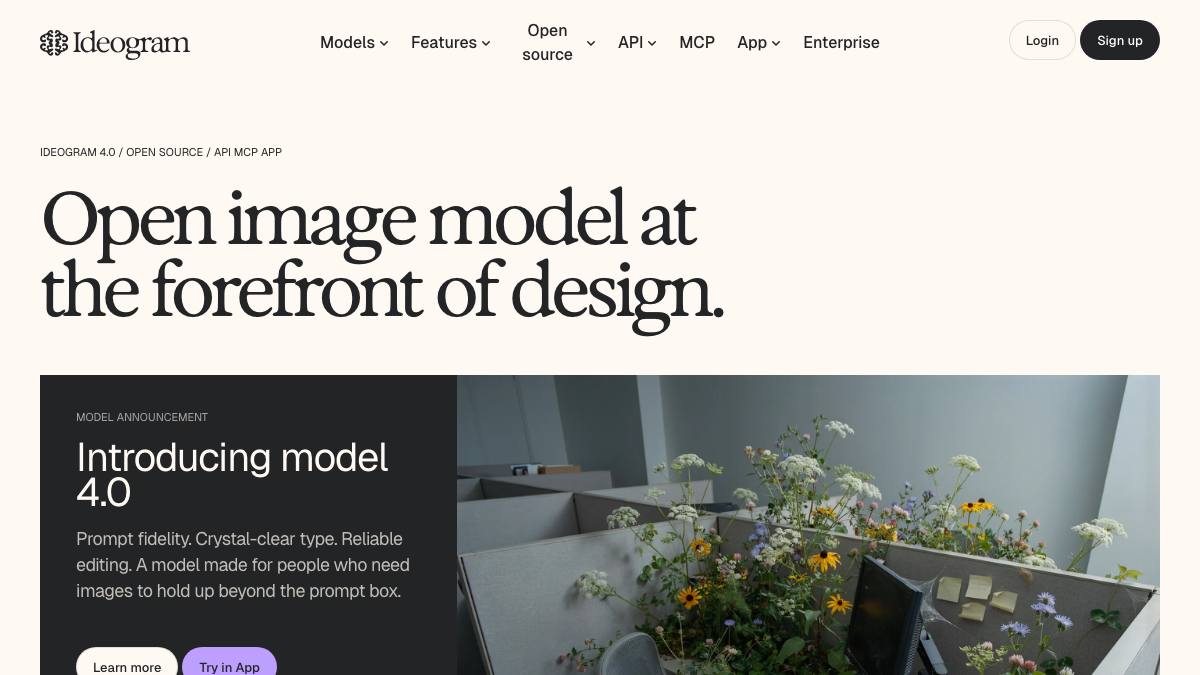
Ideogram is a generative AI text-to-image service built around a capability most generators struggle with: rendering legible, correctly spelled text inside images. That focus makes it popular for logos, posters, social graphics, ads, and other design work where words and layout matter, alongside general photorealistic and illustrative generation. It runs as a web app and mobile apps, and also exposes a paid API. The company was founded in 2023 by a team of former Google Brain, UC Berkeley, CMU, and University of Toronto researchers (William Chan, Jonathan Ho, Mohammad Norouzi, and Chitwan Saharia), is based in Toronto, and has raised a $16.5M seed round and an $80M Series A led by Andreessen Horowitz. Ideogram is a creative generation tool, not an autonomous agent: a person writes a prompt, generates a set of options, then edits, remixes, upscales, or re-rolls until satisfied. Its latest model, Ideogram 4.0 (released June 3, 2026), is a roughly 9.3B-parameter diffusion transformer that the company released as open weights on GitHub (commercial use requires a paid license), generating at native 2K resolution with strong typography and multi-element composition.
What it can do
Generate images from text prompts with accurate in-image text
AssistantProduces images from natural-language prompts, returning up to four options at a time, and is specifically known for rendering legible, correctly spelled text and typography directly in the image, which makes it suited to logos, posters, and ad visuals.
sourceEdit images with Magic Fill, Extend, and Canvas
AssistantIncludes inpainting (Magic Fill), outpainting (Extend), an infinite Canvas for composing and editing, remix from an existing image, a Describe tool to caption images, and upscaling up to 2x, all under direct human control.
sourceGuide generation with style references and styles
AssistantLets users supply an image as a style reference and apply style controls to steer the look of outputs; the separate Ideogram Character tool is used for keeping a character consistent across generations.
sourceGenerate programmatically via the Ideogram API
AssistantOffers a paid REST API for text-to-image generation and editing (billed per image, separate from web subscriptions), plus custom-model training, so the model can be embedded in other products rather than only used in the web app.
source
Strengths
- +Best-in-class at rendering legible, correctly spelled text inside images, which is a common weak point for other generators
- +Full editing toolkit (Magic Fill inpainting, Extend, Canvas, Remix, Describe, upscale) plus style references
- +Has a free tier, low entry price ($7/month), and a public API, including open weights for Ideogram 4.0 on GitHub
Limitations
- −An assistant, not an autonomous agent: the human writes prompts, curates, and iterates on every output
- −Free tier is limited (reportedly cut to roughly 10 credits per week in early 2025) and slow-queue waits can run long
- −Character consistency requires the separate Ideogram Character tool; editable text-layer extraction was a roadmap feature, not fully live, as of the 4.0 launch
Overview
Ideogram is a generative AI text-to-image service whose defining strength is rendering legible, correctly spelled text inside images, a weak spot for most other generators. It was founded in 2023 by former Google Brain, UC Berkeley, CMU, and University of Toronto researchers (including Jonathan Ho and Mohammad Norouzi), is headquartered in Toronto, and has raised a $16.5M seed round and an $80M Series A led by Andreessen Horowitz. It runs as a web app and mobile apps and exposes a paid API.
What it does
Users write a prompt and Ideogram returns image options (typically up to four), which can then be edited with Magic Fill (inpainting), Extend (outpainting), an infinite Canvas, Remix, and upscaling up to 2x. A Describe tool captions images, and generation can be steered with image style references and style controls. Its focus on typography makes it well suited to logos, posters, ads, and social graphics where the text has to be right. The latest model, Ideogram 4.0 (released June 3, 2026), is a roughly 9.3B-parameter diffusion transformer that generates at native 2K resolution with strong multi-element composition; the company released its weights as open weights on GitHub (commercial use requires a paid license). Throughout, the human prompts and curates: Ideogram is an assistant, not an autonomous agent.
Integrations & setup
Ideogram is used directly through its web app at ideogram.ai or its iOS and Android apps. For developers, a paid REST API supports text-to-image generation, editing, and custom-model training, billed per image separately from web subscriptions, so the model can be embedded in other products. Ideogram 4.0 weights are additionally downloadable from GitHub under a license that requires a paid agreement for commercial use.
Pricing
Freemium. A free tier offers a limited weekly credit allowance (reportedly tightened to around 10 credits per week in early 2025). Reported paid web plans are Basic ($7/month), Plus ($15/month), Pro ($42/month), and a Team plan (around $20 per user/month), with higher tiers adding more monthly prompts and faster generation; annual billing is discounted. The API is priced separately and billed per generated image (reportedly roughly $0.06 to $0.18 per image depending on quality), with custom-model training charged per run. Always confirm current numbers on the pricing page.
Best for / not for
Best for designers, marketers, and content creators who need accurate text inside generated visuals (logos, posters, ads, social graphics), and for developers who want an API or open weights. Less suited to anyone wanting an autonomous agent, heavy character-series production (use the separate Ideogram Character tool), or generous unlimited free generation.
Alternatives
Midjourney offers a stronger, more opinionated art style but no free tier or public API; Recraft targets brand and vector design with an API; Adobe Firefly emphasizes commercially safe training data and Creative Cloud integration. Ideogram differentiates on in-image text accuracy.
What people are saying
We aggregate real LinkedIn discussion into sentiment for the agents people search most. Ideogram isn't tracked yet, want it added? Request tracking.
Used this agent?
Sign in to upvote, rate, follow, or leave a comment.
FAQ
Is Ideogram an AI agent?+
No. It is a text-to-image generation and editing tool. A person writes a prompt, generates options, then edits, remixes, upscales, or re-rolls. It operates at the assistant level with no independent multi-step action.
What is Ideogram best known for?+
Rendering accurate, legible text and typography directly inside generated images. That makes it a common choice for logos, posters, social media graphics, and ad creative where the wording and layout matter, not just the art.
Does Ideogram have a free plan and an API?+
Yes to both. There is a free tier with a limited credit allowance, paid plans starting at $7/month (Basic), and a separate paid REST API billed per image. Ideogram 4.0 was also released as downloadable open weights on GitHub, with commercial use requiring a paid license.
Sources
- Generating Images (Ideogram documentation) · accessed 2026-06-20
- Ideogram 4.0 Overview: Open-Weight Design Model (ImagineArt) · accessed 2026-06-20
- Midjourney rival Ideogram gets $80M in Series A led by Andreessen Horowitz (VentureBeat) · accessed 2026-06-20
- Ideogram launches with $22.3 million CAD for generative AI text-to-image platform (BetaKit) · accessed 2026-06-20
- Ideogram pricing 2026: Every plan, every credit cost, every gotcha (eesel AI) · accessed 2026-06-20
Last reviewed 2026-06-20