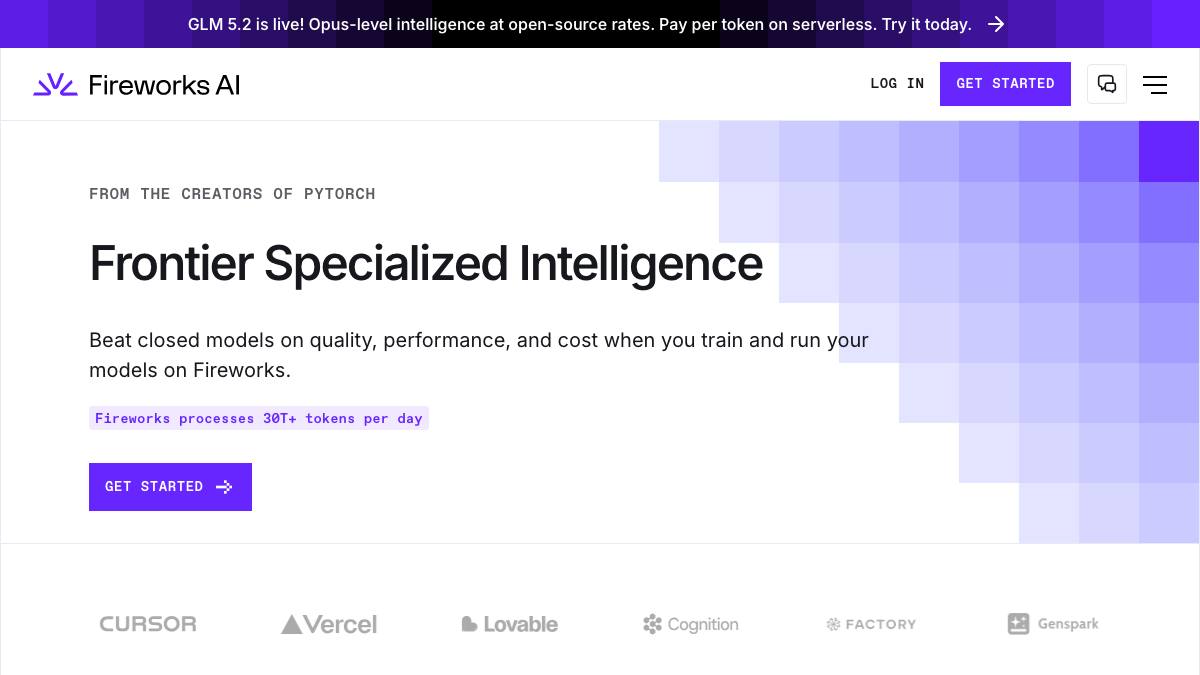
Fireworks AI
by Fireworks AI, Inc.
Fast inference and fine-tuning platform for open-source AI models
Last reviewed 2026-06-20
Fireworks AI is a developer platform for running and customizing open-source and open-weight AI models in production, built around proprietary inference optimizations (its FireAttention engine and FireOptimizer) that the company says deliver high throughput and low latency. It exposes 100+ chat, reasoning, vision, image, audio, and embedding models through an OpenAI- and Anthropic-compatible API, with serverless pay-per-token, on-demand dedicated GPU deployments, and reserved capacity. It also offers supervised and reinforcement fine-tuning of models up to 1T+ parameters, plus function calling, structured (JSON) outputs, embeddings and reranking, and batch inference. Fireworks does not sell its own proprietary frontier model; it serves third-party open models (Llama, DeepSeek, Qwen, Kimi, GLM, FLUX, Whisper, and others) plus models you fine-tune or bring yourself. In this directory it is a platform and inference layer, not an agent: by default it returns model outputs to your application, which owns any agent orchestration. It markets itself for agentic workloads and ships building blocks for them (function calling, the FireFunction open function-calling model, structured outputs, low-latency serving), but the agent logic and human approvals live in the developer's application.
What it can do
Serverless inference for open-source models
AssistantRuns 100+ open and open-weight models (chat, reasoning, vision, image, audio, embeddings) on demand with pay-per-token pricing and no infrastructure to manage, marketed for high throughput and low latency from its proprietary FireAttention engine and FireOptimizer.
sourceOpenAI- and Anthropic-compatible API
AssistantExposes inference and fine-tuning through OpenAI- and Anthropic-compatible endpoints with Python, JS, and REST access, positioned as a drop-in replacement that keeps the same API and SFT data format so existing app code can be repointed at Fireworks.
sourceSupervised and reinforcement fine-tuning
AssistantProvides supervised fine-tuning (SFT), DPO, and reinforcement fine-tuning (RFT) of models up to 1T+ parameters, including LoRA and full fine-tuning, with per-million-training-token pricing and immediate deployment of the resulting model. Multi-LoRA lets many fine-tuned models be served without added infrastructure.
sourceOn-demand dedicated and reserved deployments
AssistantDeploys models on dedicated GPUs (H100/H200, B200, B300) with fast autoscaling and minimal cold starts, plus reserved capacity for guaranteed throughput and higher rate limits, billed per GPU-hour.
sourceFunction calling and structured outputs
SupervisedSupports function calling, JSON mode, and grammar-constrained structured outputs for agentic workflows, and ships FireFunction, an open-weight function-calling model that can route across models and external APIs. These are the building blocks developers use to build agents; the orchestration and approvals live in the developer's application.
sourceEmbeddings, reranking, and batch inference
AssistantOffers embedding and reranking models for search and retrieval, and an asynchronous batch inference API priced at a discount to serverless for large-scale offline jobs.
source
Strengths
- +Proprietary FireAttention engine and FireOptimizer marketed for fast, low-latency open-model inference
- +OpenAI- and Anthropic-compatible API makes migration nearly drop-in
- +Supervised plus reinforcement fine-tuning (RFT) up to 1T+ parameters, with Multi-LoRA hosting
- +Full ladder from serverless to dedicated GPUs to reserved capacity
- +Function calling, structured outputs, and the FireFunction model for agent backends
Limitations
- −Serves open and bring-your-own models; no proprietary frontier model of its own
- −It is an inference and fine-tuning layer, not an end-to-end agent: orchestration is on you
- −Per-token and per-GPU-hour costs require monitoring at scale
- −Model availability shifts as open-weight releases come and go
Overview
Fireworks AI is an AI cloud founded in 2022 in Redwood City, California, by Lin Qiao (CEO) and a founding team drawn largely from the PyTorch group at Meta. It positions itself as the fastest platform for building with open-source AI models, built around proprietary inference optimizations: the FireAttention engine and the FireOptimizer. The product most developers touch is its serverless inference API, but the platform also spans fine-tuning, dedicated and reserved GPU deployments, embeddings and reranking, and batch inference.
Fireworks does not sell its own proprietary frontier model. It serves other organizations' open models (Llama, DeepSeek, Qwen, Kimi, GLM, FLUX, Whisper, and more), publishes some open models of its own such as the FireFunction function-calling model, and hosts models you fine-tune or bring yourself, competing on inference performance, fine-tuning, and cost. So in this directory it is a platform / inference layer, not an agent. Its honest overall autonomy is assistant: by default it returns model outputs to a request. It gains agentic surface (function calling, structured outputs, low-latency serving) when a developer wires it into an application, but the orchestration and approvals stay in that application.
What it does
Fireworks runs LLMs, reasoning models, vision models, and image, audio, and embedding models, with several deployment shapes per the product pages and docs:
- Serverless inference on 100+ open models, pay-per-token, marketed for high throughput and low latency from FireAttention and FireOptimizer.
- OpenAI- and Anthropic-compatible API with Python, JS, and REST access, positioned as a drop-in replacement that keeps the same API and SFT data format.
- Supervised and reinforcement fine-tuning (SFT, DPO, RFT) of models up to 1T+ parameters, including LoRA and full fine-tuning, with immediate deployment and Multi-LoRA hosting.
- On-demand dedicated and reserved deployments on H100/H200, B200, and B300 GPUs with fast autoscaling and minimal cold starts.
- Function calling, JSON mode, and grammar-constrained structured outputs, plus the open FireFunction model, the building blocks developers use for agent workflows.
- Embeddings, reranking, and batch inference for search, retrieval, and large asynchronous offline jobs at a discount to serverless.
Integrations & setup
Because the API is OpenAI- and Anthropic-compatible, integration is close to a drop-in: swap the base URL and key in an OpenAI SDK or Anthropic Messages API call, or use ecosystem libraries such as LangChain, LlamaIndex, and the Vercel AI SDK. Models can be pulled from the open ecosystem (for example Hugging Face) and served or fine-tuned on the platform. Fireworks is also distributed through AWS Marketplace and Microsoft Azure / Foundry. For teams that need consistent performance and control, Fireworks offers dedicated GPU deployments and reserved capacity rather than only shared serverless.
Pricing
Fireworks AI uses usage-based pricing, and new users receive $1 in free credits. Reported figures from its pricing and docs pages (which change over time):
- Serverless inference: per million tokens, with cached input priced at 50% and batch inference at 50% of serverless rates per the docs.
- Embeddings: roughly $0.008 per 1M tokens for small models up to about $0.10 per 1M tokens for larger ones (for example Qwen3 8B).
- Fine-tuning: per million training tokens, scaling with model size and method (for example LoRA SFT from about $0.50 per 1M tokens up to about $10 for >300B-parameter models; full and DPO variants cost more).
- On-demand GPUs: roughly $7/hr for H100/H200, $10/hr for B200, and $12/hr for B300.
- Enterprise and reserved: contact-based, for faster speeds, lower costs, and higher rate limits.
See https://fireworks.ai/pricing for current rates.
Best for / not for
Best for developers and teams building on open models who want one platform that covers fast serverless inference, supervised and reinforcement fine-tuning, dedicated GPUs, and reserved capacity behind a familiar OpenAI- or Anthropic-style API, plus function calling and structured outputs for agent backends.
Not for teams that need a managed, end-to-end agent out of the box (Fireworks gives you the engine and the compute, not the autopilot), or that specifically require a proprietary frontier model rather than open weights.
Alternatives
The closest comparisons are other open-model inference and AI-cloud providers: Together AI, Groq (custom-silicon inference), OpenRouter (a routing aggregator), Replicate, and Hugging Face's hosted inference. Against general-purpose API providers like OpenAI, the tradeoff is open models, fine-tuning control, and dedicated GPU access versus a proprietary frontier model.
What people are saying
We aggregate real LinkedIn discussion into sentiment for the agents people search most. Fireworks AI isn't tracked yet, want it added? Request tracking.
Used this agent?
Sign in to upvote, rate, follow, or leave a comment.
FAQ
Does Fireworks AI make its own AI models?+
Not a proprietary frontier model. Fireworks AI serves third-party open and open-weight models (Llama, DeepSeek, Qwen, Kimi, GLM, FLUX, Whisper, and others) plus models you fine-tune or bring yourself. It does publish some open models of its own, such as the FireFunction function-calling model, but it competes mainly on inference speed, fine-tuning, and cost rather than a closed frontier model.
Is Fireworks AI an AI agent?+
Not on its own. Fireworks AI is a developer platform and inference layer. It provides model serving, function calling, structured outputs, embeddings, and fine-tuning that developers use to build agents. The agent logic, orchestration, and human approvals live in your application, so its honest overall autonomy is assistant-level.
Is the Fireworks AI API OpenAI-compatible?+
Yes, and it is also Anthropic-compatible. Fireworks positions its inference and fine-tuning as a drop-in replacement that keeps the same API and SFT data format, so code written for the OpenAI SDK or Anthropic Messages API can usually be repointed at Fireworks by changing the base URL and key.
How is Fireworks AI priced?+
Usage-based. New users get $1 in free credits. Serverless inference is per million tokens (cached input at 50% and batch inference at 50% of serverless rates per the docs). Fine-tuning is priced per million training tokens, scaling with model size and method (LoRA/full, SFT/DPO). On-demand GPUs are billed per hour (for example H100/H200 around $7/hr, B200 around $10/hr, B300 around $12/hr). Enterprise and reserved capacity are contact-based. See https://fireworks.ai/pricing for current rates.
Can I fine-tune and deploy custom models on Fireworks AI?+
Yes. Fireworks supports supervised fine-tuning, DPO, and reinforcement fine-tuning (RFT) of open models up to 1T+ parameters, including LoRA and full fine-tuning, then deploys the resulting model immediately via serverless or dedicated endpoints. Multi-LoRA lets many fine-tuned variants be served without added infrastructure.
Sources
- Fireworks AI homepage · accessed 2026-06-20
- Fireworks AI inference · accessed 2026-06-20
- Fireworks AI training and fine-tuning · accessed 2026-06-20
- Fireworks AI pricing · accessed 2026-06-20
- Build with Fireworks AI (docs introduction) · accessed 2026-06-20
- Understanding Function Calling (Fireworks blog) · accessed 2026-06-20
- Fireworks AI Raises $250M Series C to Lead the AI Inference Market (company blog) · accessed 2026-06-20
- Fireworks AI Raises $250 Million Series C at $4 Billion Valuation (Orrick) · accessed 2026-06-20
Last reviewed 2026-06-20