Hugging Face
Open-source AI platform: model hub, datasets, inference, and the smolagents framework
Last reviewed 2026-06-20
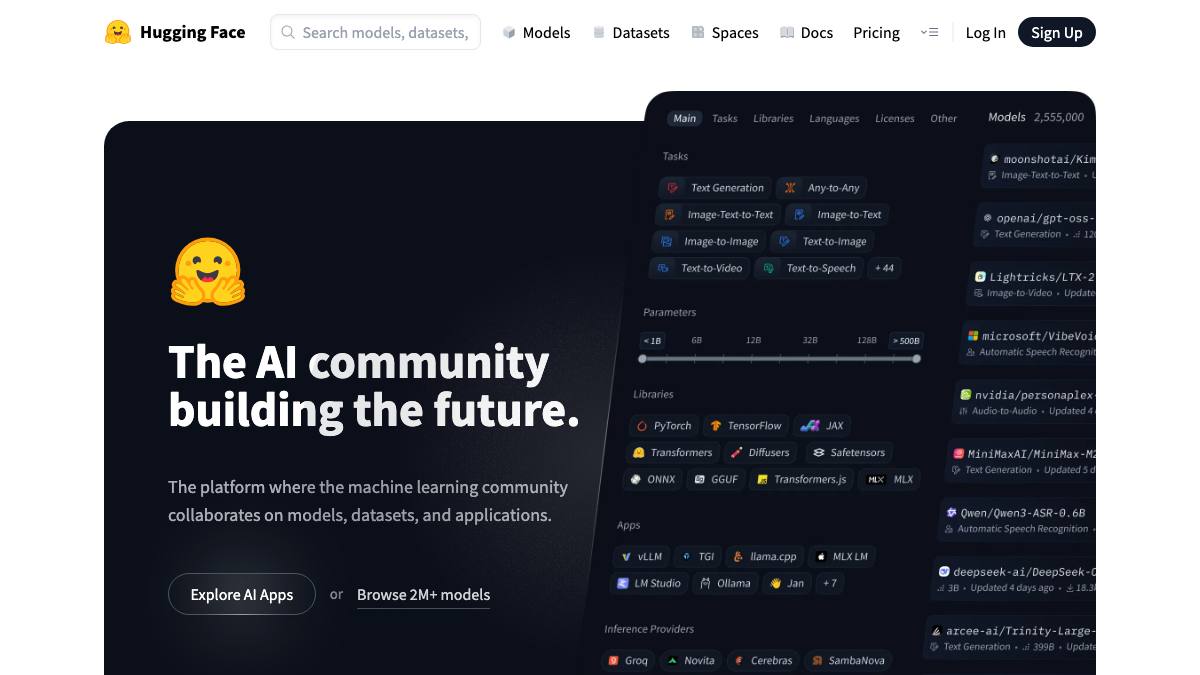
Hugging Face is the open-source machine-learning platform where the AI community shares and runs models, datasets, and applications. The Hub hosts over two million models, 500,000+ datasets, and a million+ interactive apps (Spaces), with an Inference layer that serves models through a unified API and dedicated GPU Inference Endpoints. It is the de facto distribution and collaboration backbone for open-weight models, used by individual developers and large organizations alike (Google, Meta, Amazon, and Microsoft are listed among the 50,000+ organizations on the platform). For agent builders specifically, Hugging Face maintains smolagents, a minimal open-source Python framework (about a thousand lines of core code) for building agents that act by writing and running Python code (CodeAgent) or via JSON tool-calling (ToolCallingAgent). smolagents is model-agnostic, integrates tools from MCP servers, LangChain, or Hub Spaces, and runs code in sandboxed environments (E2B, Modal, Docker, and others). Hugging Face is infrastructure and tooling, not a finished end-user agent: how autonomous anything built on it behaves depends on what the developer assembles.
What it can do
Host, version, and share ML models and datasets
AssistantThe Hub stores 2M+ models and 500K+ datasets with git-based versioning, model cards, and collaboration, serving as the distribution layer for open-weight models. This is infrastructure, not an autonomous actor.
sourceServe models via unified Inference API and GPU Endpoints
AssistantProvides access to models through a unified Inference API and dedicated, auto-scaling GPU Inference Endpoints for deploying models at scale.
sourceBuild code-writing agents with smolagents (CodeAgent)
Supervisedsmolagents lets developers build agents that act by writing and executing Python code, enabling loops, conditionals, and function nesting; execution can be sandboxed via E2B, Modal, or Docker. Autonomy is developer-defined, and human-in-the-loop is typical.
sourceConnect tools from MCP, LangChain, or Hub Spaces
Supervisedsmolagents is tool-agnostic and model-agnostic: it can pull tools from any MCP server, import LangChain tools, or use a Hub Space as a tool, and run any LLM hosted on the Hub, via API (OpenAI, Anthropic, others through LiteLLM), or locally.
sourceHost and run interactive ML apps (Spaces)
AssistantSpaces hosts a million-plus interactive ML applications (Gradio and Streamlit), with paid CPU and GPU instances for compute-heavy demos.
source
Strengths
- +The de facto hub for open-weight models and datasets, with an enormous community and ecosystem
- +smolagents is a genuinely minimal, transparent, model-agnostic agent framework with MCP, LangChain, and Hub-Space tool support
- +Flexible deployment: managed Inference Endpoints, Spaces hosting, or fully self-hosted with open-source libraries
Limitations
- −It is a platform and tooling, not a turnkey agent: building an agent requires developer work and the autonomy is whatever you assemble
- −Hub seat pricing is separate from compute; every model you run adds GPU/CPU charges on top, so total cost can be hard to predict
- −Breadth over depth: it competes with purpose-built vertical agents only as a foundation, not as a finished product
Overview
Hugging Face is the open-source machine-learning platform that the AI community uses to share, discover, and run models, datasets, and applications. The Hub hosts over two million models and 500,000+ datasets, Spaces hosts a million-plus interactive ML apps, and an Inference layer serves models through a unified API and dedicated GPU endpoints. It is best understood as infrastructure and developer tooling, not a single product, and certainly not a turnkey agent.
What it does
Four pillars: the Hub (git-based hosting and versioning for models and datasets, with model cards and collaboration), Datasets (load and stream training data), Spaces (host Gradio/Streamlit demos and apps on CPU or GPU), and Inference (a unified Inference API plus auto-scaling GPU Inference Endpoints for production serving). For agent builders, Hugging Face maintains smolagents, a minimal Python framework whose CodeAgent acts by writing and executing Python code (enabling loops, conditionals, and function nesting) and whose ToolCallingAgent uses JSON tool-calling. Code execution can be sandboxed via E2B, Modal, or Docker. It is model-agnostic (any LLM on the Hub, via API through LiteLLM, or local via Transformers/Ollama) and tool-agnostic (tools from MCP servers, LangChain, or a Hub Space). How autonomous anything you build behaves is your design decision, and human-in-the-loop is the norm.
Integrations & setup
The open-source libraries (Transformers, Diffusers, Datasets, smolagents) install via pip. smolagents pulls tools from MCP servers, LangChain, or Hub Spaces, and ships CLI utilities (smolagent, webagent). Inference Endpoints and Spaces are managed in the Hugging Face web console; everything can also be self-hosted. The platform is used by 50,000+ organizations including Google, Meta, Amazon, and Microsoft.
Pricing
The Hub, the open-source libraries, and smolagents are free. Account plans: Free, PRO at $9/month, Team at $20/user/month, and Enterprise from $50/user/month (SSO, audit logs, priority support). Compute is billed separately: Inference Endpoints from roughly $0.06/hour (CPU) and $0.60/hour (T4 GPU) upward, and Spaces GPUs from about $0.40/hour, plus persistent storage. Seat price covers your Hub access; running models adds compute charges on top. (Prices as of June 2026; check the pricing page for current figures.)
Best for / not for
Best for developers and ML teams who want the largest open-model ecosystem, flexible deployment, and a minimal, transparent agent framework to build on. Less suited to non-technical buyers who want a finished, out-of-the-box agent, or to anyone who needs predictable all-in pricing without modeling separate compute costs.
Alternatives
For the agent-framework piece, LangChain and LlamaIndex offer broader (heavier) abstractions, CrewAI focuses on role-based multi-agent crews, and AutoGen centers on multi-agent conversation. As a model/inference platform, alternatives include the cloud providers' model gardens and dedicated inference vendors, though none match the Hub's open-model breadth.
What people are saying
We aggregate real LinkedIn discussion into sentiment for the agents people search most. Hugging Face isn't tracked yet, want it added? Request tracking.
Used this agent?
Sign in to upvote, rate, follow, or leave a comment.
FAQ
Is Hugging Face an AI agent?+
No. Hugging Face is an open-source platform (model hub, datasets, Spaces, and inference) plus developer tooling. It maintains smolagents, a framework for building agents, but agents built with it are developer-defined and typically run with human-in-the-loop. The platform itself is infrastructure, not an autonomous agent.
What is smolagents?+
smolagents is Hugging Face's minimal open-source Python framework (about a thousand lines of core code) for building agents. Its CodeAgent acts by writing and executing Python code; a ToolCallingAgent uses JSON tool-calling. It is model-agnostic, supports sandboxed code execution (E2B, Modal, Docker), and can use tools from MCP servers, LangChain, or Hub Spaces.
Is Hugging Face free?+
The Hub, the open-source libraries, and smolagents are free. Account plans run from a free tier to PRO at $9/month, Team at $20/user/month, and Enterprise from $50/user/month. Running models on Inference Endpoints, Spaces GPUs, or storage adds separate compute charges on top of the seat price.
Sources
- Hugging Face homepage · accessed 2026-06-20
- smolagents documentation · accessed 2026-06-20
- huggingface/smolagents on GitHub · accessed 2026-06-20
- Inference Endpoints pricing · accessed 2026-06-20
- Hugging Face raises $235M Series D (TechCrunch) · accessed 2026-06-20
Last reviewed 2026-06-20