OpenRouter
by OpenRouter, Inc.
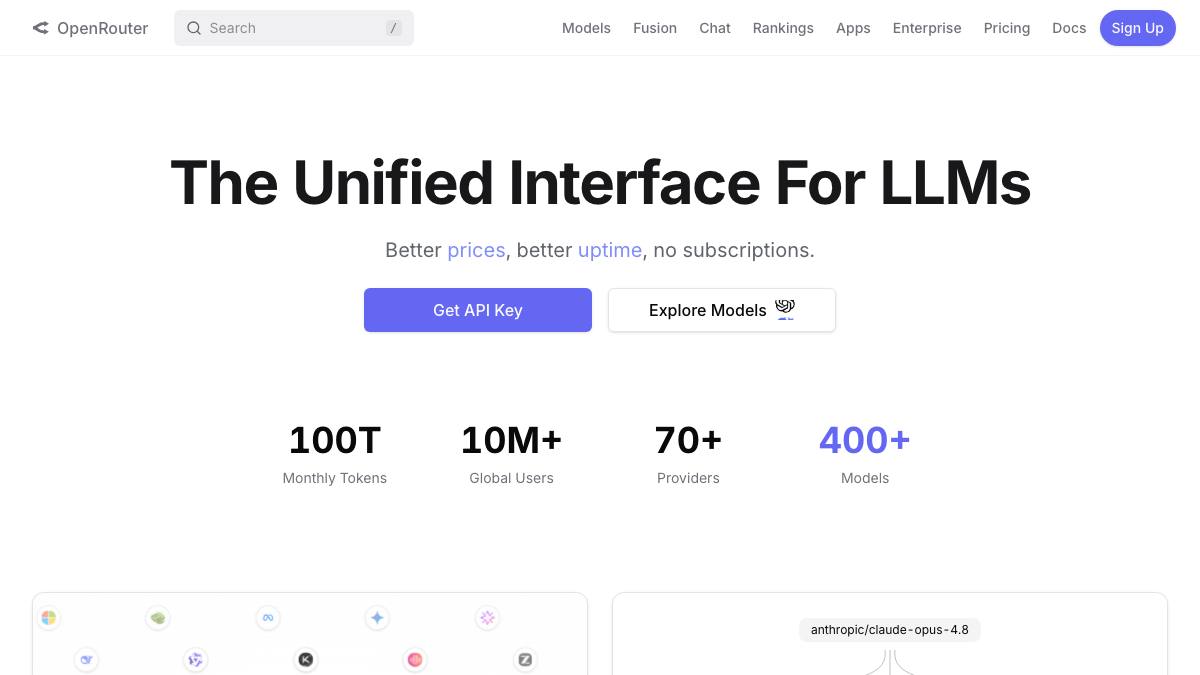
One OpenAI-compatible API for 400+ LLMs across 70+ providers, with routing and fallbacks
Last reviewed 2026-06-20
OpenRouter is a unified inference gateway that gives developers a single, OpenAI-compatible API to call hundreds of large language models from dozens of providers (Anthropic, OpenAI, Google, Meta, Mistral, DeepSeek, xAI and others). Instead of integrating each provider separately, a team points at OpenRouter once and can switch models or providers with a string change, while OpenRouter pools provider uptime, routes requests, and automatically falls back to alternate providers when one is down or rate-limited. It is aimed at developers and companies building LLM-powered apps and agents that want model choice, unified billing, and reliability without maintaining many provider relationships. OpenRouter passes through provider pricing (it states it does not mark up inference) and charges a fee on credit purchases. It is infrastructure, not an agent itself: it is the model-access layer that agent frameworks and apps build on.
What it can do
Unified OpenAI-compatible API for 400+ models
AssistantExposes one endpoint and an OpenAI-compatible schema so apps can call 400+ models across 70+ providers without per-provider integrations; the OpenAI SDK works against it directly.
sourceProvider routing and automatic fallback
AssistantPools provider uptime and routes each request, automatically falling back to alternate providers on downtime or errors, and does not charge for failed or fallback attempts.
sourceRouting variants for throughput, cost, and tool-calling
AssistantModel suffixes (:nitro for throughput, :floor for lowest cost, :exacto for tool-calling quality) let callers bias routing per request, per OpenRouter docs.
sourceUnified billing, analytics, and data-privacy controls
AssistantProvides credit-based USD billing across all providers, usage analytics, and fine-grained policies controlling which providers and models can receive prompts and how they may log data.
sourceBring Your Own Key (BYOK) and MCP server
AssistantLets users route through their own provider API keys at a reduced fee, and ships an MCP server so MCP-compatible clients can use OpenRouter as a model source.
source
Strengths
- +One OpenAI-compatible API and key for 400+ models across 70+ providers, with trivial model switching
- +Provider routing and automatic fallback pool uptime across providers for higher availability
- +States it does not mark up inference (provider pass-through pricing); free models and BYOK available
Limitations
- −Adds a fee on credit purchases (around 5.5% pay-as-you-go) on top of provider rates
- −It is a routing layer, not an agent: it provides model access, not autonomous task execution
- −Routing through a third party adds a dependency and a data-path to consider for sensitive workloads
Overview
OpenRouter is a unified inference gateway: one OpenAI-compatible API that fronts 400+ large language models from 70+ providers. Founded in 2023 by Alex Atallah (co-founder of OpenSea) and Louis Vichy, it lets a team integrate once and then switch models or providers with a string change, while OpenRouter handles routing, fallbacks, and unified billing. It is infrastructure that agent frameworks and LLM apps build on, not an agent itself.
What it does
The core product is a single endpoint with an OpenAI-compatible schema, so the OpenAI SDK and most existing integrations work unchanged. OpenRouter pools provider uptime and routes each request, automatically falling back to alternate providers on downtime or errors (it states failed and fallback attempts are not billed). Routing variants let callers bias each request: ':nitro' for throughput, ':floor' for lowest cost, ':exacto' for tool-calling quality. It adds unified USD credit billing across all providers, usage analytics, fine-grained data-privacy policies (which providers may see prompts and how they may log), a Bring Your Own Key (BYOK) mode, and an MCP server so MCP-compatible clients can use it as a model source. Autonomy lives in the apps and agents calling it; OpenRouter itself is an assistant-level access layer.
Integrations & setup
Because it is OpenAI-compatible, it drops into the OpenAI SDK and tools that speak that schema (LangChain, the Vercel AI SDK, OpenWebUI, coding agents like Cline and Aider, and many others). Setup is an API key and a base-URL change; models are selected by string id, and BYOK lets you route through your own provider keys.
Pricing
Usage-based. A free tier offers a set of free models with daily rate limits and no platform fee. Pay-as-you-go buys credits and adds a fee on purchases (around 5.5% as of June 2026) while passing provider inference pricing through without markup; input and output tokens are billed per model. Enterprise adds discounted fees, higher free-request allowances, volume pricing, invoicing, and purchase orders. BYOK is charged at a reduced percentage of normal cost.
Best for / not for
Best for developers and companies that want model choice, one API and bill, and provider-level reliability without maintaining many provider relationships, and for teams that switch models often or want automatic failover. Less suited to teams that only ever use a single provider and want to avoid any intermediary fee or added data-path, or to anyone expecting an autonomous agent rather than a model gateway.
Traction & funding
OpenRouter reported raising a $113M Series B led by CapitalG in 2026, with participation from Andreessen Horowitz, Menlo Ventures, NVentures, ServiceNow Ventures, MongoDB Ventures, Snowflake Ventures, and Databricks Ventures, after earlier a16z- and Menlo-led seed and Series A rounds. It has cited very large processed-token volumes (reported in the trillions of tokens per week); such figures are company-reported.
Alternatives
Together AI and Fireworks AI offer hosted multi-model inference, and LiteLLM is an open-source library that provides a similar unified LLM-API abstraction you self-host. OpenRouter differentiates on breadth of providers behind one commercial API plus routing and fallback.
What people are saying
We aggregate real LinkedIn discussion into sentiment for the agents people search most. OpenRouter isn't tracked yet, want it added? Request tracking.
Used this agent?
Sign in to upvote, rate, follow, or leave a comment.
FAQ
What is OpenRouter used for?+
It gives developers a single OpenAI-compatible API to access 400+ LLMs across 70+ providers, with model routing, automatic provider fallback, unified billing, and data-privacy controls, so they can pick or switch models without integrating each provider separately.
Does OpenRouter mark up model pricing?+
OpenRouter states it passes through provider pricing without marking up inference. It instead charges a fee on credit purchases (around 5.5% on pay-as-you-go as of June 2026), with free models and a reduced-fee Bring Your Own Key option available.
Is OpenRouter an AI agent?+
No. OpenRouter is model-access infrastructure (a unified API gateway), not an autonomous agent. Agents and apps call models through it, but OpenRouter itself does not plan or take multi-step actions.
Sources
- OpenRouter (official site) · accessed 2026-06-20
- OpenRouter pricing · accessed 2026-06-20
- OpenRouter FAQ (documentation) · accessed 2026-06-20
- OpenRouter Raises $113 Million CapitalG-led Series B (Business Wire) · accessed 2026-06-20
- Investing in OpenRouter (Andreessen Horowitz) · accessed 2026-06-20
Last reviewed 2026-06-20