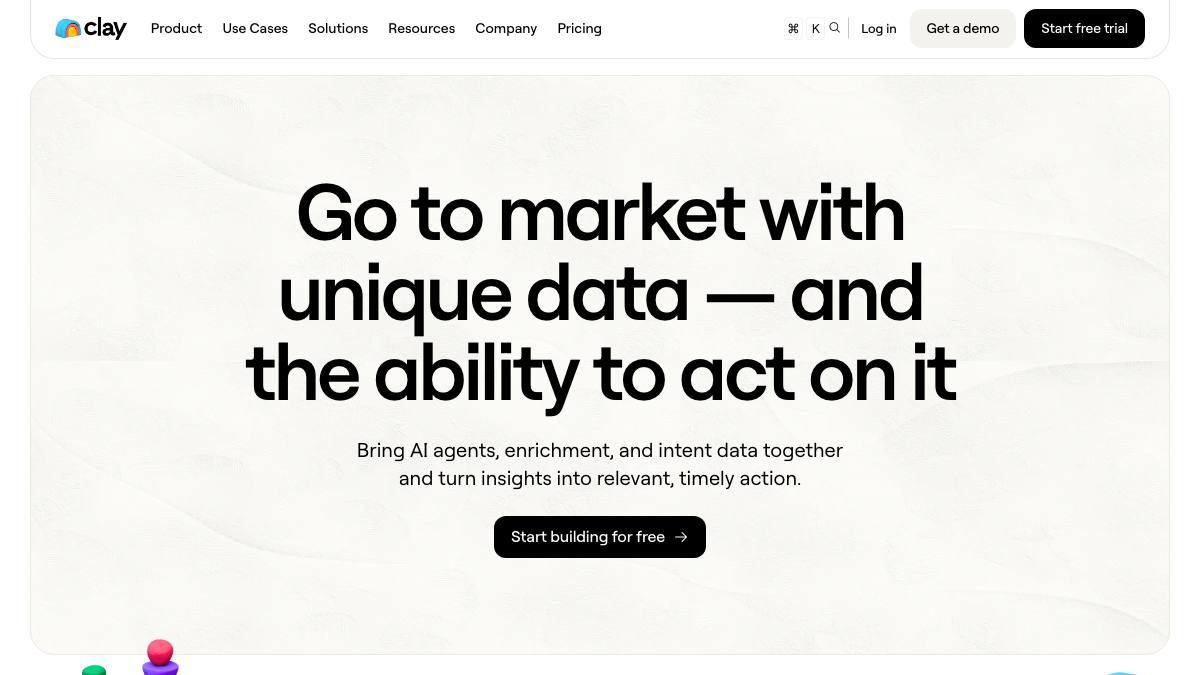
Clay
Programmable GTM data platform with AI research agents (Claygent)
Last reviewed 2026-06-18
Clay is a go-to-market data platform that lets sales and marketing teams build enrichment and outbound workflows in a spreadsheet-style interface. It chains 150+ third-party data providers into waterfalls (try one source, fall back to the next), enriches contacts and companies, and pushes clean records into a CRM. Its AI layer, Claygent, is a web research agent: users describe a research task in natural language and Claygent reads public sources (company pages, job listings, press releases) and, with its Navigator mode, interacts with pages (filters, forms, clicks) to extract structured data other providers cannot find. Clay is aimed at RevOps, growth, and SDR teams who want to compose custom enrichment and signal-based outbound rather than buy a fixed dataset. The AI does the research and drafting; humans build, test, and approve the workflows before scaling them, so in practice the AI features are supervised rather than fully autonomous.
What it can do
Waterfall data enrichment across 150+ providers
SupervisedChains multiple data vendors so that if one source lacks an email, phone, or firmographic field, Clay falls back to the next, maximizing match rates in a single configured workflow.
sourceAI web research with Claygent
SupervisedClaygent reads public web sources (company sites, job listings, press releases) from a natural-language prompt and returns structured answers; the user authors and tests the prompt before running it at scale.
sourceInteractive page navigation (Navigator)
SupervisedNavigator lets Claygent go beyond reading pages: it applies filters, fills search forms, clicks buttons, and retrieves structured data from sites that block easy scraping.
sourceNatural-language agent building (Sculptor)
CopilotSculptor is an AI copilot that turns a plain-language description of a research or enrichment task into a production-ready agent configuration, removing the need for prompt engineering.
sourceCRM sync and data routing
SupervisedPushes enriched and researched records into CRMs and other systems via auto-sync, HTTP API, and webhooks, with routing logic defined by the user.
source
Strengths
- +Composable enrichment: waterfalls across 150+ providers in one workflow beat any single-vendor dataset on match rate
- +Claygent plus Navigator can extract bespoke data (and interact with pages) that fixed providers miss
- +Free tier and broad integrations make it accessible, with API and webhooks for programmatic use
Limitations
- −Steep learning curve; getting value requires building and tuning workflows, not just turning it on
- −Credit-based costs (split into Data Credits and Actions after the March 2026 pricing change) can be hard to predict at scale
- −The AI is a research and drafting layer, not an autonomous SDR: humans build, test, and approve the plays
Overview
Clay is a programmable go-to-market (GTM) data platform. In a spreadsheet-style interface, teams build enrichment and outbound workflows that pull from 150+ data providers, run AI research, and sync clean records to a CRM. Its AI layer is Claygent, a web research agent.
What it does
The core mechanic is the waterfall: chain several data vendors so a missing email, phone, or firmographic field falls back to the next source, maximizing match rate in one configured run. On top of that, Claygent reads public sources from a natural-language prompt and returns structured answers, and its Navigator mode interacts with pages (filters, forms, clicks) to extract data that blocks easy scraping. Sculptor, an AI copilot, turns plain-language descriptions into production-ready agent configs. Across all of this, the human builds, tests, and approves the workflow before scaling, which is why the AI features are supervised rather than autonomous.
Integrations & setup
Clay connects to CRMs (HubSpot, Salesforce), prospecting tools (Apollo, LinkedIn Sales Navigator), email, and Slack, plus HTTP API and webhooks for programmatic routing. It is model-flexible, calling frontier LLMs for the AI steps.
Pricing
Freemium. A free tier includes Claygent enrichment and multi-provider waterfalls; paid plans (Launch around $185/mo, Growth higher) add CRM auto-sync, API, and more. After a March 2026 change, usage splits into Data Credits (enrichment data) and Actions (platform operations); reported reporting suggests data costs dropped while platform Actions are metered separately.
Best for / not for
Best for RevOps, growth, and SDR teams that want to compose custom enrichment and signal-based outbound and are willing to learn the tool. Not ideal for teams that want a turnkey, hands-off AI rep or fully predictable flat billing.
Traction
Clay raised a $100M Series C in August 2025 led by CapitalG at a reported $3.1B valuation, bringing reported total funding to around $204M; the CEO told the press the company expected roughly $100M in revenue for the year (a stated, not audited, figure).
Alternatives
For AI SDR automation built on top of data like Clay's, see 11x and Artisan; for general agent-building platforms, see Relevance AI.
What people are saying
Loved for
- +data
Common gripes
- −because
- −trees
- −broken
Recent mentions
“I don't type context into Claude anymore. My tools do it for me. The immigrant mathematics of AI integration: Isolated tool = limited output Connected system = compounding leverage Once Claude talks to your existing stac”
“Qiddiya’s National Tennis Centre: A New Landmark Set to Become the Region’s Largest Tennis Facility Qiddiya Investment Company has unveiled the National Tennis Centre, a landmark development set to become the l”
“Four years ago today, I officially became David Henry Jacobs Bicentennial Dean of the Indiana University Jacobs School of Music. What an extraordinary four years it has been. Together, our faculty, staff, students, alumn”
“You know you're on the right track when people don't just pay you once. They want to give you more work. 1 month into providing GTM services, and the biggest lesson so far is: Trust is built one small win at a time. Over”
“The intersection between AI and rare earths is incredibly exciting. The Aclara Resources Data Science team is developing technology to define exploration targets for ionic clay deposits using AI in collaboration with Min”
Used this agent?
Sign in to upvote, rate, follow, or leave a comment.
FAQ
Is Claygent an autonomous agent?+
Not fully. Claygent autonomously researches the web and returns structured data from a prompt, but a human builds, tests, and approves the workflow before it runs at scale, so it operates as a supervised agent for research and enrichment rather than an end-to-end autonomous SDR.
How is Clay priced?+
Clay is freemium. There is a free tier, and paid plans (Launch, Growth, and higher) start around $185/mo. After a March 2026 change, usage is split into Data Credits (for buying enrichment data) and Actions (for platform operations like running steps, calling AI models, and CRM exports).
Sources
- Clay (official site) · accessed 2026-06-18
- Claygent: AI Agents for GTM (official) · accessed 2026-06-18
- Clay pricing (official) · accessed 2026-06-18
- Clay confirms it closed $100M round at $3.1B valuation (TechCrunch) · accessed 2026-06-18
Last reviewed 2026-06-18