Warp
Agentic development environment built from a modern terminal
Last reviewed 2026-06-19
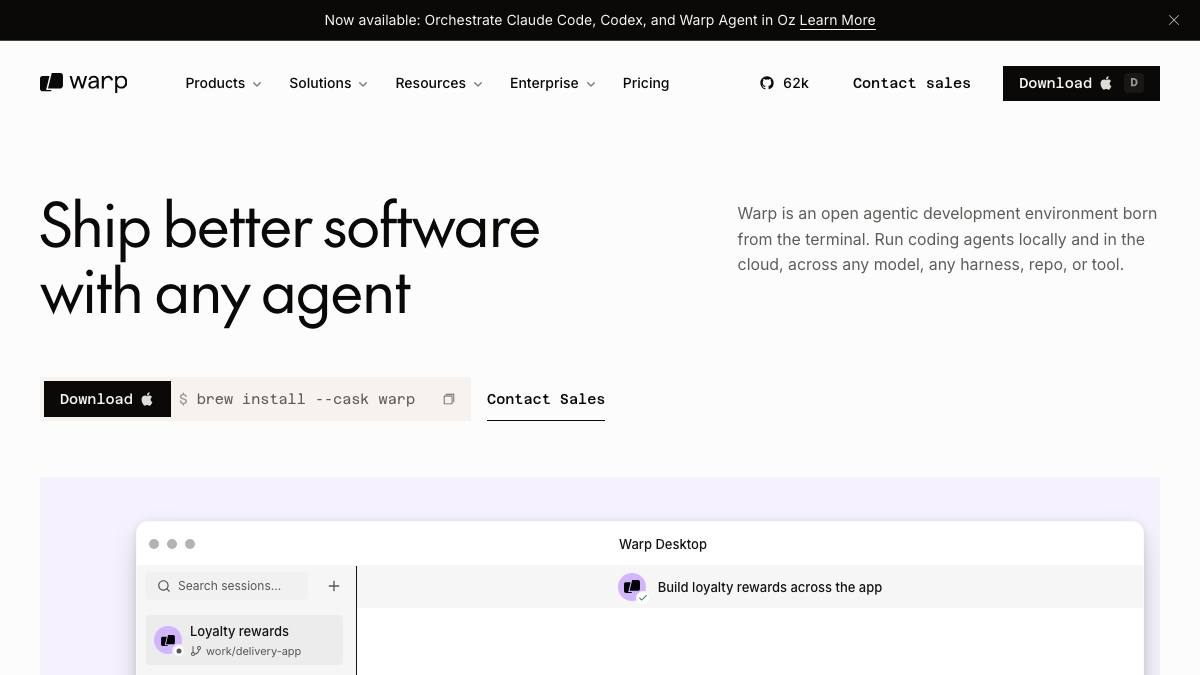
Warp is a Rust-based terminal that has grown into what the company calls an agentic development environment. Alongside a fast, modern terminal UI (command blocks, IDE-like editing, AI command help), it runs coding agents both locally and in the cloud: an Agent Mode that performs multi-step tasks with self-correction, a Warp Agent with codebase indexing and permission controls, and Oz, a platform for orchestrating fleets of cloud agents. It can also wrap third-party CLI agents like Claude Code, Codex, and Gemini CLI. Warp is model- and harness-agnostic and is used by individual developers through to enterprise engineering orgs. In April 2026 the company open-sourced its terminal client (MIT for the UI crates, AGPL v3 for the rest) and the Oz orchestration platform, with OpenAI as a founding sponsor. Autonomy is configurable, from approving each step to more autonomous execution, with a human in the loop by default.
What it can do
Suggest and explain terminal commands
CopilotGenerates commands from natural language and explains output inline within the terminal.
sourceRun multi-step tasks in Agent Mode
SupervisedExecutes multi-step terminal and coding tasks with self-correction and retries; how much it does before asking is configurable.
sourceDelegate codebase-aware work to Warp Agent
SupervisedIndexes the codebase and runs delegated work with permission controls, with autonomy configurable from per-step approval to more autonomous execution.
sourceOrchestrate fleets of cloud agents (Oz)
SupervisedRuns and supervises multiple background cloud agents from a central dashboard, including third-party CLI agents like Claude Code, Codex, and Gemini CLI.
source
Strengths
- +Best-in-class terminal UX: fast Rust client, command blocks, and IDE-like editing
- +Model- and harness-agnostic: orchestrates Claude Code, Codex, Gemini, and its own agent, local and cloud
- +Open-sourced the terminal client and the Oz orchestration platform in 2026
Limitations
- −Requires an account and sends data to the cloud for AI features, raising privacy/telemetry concerns
- −An October 2025 shift to credit/usage pricing drew community backlash
- −Power-user gaps remain (e.g. no tmux support)
Overview
Warp is a Rust-based terminal that has expanded into an agentic development environment. It pairs a fast, modern terminal UI with coding agents that run locally and in the cloud.
What it does
Warp offers natural-language command help, an Agent Mode for multi-step self-correcting tasks, a codebase-aware Warp Agent with permission controls, and Oz, a platform for orchestrating fleets of cloud agents. It can also run third-party CLI agents such as Claude Code, Codex, and Gemini CLI. Autonomy is configurable, from approving each step to more autonomous execution.
Integrations & setup
Runs on macOS, Linux, and Windows, works with Bash/Zsh/Fish, supports MCP (experimental), and exposes an Oz API/SDK plus an Enterprise analytics API. SAML SSO is available on Business and above. It is model-agnostic with bring-your-own-LLM on Enterprise.
Pricing
Freemium with usage credits. Free at $0 for small teams; Build from $20/mo with 1,500 monthly credits; Business from $50/mo with SAML SSO; Enterprise is custom with BYO LLM and self-hosted cloud agents.
Best for / not for
Best for developers and engineering teams that live in the terminal and want to orchestrate multiple coding agents. Less suited to users who need a fully local, no-account, no-telemetry tool.
Traction
Warp raised a reported $50M Series B in June 2023 led by Sequoia, with angels including Sam Altman and Marc Benioff. The company self-reports a large developer base; treat the figure as self-reported.
Alternatives
Claude Code is the closest terminal-native agent; Cursor and Windsurf target the in-IDE end of coding.
What people are saying
We aggregate real LinkedIn discussion into sentiment for the agents people search most. Warp isn't tracked yet, want it added? Request tracking.
Used this agent?
Sign in to upvote, rate, follow, or leave a comment.
FAQ
Is Warp just a terminal?+
It started as a modern terminal but is now positioned as an agentic development environment: it runs coding agents locally and in the cloud, orchestrates third-party CLI agents, and includes the Oz platform for fleets of cloud agents.
What models does Warp use?+
Warp is model-agnostic. Its agent includes frontier OpenAI, Anthropic, and Google models, and Enterprise customers can bring their own LLM or custom endpoints.
Sources
- Warp (official site) · accessed 2026-06-19
- Warp pricing · accessed 2026-06-19
- Warp documentation · accessed 2026-06-19
- warpdotdev/warp (GitHub) · accessed 2026-06-19
Last reviewed 2026-06-19