Topaz Labs
AI photo and video enhancement: upscaling, denoise, sharpen
Last reviewed 2026-06-20
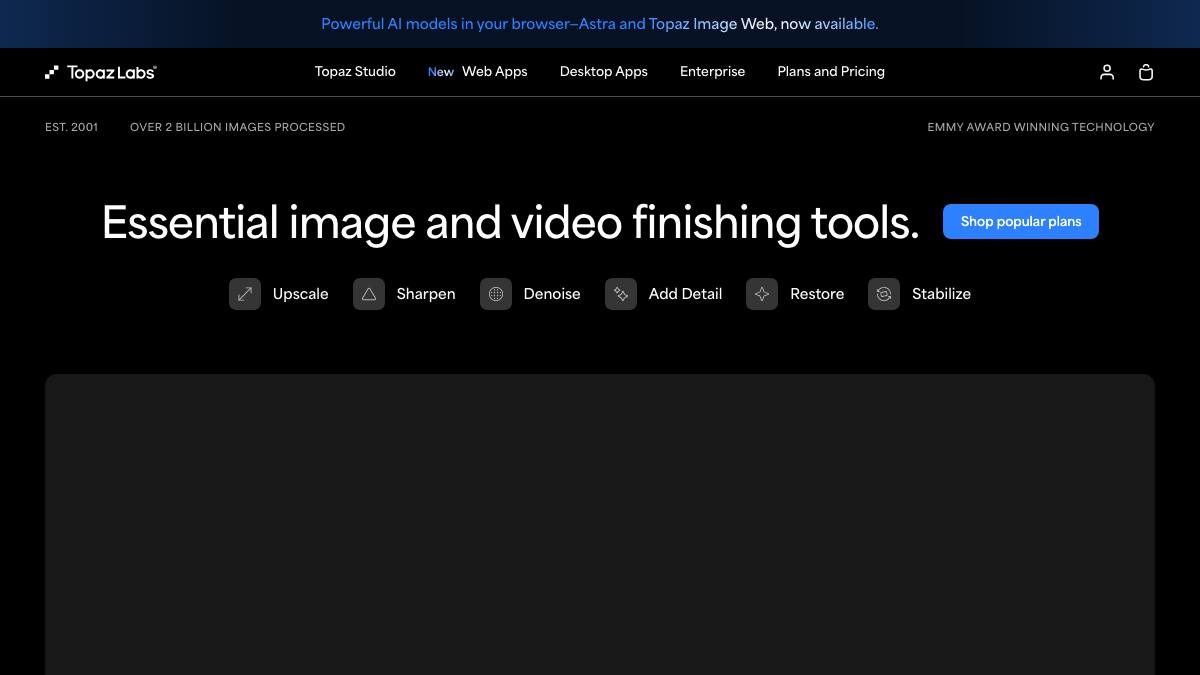
Topaz Labs makes AI-powered photo and video enhancement software for photographers, video editors, and creative professionals. Its desktop apps (Topaz Photo, Topaz Video, Topaz Gigapixel) and cloud tools (Astra, Topaz Image Web) use trained neural models to upscale images and video, reduce noise, sharpen, recover detail, deblur, and remove artifacts, with Gigapixel upscaling images up to 16x. Topaz also offers a REST API that exposes the same enhancement models for programmatic use in apps and production pipelines. It is a human-driven creative tool, not an agent. A user loads a photo or video, picks a model and settings, previews the result, and renders. Topaz selects and applies enhancement models on the input the user provides, but it does not plan multi-step work or take independent actions, so it sits at the assistant end of the autonomy ladder.
What it can do
Upscale images up to 16x (Gigapixel)
AssistantTopaz Gigapixel upscales images up to 16x using trained models (Wonder, Standard, Standard Max, High Fidelity), adding detail during enlargement.
sourceEnhance photos: denoise, sharpen, deblur, recover detail
AssistantTopaz Photo and Topaz Image Web reduce noise, sharpen, unblur, fix lighting, and recover detail with models such as Wonder, Super Focus, and Remove, local or cloud rendered.
sourceRestore and upscale video
AssistantTopaz Video and Astra restore and upscale footage, reduce noise and shake, and sharpen, using models like Starlight, Proteus, Iris, Nyx, and Rhea, with local and cloud rendering.
sourceEnhance via REST API
AssistantA REST API exposes Topaz Photo, Gigapixel, and video enhancement models (for example an Enhance endpoint) for programmatic image and video upscaling, billed per credit.
source
Strengths
- +Strong, well-regarded detail recovery and upscaling quality for photos and video
- +Local desktop rendering option, not only cloud, plus a REST API for pipelines
- +Specialized models per task (denoise, sharpen, upscale, restore) rather than one generic filter
Limitations
- −Shifted from one-time licenses to subscriptions, raising ongoing cost
- −Output needs human review and per-image tuning; not a hands-off agent
- −Local rendering of high-resolution video is hardware-intensive and slow on weak GPUs
Overview
Topaz Labs (founded 2005, Dallas, Texas) makes AI-powered photo and video enhancement software used by photographers, video editors, and creative professionals. Its tools upscale, denoise, sharpen, deblur, restore, and recover detail using trained neural models.
What it does
The lineup spans desktop apps and cloud tools. Topaz Gigapixel upscales images up to 16x. Topaz Photo and the browser-based Topaz Image Web reduce noise, sharpen, unblur, and recover detail with models such as Wonder, Super Focus, and Remove. Topaz Video and Astra restore and upscale footage, cut noise and shake, and sharpen, using models like Starlight, Proteus, Iris, Nyx, and Rhea. Rendering can run locally on the user's GPU or in Topaz's cloud. A REST API exposes the same enhancement models for programmatic use in apps and production pipelines.
It is a human-driven creative tool. A user provides the input, chooses a model and settings, previews, and renders. Topaz applies the model but does not plan multi-step work or act independently, so it sits at the assistant end of the autonomy ladder.
Integrations & setup
Desktop apps run on macOS and Windows and integrate with Adobe Lightroom and Photoshop as plugins. The REST API offers straightforward integration (the site advertises starting in minutes with no card required at the free tier).
Pricing
Apps are subscription-based. Examples (as reviewed): Gigapixel from about $149/yr (Personal), Photo from about $199/yr, Video from about $299/yr, with a Topaz Studio bundle around $399/yr. The API is usage-based on credits: pay-as-you-go around $0.12/credit, a Developer tier (around $50/mo for 500 credits, ~$0.10/credit), and a Scale tier (around $240/mo for 3,000 credits, ~$0.08/credit). One credit processes up to 24MP output; larger outputs cost more credits.
Best for / not for
Best for photographers, editors, and developers who need high-quality upscaling and restoration, with the option of local rendering or an API. Less suited to anyone wanting one-time licensing or a hands-off automated pipeline, since output benefits from per-image human tuning.
Alternatives
Krea and Leonardo offer AI upscaling/enhancement among broader generation feature sets; generative tools like Midjourney, Recraft, and Runway create media rather than primarily restoring and enlarging existing assets.
What people are saying
We aggregate real LinkedIn discussion into sentiment for the agents people search most. Topaz Labs isn't tracked yet, want it added? Request tracking.
Used this agent?
Sign in to upvote, rate, follow, or leave a comment.
FAQ
Is Topaz Labs an AI agent?+
No. It is an AI-powered photo and video enhancement tool. A human loads media, picks a model and settings, previews, and renders. It applies enhancement models on demand rather than acting autonomously.
Does Topaz Labs have an API?+
Yes. Topaz offers a REST API that exposes its image and video enhancement models for programmatic use, billed per credit (pay-as-you-go from about $0.12/credit, with Developer and Scale tiers at lower per-credit rates).
Is Topaz Labs subscription or one-time?+
Its current apps are subscription-based, sold individually (Photo, Video, Gigapixel) or bundled as Topaz Studio. The API is usage-based with credits.
Sources
- Topaz Labs (official site) · accessed 2026-06-20
- Topaz Labs API · accessed 2026-06-20
- Topaz Labs pricing · accessed 2026-06-20
- Topaz Video AI Pro · accessed 2026-06-20
Last reviewed 2026-06-20