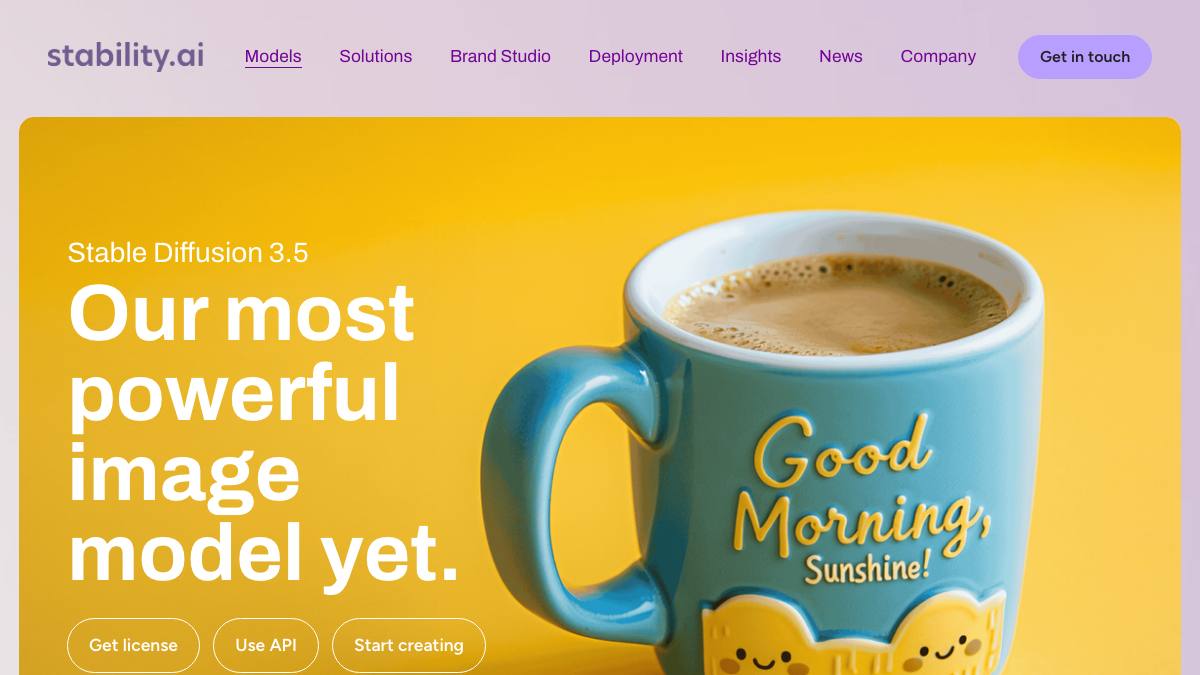
Stable Diffusion
by Stability AI
Open-weight text-to-image diffusion models that run on your own hardware
Last reviewed 2026-06-20
Stable Diffusion is a family of open-weight, text-to-image latent diffusion models from Stability AI. First released in August 2022 (developed with CompVis at LMU Munich and Runway), it became the default open foundation for image generation because the model weights and inference code are published, so anyone can download them and run generation locally on a consumer GPU rather than calling a hosted service. The line has iterated through SD 1.x, SD 2.x, SDXL (2023), SD 3 and SD 3.5 (October 2024), with SD 3.5 shipping in Large (8.1B parameters), Large Turbo, and Medium (2.5B, runs in under 10GB VRAM) variants. Stable Diffusion is best understood as a generation engine and assistant, not an autonomous agent: a person writes a prompt, generates options, and refines through inpainting, image-to-image, ControlNet, and re-rolls until satisfied. Because it is open, it powers a large ecosystem (ComfyUI, AUTOMATIC1111, the Diffusers library, fine-tunes, LoRAs, and ControlNet) and underpins many third-party apps and APIs. Stability AI is a London-based company founded in 2019; it also offers hosted access to these models through its Developer Platform API and the DreamStudio web app. SD 3.5 is distributed under the permissive Stability AI Community License, free for non-commercial use and for commercial use by organizations under $1M in annual revenue, with an Enterprise License required above that.
What it can do
Text-to-image generation from open weights
AssistantGenerates images from natural-language prompts using published model weights that can be downloaded and run locally. SD 3.5 ships as Large (8.1B parameters), Large Turbo (4-step distilled), and Medium (2.5B, runs in about 9.9GB VRAM).
sourceImage editing: image-to-image, inpainting, outpainting
AssistantBeyond text-to-image, the models support image modification (img2img), inpainting (region edits), and outpainting (canvas extension), all under direct human control.
sourceControlNet and conditional generation
AssistantSupports ControlNet conditioning (the SD 3.5 Large repo ships Blur, Canny, and Depth ControlNets) so generation can be guided by edges, depth maps, or reference structure rather than text alone.
sourceFine-tuning, LoRA, and self-hosted deployment
AssistantBecause weights and a reference inference implementation are open, the models can be fine-tuned, adapted with LoRAs, and deployed self-hosted via tooling such as ComfyUI, the Diffusers library, AUTOMATIC1111, Replicate, and Fireworks.
sourceHosted API and DreamStudio access
AssistantStability AI also serves the models through its Developer Platform API (including Stable Image Core and Stable Image Ultra, the latter based on SD 3.5) and the DreamStudio web app for those who prefer not to self-host.
source
Strengths
- +Open weights you can download and run locally on consumer hardware, no per-image fee for self-hosting
- +Huge ecosystem (ComfyUI, Diffusers, AUTOMATIC1111, ControlNet, LoRAs) plus fine-tuning and customization
- +Permissive Community License: free for non-commercial use and for commercial use under $1M annual revenue
Limitations
- −An assistant, not an autonomous agent: the human prompts, curates, and iterates on every output
- −Self-hosting requires a capable GPU and technical setup (the easy path is third-party apps or the hosted API)
- −Commercial use above $1M in annual revenue requires a paid Stability AI Enterprise License
Overview
Stable Diffusion is a family of open-weight, text-to-image latent diffusion models from Stability AI, a London-based company founded in 2019. First released on August 22, 2022 (developed together with CompVis at LMU Munich and Runway), it became the default open foundation for image generation: unlike closed services, its model weights and inference code are published, so anyone can download them and run generation locally rather than calling a hosted API. The line has iterated through SD 1.x, SD 2.x, SDXL (2023), and SD 3 / SD 3.5 (October 2024).
What it does
It generates images from natural-language prompts and supports image-to-image, inpainting (region edits), outpainting (canvas extension), and ControlNet conditioning (the SD 3.5 Large repo ships Blur, Canny, and Depth ControlNets). SD 3.5 comes in three variants: Large (8.1B parameters, ~1MP), Large Turbo (a 4-step distilled version for speed), and Medium (2.5B parameters, reported to run in about 9.9GB VRAM). Because it is open, it can be fine-tuned and extended with LoRAs and a large ecosystem of community tools. Throughout, a person prompts, curates, and refines: Stable Diffusion is an assistant and a generation engine, not an autonomous agent.
Integrations & setup
The weights and a reference inference implementation are open (the SD 3.5 reference code at github.com/Stability-AI/sd3.5 is MIT-licensed). It runs self-hosted via ComfyUI, AUTOMATIC1111, and the Hugging Face Diffusers library, and is served by third parties such as Replicate, Fireworks AI, and DeepInfra. Stability AI also offers hosted access through its Developer Platform API (including Stable Image Core and Stable Image Ultra, the latter based on SD 3.5) and the DreamStudio web app. It exposes a REST API; no MCP or A2A support is documented as of this review.
Pricing
The model weights are free to download and run. SD 3.5 is distributed under the Stability AI Community License: free for non-commercial use and for commercial use by organizations with under $1M in total annual revenue; organizations above that threshold must obtain a paid Enterprise License. Hosted generation through the Stability AI API and DreamStudio is paid per image; API credits are reported at roughly $10 per 1,000 credits (1 credit = $0.01), with per-image cost depending on the model and settings. Confirm current numbers on the pricing page.
Best for / not for
Best for developers, studios, and creators who want open weights, local or self-hosted generation, deep customization (fine-tuning, LoRAs, ControlNet), and no per-image fee at small scale. Less suited to non-technical users who want a polished one-click app (third-party front-ends or the hosted API are the easier path), or to organizations above $1M in revenue that have not licensed it for commercial use.
Alternatives
Midjourney offers a more opinionated, high-aesthetic style in a hosted app; Leonardo AI bundles Stable Diffusion-style generation plus other models with a creative web app and API; Recraft targets brand-consistent and true-vector design.
What people are saying
We aggregate real LinkedIn discussion into sentiment for the agents people search most. Stable Diffusion isn't tracked yet, want it added? Request tracking.
Used this agent?
Sign in to upvote, rate, follow, or leave a comment.
FAQ
Is Stable Diffusion an AI agent?+
No. It is a text-to-image generation model family. A person writes a prompt, generates options, and refines through image-to-image, inpainting, ControlNet, and re-rolls. It operates at the assistant level with no independent multi-step action.
Is Stable Diffusion free?+
The model weights are open and free to download and run yourself. SD 3.5 uses the Stability AI Community License: free for non-commercial use and for commercial use by organizations with under $1M in annual revenue, with an Enterprise License required above that. Hosted access via the Stability AI API and DreamStudio is paid per generation (credits cost about $10 per 1,000).
Can I run Stable Diffusion on my own computer?+
Yes. That is its defining feature. The weights and inference code are published, so it can run self-hosted on a consumer GPU. SD 3.5 Medium (2.5B parameters) is reported to run in about 9.9GB of VRAM. Common local tooling includes ComfyUI, AUTOMATIC1111, and the Hugging Face Diffusers library.
What models are in the Stable Diffusion family?+
The line spans SD 1.x and 2.x (2022), SDXL (2023), SD 3 and SD 3.5 (October 2024). SD 3.5 ships in Large (8.1B parameters), Large Turbo (4-step distilled), and Medium (2.5B) variants.
Sources
- Introducing Stable Diffusion 3.5 (Stability AI) · accessed 2026-06-20
- Stable Diffusion (Wikipedia) · accessed 2026-06-20
- Stability-AI/sd3.5 reference implementation (GitHub) · accessed 2026-06-20
- Stability AI Developer Platform documentation · accessed 2026-06-20
- Stability AI (Wikipedia) · accessed 2026-06-20
Last reviewed 2026-06-20