Sora
by OpenAI
OpenAI's text-to-video model with synced audio and self-insertion cameos
Last reviewed 2026-06-20
Sora is OpenAI's text-to-video generation model. A user writes a prompt (and optionally supplies images or clips), and Sora produces a short video, with Sora 2 adding synchronized dialogue and sound effects, more physically accurate motion, a "cameo" feature that drops the user's own likeness into scenes, and a storyboard tool for shot-by-shot control. It launched as a research preview in February 2024, reached general availability via sora.com and ChatGPT in December 2024, and shipped Sora 2 alongside a TikTok-style social app in September 2025. Sora is a consumer creative tool, not an agent: it generates clips on request and a human prompts, iterates, and curates the result. OpenAI discontinued the Sora web and mobile apps on April 26, 2026, and announced that the developer API will stop accepting requests on September 24, 2026, retaining Sora as an internal world-models research effort rather than a shipping consumer product. The entry is kept for reference and marked deprecated.
What it can do
Generate video from a text prompt
AssistantProduces short video clips from natural-language prompts, up to 1080p and up to about 20 seconds in widescreen, vertical, or square aspect ratios.
sourceSynchronized audio and dialogue (Sora 2)
AssistantSora 2 generates synchronized dialogue and sound effects with the video, and OpenAI describes it as more physically accurate and controllable than prior versions.
sourceCameos (insert your own likeness)
AssistantA one-time recorded "cameo" captures the user's appearance and voice, which Sora can then drop into generated scenes as a full-body likeness.
sourceRemix, blend, and storyboard inputs
AssistantUsers can extend, remix, or blend their own assets, and a storyboard tool lets them specify inputs frame by frame for shot-by-shot control.
sourceProgrammatic generation via API
AssistantThe Sora 2 API exposed text-to-video generation to developers on per-second billing; OpenAI announced the API will stop accepting requests on September 24, 2026.
source
Strengths
- +Sora 2 reportedly produces high physical realism with synchronized audio and dialogue
- +Cameo feature inserts a user's own likeness into generated video
- +Was bundled into ChatGPT Plus/Pro plus a developer API
Limitations
- −Discontinued: web and mobile apps shut down April 26, 2026, and the API winds down September 24, 2026
- −A consumer generation tool, not an agent: human prompts and curates every clip
- −Sora 2's default use of copyrighted likenesses and characters drew opt-out and rights-holder objections
Overview
Sora is OpenAI's text-to-video model. A user describes a scene (optionally supplying reference images or clips) and Sora generates a short video. It was previewed as a research preview in February 2024, reached general availability via sora.com and ChatGPT in December 2024, and Sora 2 launched on September 30, 2025 alongside a TikTok-style social app.
What it does
Sora generates short clips (up to roughly 1080p and 20 seconds, in widescreen, vertical, or square) from text prompts. Sora 2 added synchronized dialogue and sound effects, more physically accurate motion, a "cameo" feature that inserts the user's own recorded likeness into scenes, and a storyboard tool for shot-by-shot control. Users could also extend, remix, and blend their own assets. Generation runs on request under direct human control: you prompt, review, and iterate, which is why its autonomy is assistant, not agent.
Integrations & setup
Sora was available through the Sora web app and mobile apps, bundled into ChatGPT (Plus and Pro), and exposed to developers via the Sora 2 API on per-second billing. It is an OpenAI proprietary model with no third-party model options.
Pricing
Sora access was included in ChatGPT Plus (around $20/mo), with the higher-quality Sora 2 Pro available to ChatGPT Pro subscribers (around $200/mo). The Sora 2 API used per-second pricing (reported in the range of roughly $0.10 to $0.50 per second depending on model and resolution; figures are third-party reports). All of these are being wound down.
Status
Deprecated. OpenAI announced the shutdown in March 2026, discontinued the Sora web and mobile apps on April 26, 2026, and set the Sora API to stop accepting requests on September 24, 2026. Reporting frames the move as a strategic reallocation of compute toward coding and enterprise tools, with Sora retained as an internal world-models research effort. Sora 2's default handling of copyrighted likenesses and characters (opt-out rather than opt-in) also drew objections from rights holders.
Best for / not for
While live, it was best for creators wanting realistic short-form AI video with synced audio and self-insertion. It was never suited to anyone needing an autonomous workflow or long-term availability, and as of mid-2026 it is being retired.
Alternatives
Runway offers generative video plus editing and pipelines; HeyGen and Synthesia focus on avatar and presenter video; Google's video models (via Gemini) are another text-to-video option.
What people are saying
We aggregate real LinkedIn discussion into sentiment for the agents people search most. Sora isn't tracked yet, want it added? Request tracking.
Used this agent?
Sign in to upvote, rate, follow, or leave a comment.
FAQ
Is Sora still available?+
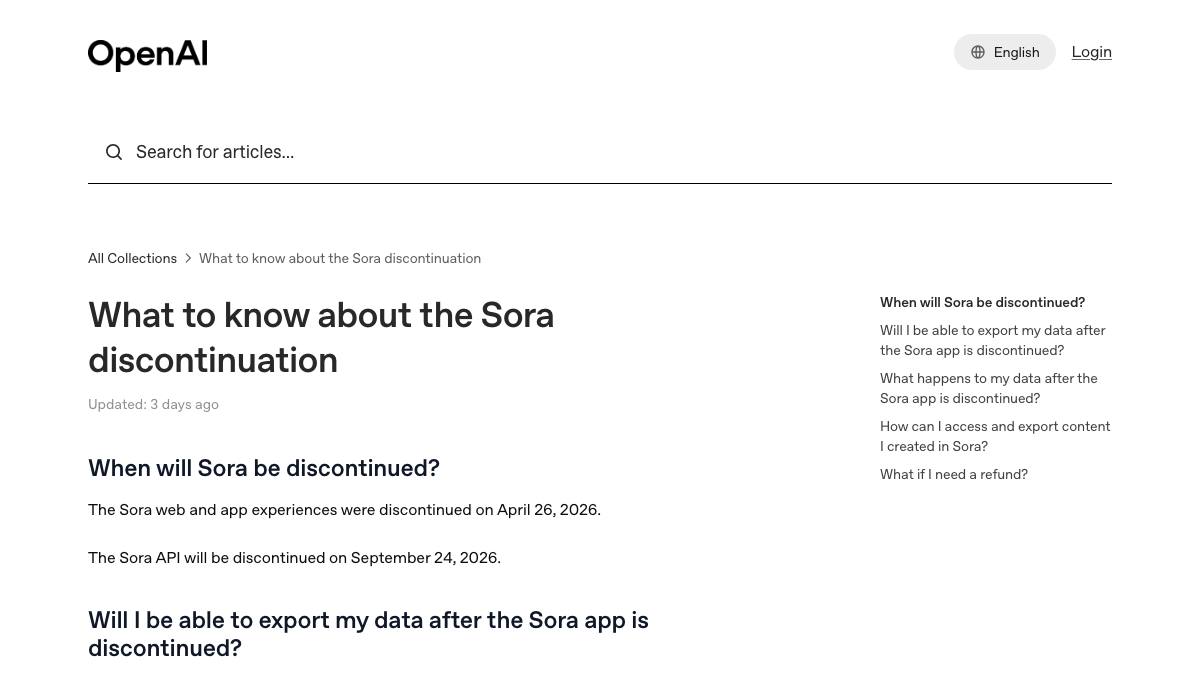
No. OpenAI discontinued the Sora web and mobile apps on April 26, 2026, and announced the Sora API will stop accepting requests on September 24, 2026. OpenAI said it is keeping Sora as an internal world-models research effort rather than a consumer product.
Is Sora an AI agent?+
No. Sora is a text-to-video generation model. A human writes the prompt and iterates on the output; it does not plan or take multi-step actions on its own, so it sits at the assistant level of autonomy.
What could Sora 2 do?+
Sora 2 generated short videos (up to about 1080p and 20 seconds) from text, images, or clips, with synchronized dialogue and sound, a cameo feature for inserting a user's likeness, and a storyboard tool for shot-by-shot control.
Sources
- Sora 2 is here (OpenAI) · accessed 2026-06-20
- Video generation with Sora (OpenAI API docs) · accessed 2026-06-20
- What to know about the Sora discontinuation (OpenAI Help Center) · accessed 2026-06-20
- OpenAI sets two-stage Sora shutdown (The Decoder) · accessed 2026-06-20
- Sora (text-to-video model) (Wikipedia) · accessed 2026-06-20
Last reviewed 2026-06-20