Synthesia
AI video platform that turns scripts into avatar-presented videos
Last reviewed 2026-06-18
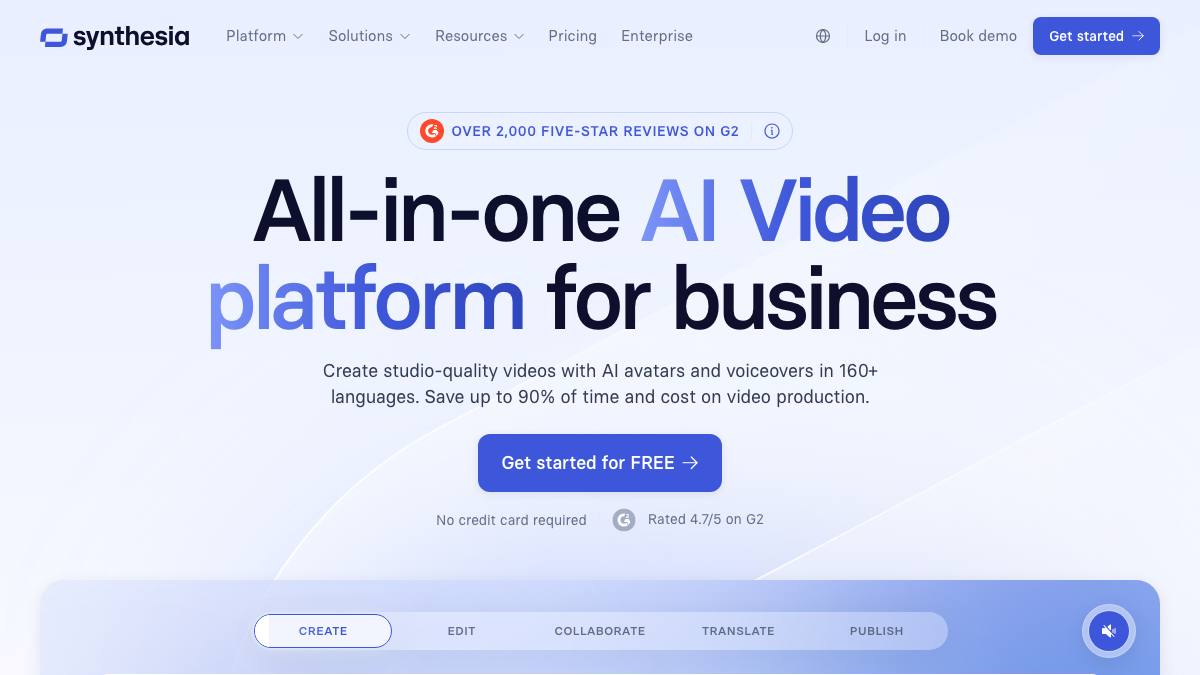
Synthesia is an AI video generation platform that turns a script, document, or URL into a video presented by a realistic AI avatar. It offers a large library of stock avatars, custom personal avatars, and AI voices across 140+ languages, plus one-click translation of finished videos and interactive video elements. It is widely used for training, learning-and-development, internal comms, and product or marketing explainers. Synthesia is an on-request creator: a user provides the script or source content, picks avatars and voices, edits scenes in a collaborative editor, and renders. It does not act autonomously; its AI assistant builds a draft script and scene layout that the human reviews.
What it can do
Generate avatar videos from a script
AssistantTurns a script into a video presented by a stock or custom AI avatar with synced speech, choosing from a library of 350+ avatars.
sourceVoice and localize in 140+ languages
AssistantGenerates AI voiceover across 140+ languages and one-click translates a finished video into other languages.
sourceDraft scripts and scenes from a URL or document
AssistantA built-in AI video assistant converts a URL or document into a full draft script and scene layout for the user to review and edit.
sourceAdd interactive elements and collaborate
AssistantSupports clickable in-video elements and Figma-like commenting with brand-kit enforcement for team review.
source
Strengths
- +Large avatar library and 140+ language voices with one-click video translation
- +Strong fit for training, L&D, and internal comms at scale; dramatically cheaper than filmed video
- +Collaborative editor with brand controls and an API for programmatic generation
Limitations
- −Credit/minute caps on lower tiers limit how much video you can render
- −Avatar delivery, while improving, can still read as synthetic for high-polish brand work
- −An assistant, not an agent: a human supplies the content and renders
Overview
Synthesia turns a script, document, or URL into a video presented by a realistic AI avatar, with voices and translation across 140+ languages.
What it does
Users pick from 350+ stock avatars or custom personal avatars, generate AI voiceover, add interactive elements, and collaborate in a Figma-like editor with brand controls. A built-in assistant drafts a script and scene layout from a URL or document. Finished videos can be translated in one click.
Integrations & setup
Exports for LMS workflows (SCORM), imports from PowerPoint, and exposes a REST API for programmatic video generation.
Pricing
Freemium: a free Basic plan with limited minutes, Starter around $18/mo and Creator around $64/mo (billed annually), and custom Enterprise with higher or unlimited minutes.
Traction
Synthesia reportedly raised $200M in late 2025 at a roughly $4B valuation, with total funding exceeding $536M; revenue figures circulating publicly are third-party estimates.
Best for / not for
Best for teams producing training, L&D, and internal-comms video at scale and across languages. Less suited to high-polish brand films or anyone needing hands-off generation.
Alternatives
HeyGen is the closest avatar-video competitor; Captions and Descript cover adjacent video creation and editing.
What people are saying
We aggregate real LinkedIn discussion into sentiment for the agents people search most. Synthesia isn't tracked yet, want it added? Request tracking.
Used this agent?
Sign in to upvote, rate, follow, or leave a comment.
FAQ
What is Synthesia used for?+
Turning scripts into avatar-presented videos for training, internal comms, product explainers, and marketing, with voiceover and translation across 140+ languages.
Does Synthesia create videos autonomously?+
No. Its AI assistant can draft a script and scene layout from a URL or document, but a human reviews, edits, and renders the video.
Sources
- Synthesia (official site) · accessed 2026-06-18
- Synthesia pricing (official) · accessed 2026-06-18
- AI video startup Synthesia reportedly raises $200M at $4B valuation (SiliconANGLE) · accessed 2026-06-18
Last reviewed 2026-06-18