Poe
by Quora
Quora's multi-model AI app: chat across 200+ models, build and share custom bots
Last reviewed 2026-06-20
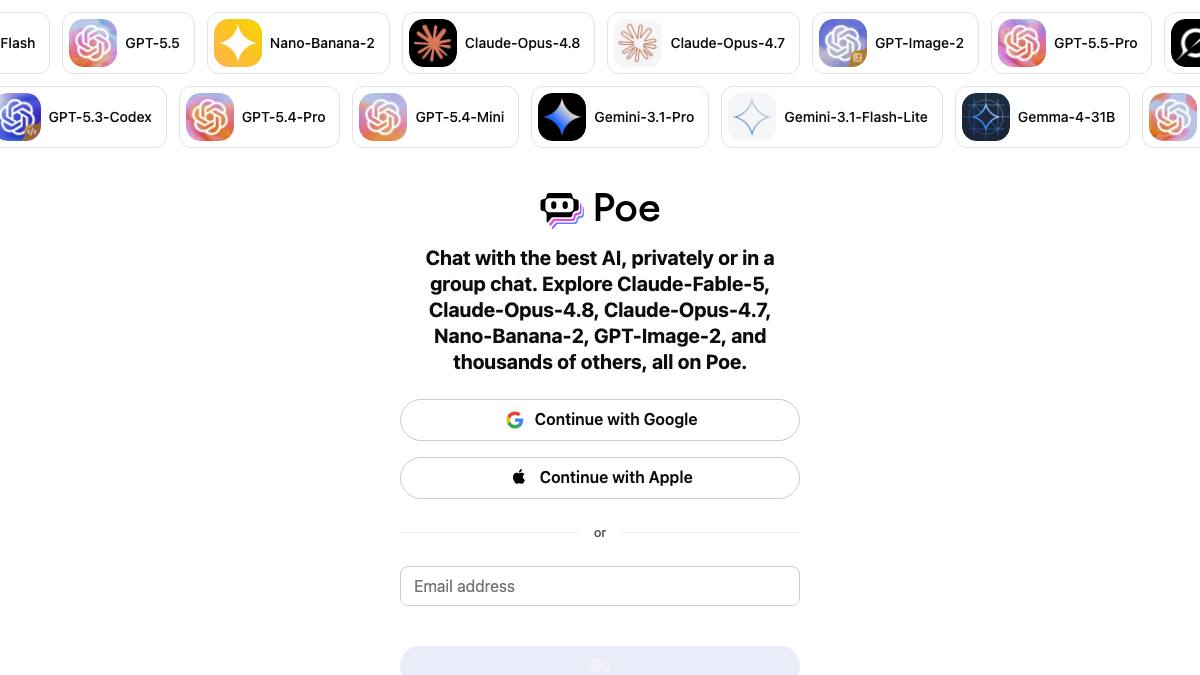
Poe (Platform for Open Exploration) is Quora's AI chat app that puts many AI models behind one interface. It was launched in December 2022 and opened to the public in February 2023, founded by Quora CEO Adam D'Angelo. Instead of subscribing to each provider separately, users chat with models from OpenAI, Anthropic, Google, Meta, DeepSeek, and others, plus image, video, and audio generators, all from a single account on web, iOS, Android, macOS, and Windows. Beyond plain chat, Poe lets anyone create custom bots (no-code prompt bots or code-backed server bots) and publish them to its audience, run multi-bot and group chats, and access models programmatically through an OpenAI-compatible API. It is best understood as a consumer and developer aggregation layer over many AI models rather than a single autonomous agent: the representative experience responds when asked, though its API now supports tool calling so developers can build their own agentic workflows on top.
What it can do
Multi-model chat in one interface
AssistantChat with models from OpenAI, Anthropic, Google, Meta, DeepSeek, and others from a single account, switching or comparing models without separate subscriptions; the experience responds when asked.
sourceCustom bots (prompt bots and server bots)
AssistantLets anyone build no-code prompt bots or code-backed server bots and publish them to Poe's audience; creators can be paid via price per message or subscription revenue share.
sourceMulti-bot and group chats
AssistantSupports conversations that mix multiple models or creator bots, and group chats with up to 200 people across more than 200 text, image, video, and audio models, launched November 2025.
sourceImage, video, and audio generation
AssistantProvides access to image, video, and audio generation models (alongside text models) so users can create media in the same app, on request.
sourceOpenAI-compatible API with tool calling
AssistantExposes all Poe models and bots through an OpenAI-compatible chat-completions API, with tool calling enabled across OpenAI, Anthropic, and Google models, so developers can wire Poe into tools like Cline, Roo Code, Continue, and n8n and build agentic workflows themselves.
source
Strengths
- +One subscription for many frontier and open-source models plus image, video, and audio generators
- +No-code custom bots plus an OpenAI-compatible API and creator monetization
- +Cross-platform (web, iOS, Android, macOS, Windows) with synced chats
Limitations
- −An aggregation and chat layer, not an autonomous agent; it responds when asked
- −Points / compute allowances and per-model token costs can be hard to predict
- −Depends entirely on third-party model providers, so availability and limits shift
Overview
Poe (Platform for Open Exploration) is Quora's AI chat app that puts many AI models behind a single interface. It launched in December 2022 and opened to the public in February 2023, founded by Quora CEO Adam D'Angelo. Rather than subscribing to each provider, users chat with models from OpenAI, Anthropic, Google, Meta, DeepSeek, and others, plus image, video, and audio generators, all from one account on web, iOS, Android, macOS, and Windows.
What it does
The core experience is multi-model chat: pick a model, ask, and get an answer, or compare models side by side. On top of that, Poe lets anyone build custom bots, either no-code prompt bots or code-backed server bots, and publish them to Poe's audience, with creator monetization via price per message or subscription revenue share. Multi-bot and group chats let people mix models and creator bots in one conversation, and group chats (launched November 2025) support up to 200 people across more than 200 text, image, video, and audio models. Image, video, and audio generation models sit alongside the text models so users create media in the same app. For developers, an OpenAI-compatible API exposes all Poe models and bots, with tool calling enabled across OpenAI, Anthropic, and Google models.
Autonomy note
Treat Poe as an assistant-grade platform: it responds when asked rather than acting on its own. The API's tool-calling support means developers can build agentic workflows on Poe, but that autonomy lives in the developer's application, not in Poe's default chat experience.
Integrations & setup
Available on the web at poe.com plus iOS, Android, macOS, and Windows apps, with chats synced across devices. The OpenAI-compatible API (managed at poe.com/api_key) plugs Poe into existing tools such as Cline, Roo Code, Continue, Cursor, the llm CLI, n8n, and Codex CLI, so a single Poe subscription can power coding assistants and automation that expect an OpenAI-style endpoint. Poe is model-agnostic by design, aggregating frontier and open-source models from many labs.
Pricing
Freemium. A free tier gives limited daily access to models. Paid subscriptions start at $4.99/month and scale up (reported up to higher enterprise-style tiers) for higher usage caps, compute-point allowances, and access to premium models. Poe also surfaces transparent USD per-token costs on model pages and lets users and developers buy additional credits to go beyond subscription limits. Exact prices, point allowances, and limits change; check the official subscription page.
Best for / not for
Best for users who want one place to use and compare many AI models (and to generate images, video, and audio) without juggling separate subscriptions, for creators who want to build and distribute bots, and for developers who want OpenAI-compatible access to many models through one key. Less suited to buyers who need a hands-off autonomous agent out of the box; Poe is an aggregation and chat layer, and any agentic behavior has to be built on its API.
Alternatives
ChatGPT, Claude, and Google Gemini are the single-provider chat assistants Poe aggregates and competes with; Perplexity competes on cited web search; OpenRouter is the closest developer-facing multi-model API aggregator. Poe's distinguishing angle is the combination of consumer multi-model chat, a creator-bot marketplace, and a unified API.
What people are saying
We aggregate real LinkedIn discussion into sentiment for the agents people search most. Poe isn't tracked yet, want it added? Request tracking.
Used this agent?
Sign in to upvote, rate, follow, or leave a comment.
FAQ
Is Poe an AI agent?+
Not really. Poe is an aggregation and chat layer that lets you talk to many AI models and creator-built bots from one app; the representative experience responds when asked. Its API supports tool calling, so developers can build agentic workflows on top of Poe, but Poe itself is best classed as an assistant-grade platform rather than an autonomous agent.
Who owns Poe?+
Poe is built and owned by Quora, the question-and-answer company. It was launched in December 2022 and opened to the public in February 2023, and is led by Quora CEO Adam D'Angelo.
Is Poe free?+
Poe has a free tier with limited daily access to models. Paid subscriptions start at $4.99/month and scale up for higher usage and access to premium models; developers can also buy additional credits and use an OpenAI-compatible API. Check the official subscription page for current prices and limits.
Sources
- Poe - About / The best AI, all in one place · accessed 2026-06-20
- Poe's AI app now supports group chats across AI models (TechCrunch) · accessed 2026-06-20
- Introducing transparent USD pricing and API tool calling (Poe blog) · accessed 2026-06-20
- Poe Creator Platform docs · accessed 2026-06-20
- Quora launches Poe, a way to talk to AI chatbots like ChatGPT (TechCrunch) · accessed 2026-06-20
- Poe Subscription Plans & Pricing · accessed 2026-06-20
Last reviewed 2026-06-20