OpenAI Agents SDK
by OpenAI
Lightweight open-source framework for building multi-agent workflows
Last reviewed 2026-06-18
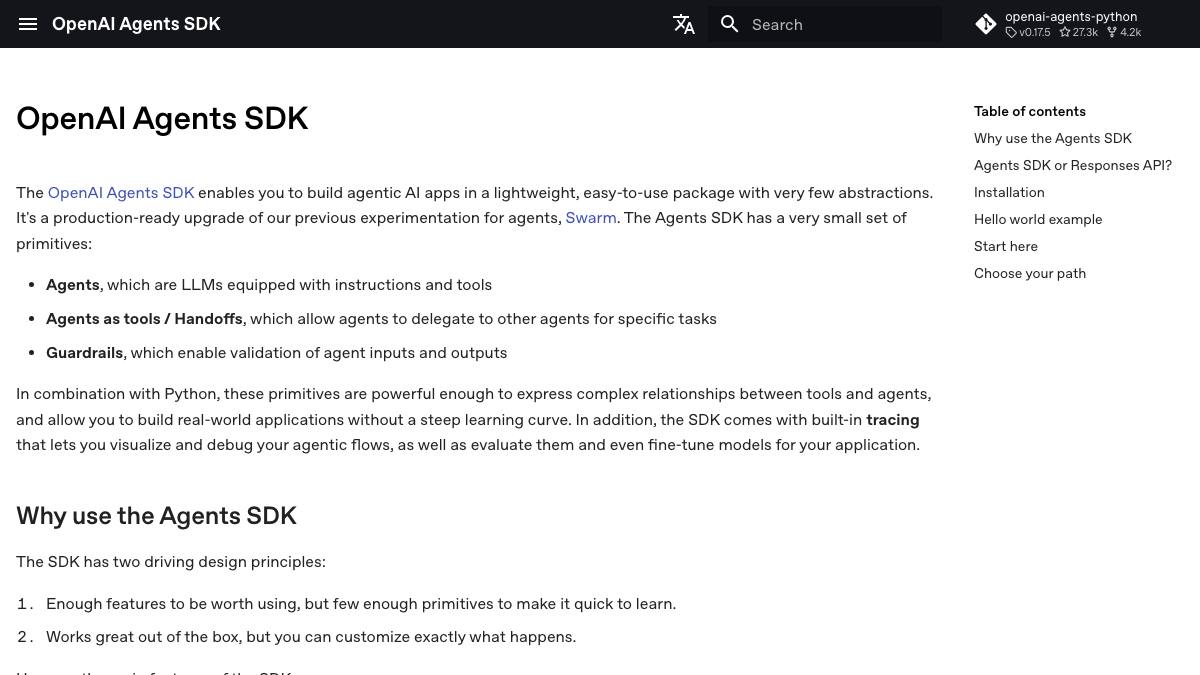
The OpenAI Agents SDK is an open-source framework for building multi-agent workflows. It models an agent as an LLM configured with instructions, tools, guardrails, and handoffs, and provides primitives for delegating between specialized agents (handoffs), validating inputs and outputs (guardrails), managing conversation history (sessions), and built-in tracing. It is provider-agnostic, working with OpenAI's Responses and Chat Completions APIs as well as 100+ other LLMs, and ships in Python and JavaScript/TypeScript versions, the latter also supporting voice agents. This is a developer framework, not an end-user product: the autonomy of any system you build is defined by the developer (how many tools, what guardrails, whether a human approves actions). It is the successor to OpenAI's earlier experimental Swarm framework and is designed to be minimal with few abstractions.
What it can do
Orchestrate multi-agent handoffs
SupervisedLets one agent delegate a task to another specialized agent; handoffs are exposed to the LLM as tools (e.g. transfer_to_refund_agent).
sourceApply input and output guardrails
SupervisedRuns validation and safety checks in parallel with agent execution and fails fast when checks do not pass.
sourceRun tool-using agents with tracing and sessions
SupervisedConfigures agents with instructions and tools, manages conversation history via sessions, and provides built-in tracing and human-in-the-loop hooks.
sourceRun provider-agnostic and voice agents
SupervisedWorks with OpenAI Responses/Chat Completions and 100+ other LLMs; the JS/TS SDK also supports voice agents.
source
Strengths
- +Minimal, low-abstraction framework that is quick to learn
- +Built-in handoffs, guardrails, sessions, and tracing
- +Provider-agnostic (100+ LLMs) with Python and JS/TS (and voice) SDKs
Limitations
- −A framework, not a product: you build, host, and secure the agent yourself
- −Autonomy and safety depend entirely on how the developer configures it
- −Fewer batteries-included integrations than larger frameworks
Overview
The OpenAI Agents SDK is a lightweight, open-source framework for building multi-agent workflows, and the successor to OpenAI's earlier experimental Swarm. It is designed to be minimal, with few abstractions.
What it does
It models an agent as an LLM configured with instructions, tools, guardrails, and handoffs. Handoffs let one agent delegate to another (exposed to the LLM as tools); guardrails run input/output validation in parallel and fail fast; sessions manage conversation history; and tracing and human-in-the-loop hooks are built in. The Python and JS/TS SDKs are provider-agnostic, and the JS SDK also supports voice agents.
Autonomy note
This is a developer framework, not an end-user agent. The autonomy of any system you build is defined by you: the tools you grant, the guardrails you set, and whether a human approves actions. We list it as supervised-agent as a conservative default.
Integrations & setup
Installed as a library (Python or JS/TS). It supports MCP servers and 100+ LLM providers. You host and secure whatever you build.
Pricing
The SDK is free and open source; you pay for the underlying model usage.
Best for / not for
Best for developers who want a minimal, official OpenAI framework for tool-using and multi-agent systems. Less suited to teams wanting a no-code platform or a hosted product.
Alternatives
LangChain, LangGraph, CrewAI, AutoGen, and Pydantic AI are competing agent frameworks; Google's ADK is the Google-ecosystem equivalent.
What people are saying
We aggregate real LinkedIn discussion into sentiment for the agents people search most. OpenAI Agents SDK isn't tracked yet, want it added? Request tracking.
Used this agent?
Sign in to upvote, rate, follow, or leave a comment.
FAQ
Does the OpenAI Agents SDK only work with OpenAI models?+
No. It is provider-agnostic, supporting OpenAI's Responses and Chat Completions APIs plus 100+ other LLMs.
How autonomous are agents built with it?+
Autonomy is developer-defined. The SDK provides handoffs, guardrails, and human-in-the-loop hooks, but how much an agent acts on its own depends on how you configure tools and approvals.
Sources
- OpenAI Agents SDK (docs) · accessed 2026-06-18
- openai/openai-agents-python (GitHub) · accessed 2026-06-18
- OpenAI Agents SDK: Handoffs · accessed 2026-06-18
- OpenAI Agents SDK: Guardrails · accessed 2026-06-18
Last reviewed 2026-06-18