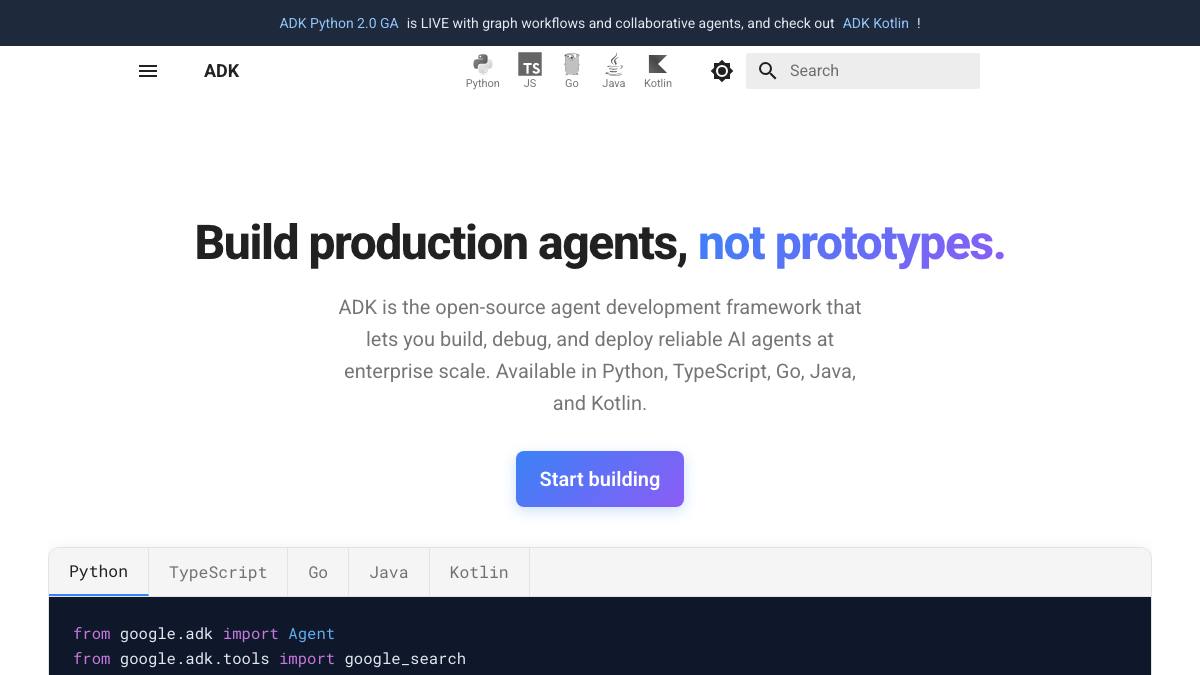
Google Agent Development Kit (ADK)
by Google
Open-source framework for building and orchestrating multi-agent systems
Last reviewed 2026-06-18
The Agent Development Kit (ADK) is Google's open-source framework for building, orchestrating, and deploying agents and multi-agent systems, introduced at Google Cloud Next 2025. It lets developers compose multiple specialized agents in a hierarchy for delegation and coordination, define tools, and deploy to runtimes like Vertex AI Agent Engine or Cloud Run. ADK agents can expose a standard HTTP endpoint and metadata for discovery via Google's open Agent2Agent (A2A) protocol, so agents built in ADK, LangGraph, CrewAI, or other frameworks can interoperate. It works with Gemini and, via LiteLLM, models from Anthropic, Meta, Mistral, and others. As a framework, the autonomy of any system built with it is developer-defined; it is aimed at developers building production multi-agent applications, especially on Google Cloud.
What it can do
Compose multi-agent hierarchies
SupervisedBuild modular, scalable applications by composing specialized agents in a hierarchy for delegation and coordination.
sourceExpose agents over the A2A protocol
SupervisedAgents expose a standard /run HTTP endpoint and metadata for discovery, enabling interoperability with agents from other frameworks via the open Agent2Agent protocol.
sourceDeploy to managed runtimes
SupervisedDeploys agents to Vertex AI Agent Engine or Cloud Run, and works with Gemini plus other models via LiteLLM.
source
Strengths
- +Backed by Google with first-class deployment to Vertex AI and Cloud Run
- +Built around the open A2A protocol for cross-framework agent interoperability
- +Model-agnostic via LiteLLM despite Gemini-first defaults
Limitations
- −A framework, not a product: you build, host, and secure agents yourself
- −Strongest when paired with Google Cloud, which can imply lock-in
- −Autonomy and guardrails are developer-defined
Overview
The Agent Development Kit (ADK) is Google's open-source framework for building, orchestrating, and deploying multi-agent systems, introduced at Google Cloud Next 2025.
What it does
ADK lets developers compose specialized agents in a hierarchy for delegation and coordination, define tools, and deploy to Vertex AI Agent Engine or Cloud Run. Agents expose a standard HTTP endpoint and metadata for discovery via Google's open A2A protocol, so ADK agents can interoperate with agents built in LangGraph, CrewAI, and other frameworks.
Autonomy note
This is a developer framework, not an end-user agent. How autonomously a built agent acts depends on the tools, guardrails, and approvals the developer configures; we list it as supervised-agent conservatively.
Integrations & setup
Installed as a library (Python; other language SDKs exist). Defaults to Gemini but is model-agnostic via LiteLLM, supports MCP, and integrates tightly with Google Cloud runtimes.
Pricing
The framework is free and open source; you pay for model and cloud usage.
Best for / not for
Best for developers building production multi-agent apps, especially on Google Cloud, who want A2A interoperability. Less ideal if you want to avoid Google Cloud or prefer a no-code platform.
Alternatives
LangChain, LangGraph, CrewAI, AutoGen, and the OpenAI Agents SDK are competing frameworks.
What people are saying
We aggregate real LinkedIn discussion into sentiment for the agents people search most. Google Agent Development Kit (ADK) isn't tracked yet, want it added? Request tracking.
Used this agent?
Sign in to upvote, rate, follow, or leave a comment.
FAQ
Does ADK only work with Gemini?+
No. ADK defaults to Gemini but is model-agnostic via LiteLLM, supporting models from Anthropic, Meta, Mistral, and others.
What is A2A?+
Agent2Agent (A2A) is an open, vendor-neutral protocol from Google that lets agents discover and communicate with each other across frameworks. ADK agents expose a standard endpoint and metadata for A2A interoperability.
Sources
- Agent Development Kit (docs) · accessed 2026-06-18
- Agent Development Kit: easy to build multi-agent applications (Google Developers Blog) · accessed 2026-06-18
- ADK with Agent2Agent (A2A) Protocol (docs) · accessed 2026-06-18
Last reviewed 2026-06-18