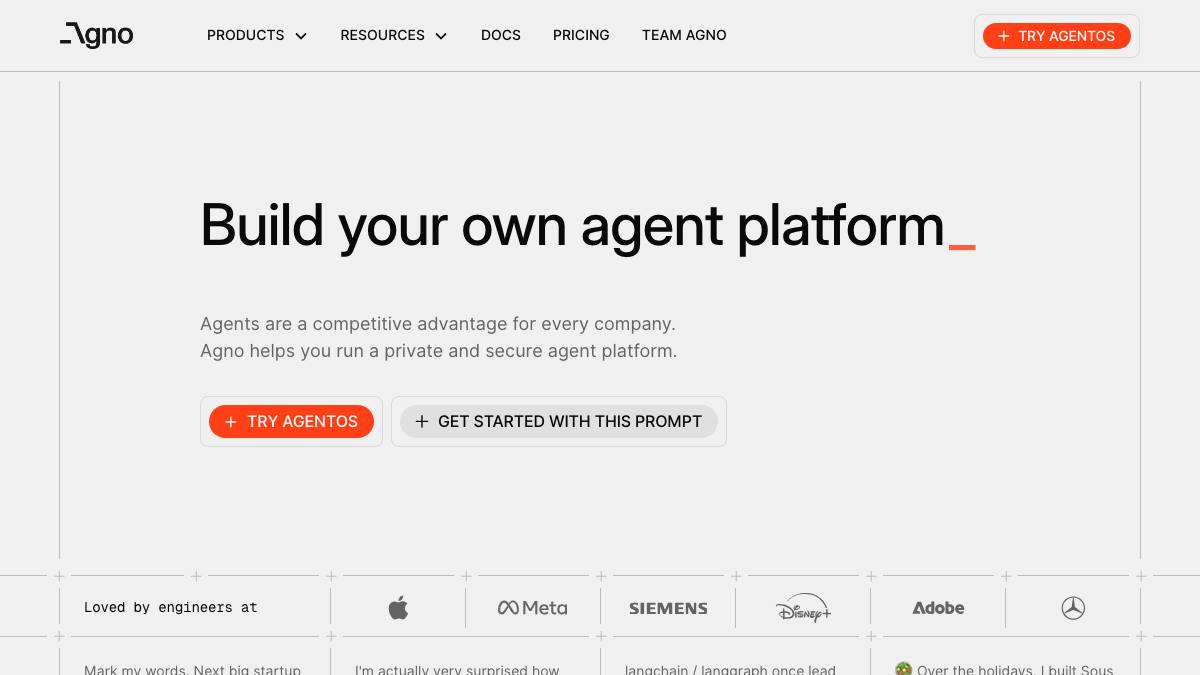
Agno
by Agno AGI
High-performance Python framework for multi-agent systems
Last reviewed 2026-06-19
Agno (formerly Phidata) is an open-source Python framework for building multi-agent systems with memory, knowledge (RAG), tools, and reasoning. It emphasizes very fast agent instantiation and a low memory footprint, and it ships AgentOS, a FastAPI-based runtime that wraps agents, teams, and workflows with session storage, tracing, and monitoring in your own database. It is a developer framework, so autonomy is defined by what the developer builds; in practice Agno apps range from copilots to supervised tool-using agents and orchestrated agent teams. The core is open-source and self-hostable, with commercial control-plane and enterprise options. Agno raised a seed round in 2024.
What it can do
Build agents with memory, knowledge, and tools
SupervisedComposable Python agents with built-in RAG knowledge, persistent memory, and a large tool library.
sourceCoordinate multi-agent teams and workflows
SupervisedOrchestrates teams of cooperating agents and deterministic workflows, bounded by developer-defined logic.
sourceRun agents as production services (AgentOS)
SupervisedA FastAPI runtime exposes agents, teams, and workflows with session storage, tracing, monitoring, and access control in your own database.
sourceBuild multimodal and reasoning agents
CopilotSupports text, image, and audio inputs and explicit reasoning steps.
source
Strengths
- +Strong performance focus (fast instantiation, low memory) with a clean Python API
- +Clear path from prototype to production via the AgentOS runtime
- +Broad model, vector-DB, and tool coverage, all self-hostable
Limitations
- −Python-only
- −Younger and smaller ecosystem than LangChain
- −Some runtime and control-plane features sit behind the commercial offering; comparative performance benchmarks are vendor-reported
Overview
Agno is an open-source Python framework for building agents and multi-agent systems. Formerly Phidata, it rebranded to Agno in early 2025. It leans hard on performance (fast agent creation, small memory footprint) and pairs the framework with AgentOS, a runtime for taking agents to production.
What it does
You compose agents from models, tools, memory, and knowledge (RAG), then coordinate them as teams or run them through deterministic workflows. AgentOS, built on FastAPI, serves agents, teams, and workflows with session storage, tracing, monitoring, and access control, all backed by your own database. Agno supports multimodal inputs and reasoning steps. As a framework, the autonomy of the result is developer-defined; most builds are copilots or supervised agents.
Integrations & setup
Model-agnostic across 20+ providers (OpenAI, Anthropic, Google, Mistral, Groq, Bedrock, Ollama and more), with many vector stores (pgvector, Qdrant, LanceDB, Pinecone-class) and a large tool library. Install the Python package; self-host AgentOS for production.
Pricing
The framework and AgentOS are open-source (MPL) and free to self-host. Commercial control-plane and enterprise tiers are available.
Traction
Agno (as Phidata) raised roughly a $5.4M seed in 2024, led by GreatPoint Ventures. The GitHub project has tens of thousands of stars.
Best for / not for
Best for Python teams that want a fast, self-hostable framework with a real production runtime. Less suited to JavaScript shops or teams that want the largest possible ecosystem and integrations, where LangChain still leads.
Alternatives
CrewAI and AutoGen target multi-agent orchestration; LangGraph offers graph-based control; LlamaIndex is data and RAG-centric.
What people are saying
We aggregate real LinkedIn discussion into sentiment for the agents people search most. Agno isn't tracked yet, want it added? Request tracking.
Used this agent?
Sign in to upvote, rate, follow, or leave a comment.
FAQ
Is Agno the same as Phidata?+
Yes. Agno is the rebrand of Phidata, which happened in early 2025. The framework continues under the Agno name and the agno-agi GitHub org.
Is Agno free?+
The core framework and the AgentOS runtime are open-source and free to self-host. Agno offers commercial control-plane and enterprise tiers for teams that want managed features.
Sources
- Agno (official site) · accessed 2026-06-19
- Agno documentation · accessed 2026-06-19
- agno-agi/agno on GitHub · accessed 2026-06-19
- Phidata (Agno) seed round (Crunchbase) · accessed 2026-06-19
Last reviewed 2026-06-19