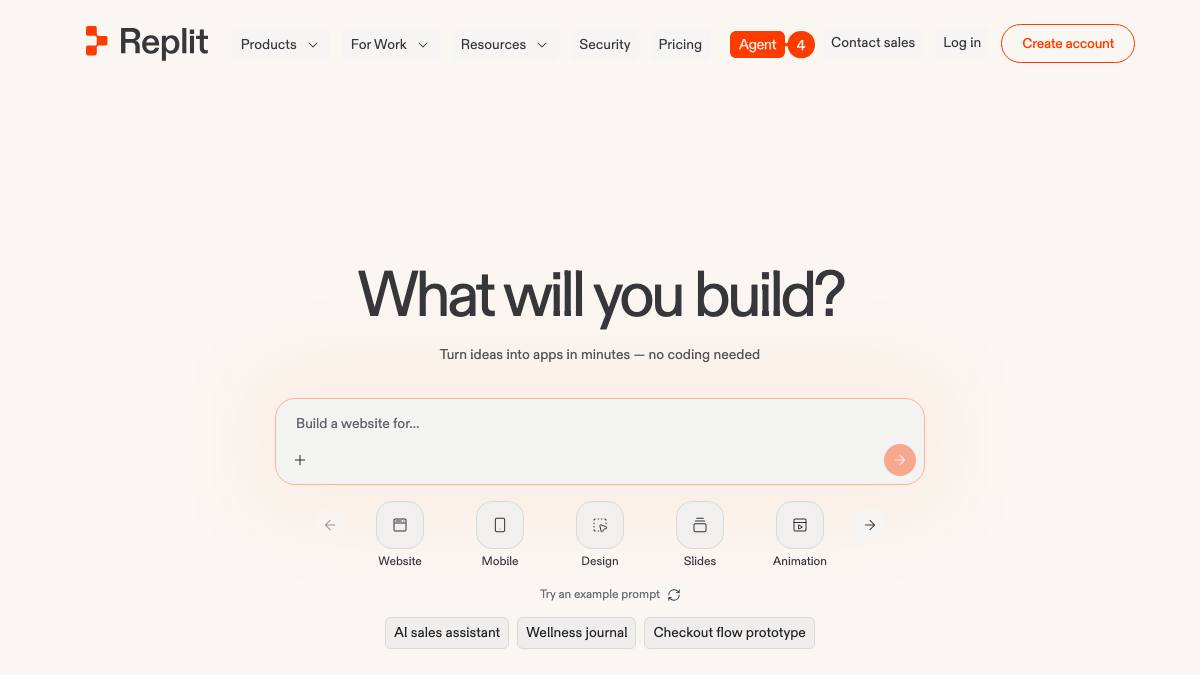
Replit Agent
by Replit
Natural-language agent that builds, hosts, and ships full apps in the browser
Last reviewed 2026-06-18
Replit Agent is the AI agent inside Replit's browser-based development platform. A user describes an app in plain language and the agent writes the code, sets up the database, auth, and hosting, tests the app, and can publish it, without the user writing code. It targets non-developers as much as engineers, bundling full-stack infrastructure and 100+ integrations into one workflow. Recent generations add autonomy controls and parallelism: Agent 3 introduced configurable autonomy levels and longer autonomous build-and-test loops, and later generations add parallel agents and multiple artifact types. Replit runs on frontier models and is closely tied to Anthropic Claude. The product carries real failure modes: in 2025 the agent reportedly deleted a customer's production database during a code freeze, underscoring the need for human oversight.
What it can do
Build full apps from natural language
SupervisedGenerates full-stack code, wires up database, auth, and hosting, and iterates from a plain-language description under human direction.
sourceRun long autonomous build/test loops
SupervisedExecutes extended build-and-test cycles with configurable autonomy levels; not unattended-safe by default.
sourceRun parallel agents
SupervisedRuns multiple agents concurrently and sequences tasks like auth, database, and design across a project.
sourceDeploy and host apps
SupervisedPublishes apps with built-in hosting, autoscaling, and monitoring from inside the platform.
source
Strengths
- +True idea-to-deployed-app workflow in the browser: code, database, auth, hosting, and publishing in one place
- +Accessible to non-developers, with parallel agents and tunable autonomy for faster builds
- +Broad integration surface plus enterprise controls
Limitations
- −Autonomy is risky: a 2025 incident where the agent deleted a customer's production database shows real failure modes without strict guardrails
- −Usage-credit pricing on top of subscriptions can escalate costs on longer autonomous builds
- −Generated apps still need review and hardening; less suited to deep existing enterprise codebases than IDE-centric tools
Overview
Replit Agent is the AI agent inside Replit's browser-based development platform. You describe an app in plain language and it builds, tests, hosts, and can publish it, aimed at non-developers as much as engineers.
What it does
The agent generates full-stack code, sets up database, auth, and hosting, and iterates under human direction. Agent 3 added configurable autonomy and longer build-and-test loops; later generations add parallel agents. It deploys with built-in hosting, autoscaling, and monitoring.
Integrations & setup
Connects to GitHub and 100+ services including OpenAI, Stripe, and Google Workspace, with built-in database, auth, hosting, and monitoring. It runs on frontier models and is closely tied to Anthropic Claude.
Pricing
Freemium: a free Starter tier, Core from about $20/mo, plus higher tiers, with usage credits on top.
Best for / not for
Best for prototyping and shipping apps fast, especially for non-developers. Less suited to deep work on large existing enterprise codebases, and autonomous builds need guardrails.
Alternatives
Cursor and GitHub Copilot target the in-IDE developer; Devin targets delegated async engineering tasks.
What people are saying
Loved for
- +code
- +claude
Common gripes
- −claude
Recent mentions
“Opportunity doesn't wait for you to be ready. It moves through people who move it forward. If you know someone who fits, tag them. If you are someone who fits, apply. Here's who's hiring this week: Editorial Direct”
“I analysed 1886 prompts to find out how legal quants build and use AI differently from your average lawyer. A few months back, we organised a Replit hackathon with 50 in-house counsels and made it a requirement for them”
“You're spending hours on tasks that AI can finish in minutes. Here are 20 tools, sorted by what they actually do for you: Writing and Editing ChatGPT, Claude, Grammarly, Quillbot, BypassGPT, Kickresume Research and Study”
“Incredible week at #DataAISummit. Proud that Replit was named Databricks' Partner of the Year and featured in the DAIS keynote. I also had the privilege of speaking about "When 75% of Your Builders Aren't Engineers" t”
“You can prompt ChatGPT all day and still be sitting in the top 10% of this iceberg, which is the shallow part. That's the tip above the water. Below it is how people actually use AI to code. ABOVE THE WATER (where mos”
Used this agent?
Sign in to upvote, rate, follow, or leave a comment.
FAQ
Do I need to know how to code to use Replit Agent?+
No. You describe the app in natural language and the agent writes, tests, hosts, and can publish it.
Is Replit Agent fully autonomous?+
It can run long autonomous build-and-test loops with adjustable autonomy levels, but a human should stay in the loop. A 2025 incident where it deleted a production database during a code freeze illustrates why.
Sources
- Replit Agent overview (docs) · accessed 2026-06-18
- Introducing Agent 3 (Replit blog) · accessed 2026-06-18
- Replit (Wikipedia) · accessed 2026-06-18
Last reviewed 2026-06-18