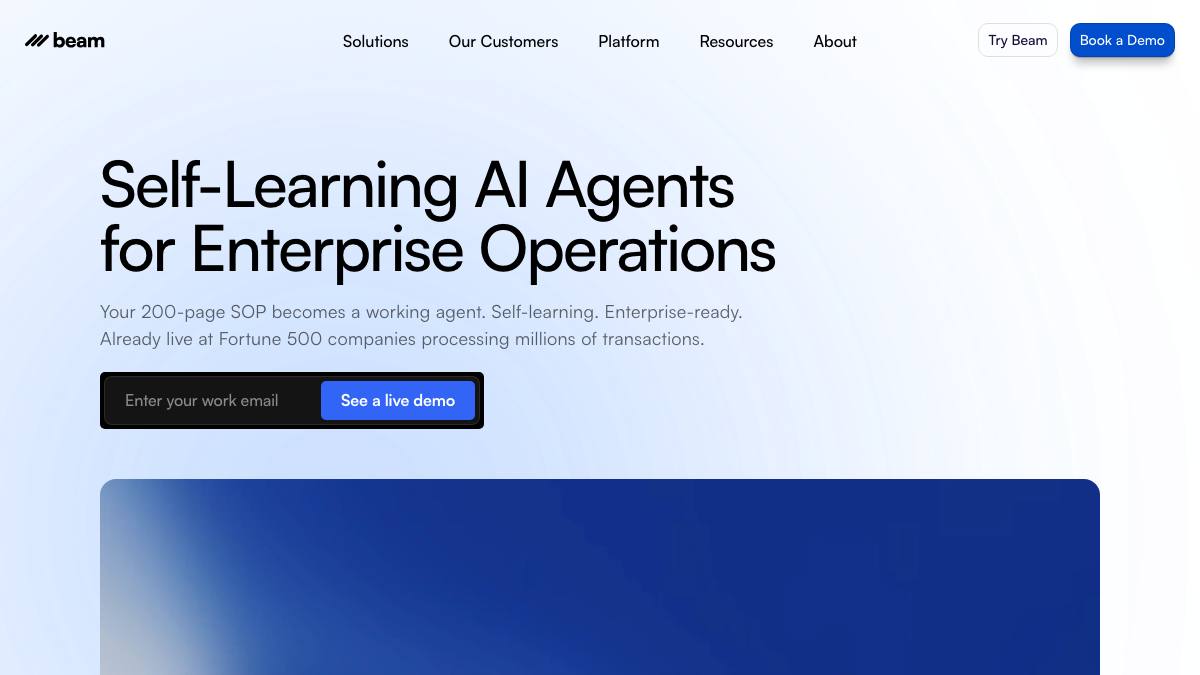
Beam AI
Platform for agentic process automation across enterprise systems
Last reviewed 2026-06-18
Beam AI is a platform for agentic process automation: you upload your business processes and deploy AI agents that execute multi-step operational workflows, handle exceptions, and coordinate across enterprise systems. The platform connects to over 1,000 enterprise applications (including Salesforce, Slack, Gmail, Airtable, and ServiceNow) and markets self-learning agents that improve over time, with output evaluation and self-healing on tasks. Beam AI targets operations teams automating back-office workflows such as invoice processing, claims, and onboarding. It is EU-hosted and GDPR-compliant with ISO 27001 and SOC 2 Type II certifications. As a building platform, the autonomy of any deployed agent is configured by the customer; despite autonomy framing, production workflows typically keep humans in the loop on exceptions and consequential actions.
What it can do
Deploy agents for business processes
SupervisedUpload a process and deploy production agents that execute multi-step operational workflows.
sourceHandle exceptions across systems
SupervisedAgents handle real exceptions and coordinate across enterprise systems rather than following only a fixed script.
sourceConnect to 1,000+ applications
SupervisedIntegrates with over 1,000 enterprise applications including Salesforce, Slack, Gmail, Airtable, and ServiceNow.
sourceEvaluate and self-heal outputs
SupervisedProvides output evaluation and self-healing on tasks, with agents marketed as improving over time.
source
Strengths
- +Focused on operational, back-office process automation with exception handling
- +Very broad integration surface (1,000+ apps)
- +EU-hosted, GDPR-compliant, with ISO 27001 and SOC 2 Type II
Limitations
- −Higher agent tiers are expensive and pricing tiers vary by source
- −Self-learning and autonomy claims should be validated against real workflows
- −A building platform: outcomes depend on how processes are configured and supervised
Overview
Beam AI is a platform for agentic process automation, aimed at operations teams automating back-office workflows.
What it does
You upload a business process and deploy agents that execute multi-step workflows, handle exceptions, and coordinate across enterprise systems. The platform connects to 1,000+ applications (Salesforce, Slack, Gmail, Airtable, ServiceNow, and more) and markets self-learning agents with output evaluation and self-healing on tasks.
Classification note
Beam AI is a building platform, not a single end-user agent. The autonomy of any deployed agent is configured by the customer, and despite autonomy framing, production workflows usually keep a human in the loop on exceptions; we list it as supervised-agent conservatively.
Integrations & setup
SaaS, EU-hosted and GDPR-compliant, with ISO 27001 and SOC 2 Type II certifications. Model-agnostic.
Pricing
Reported tiers include a Pro plan around $50/mo and agent tiers from roughly $990/mo up to custom enterprise pricing; figures vary by source, so confirm current pricing.
Best for / not for
Best for mid-market and enterprise operations teams automating high-volume back-office processes. Less suited to small teams or to those expecting unattended autonomy without validation.
Alternatives
Relevance AI and Lindy are agent platforms; Stack AI targets enterprise no-code; n8n and Gumloop are automation platforms with agent features.
What people are saying
We aggregate real LinkedIn discussion into sentiment for the agents people search most. Beam AI isn't tracked yet, want it added? Request tracking.
Used this agent?
Sign in to upvote, rate, follow, or leave a comment.
FAQ
What is Beam AI for?+
Agentic process automation: deploying AI agents that run multi-step operational workflows (like invoice processing or claims), handle exceptions, and coordinate across enterprise systems.
Is Beam AI fully autonomous?+
It markets self-learning, autonomous agents, but production operational workflows typically keep humans in the loop on exceptions and consequential actions, so in practice it operates as a supervised agent. Validate autonomy claims against your own processes.
Sources
- Beam AI (official site) · accessed 2026-06-18
- Beam AI platform (official) · accessed 2026-06-18
- Beam AI pricing (official) · accessed 2026-06-18
Last reviewed 2026-06-18