Basedash
AI-native BI that turns plain-English questions into dashboards and validated SQL
Last reviewed 2026-06-19
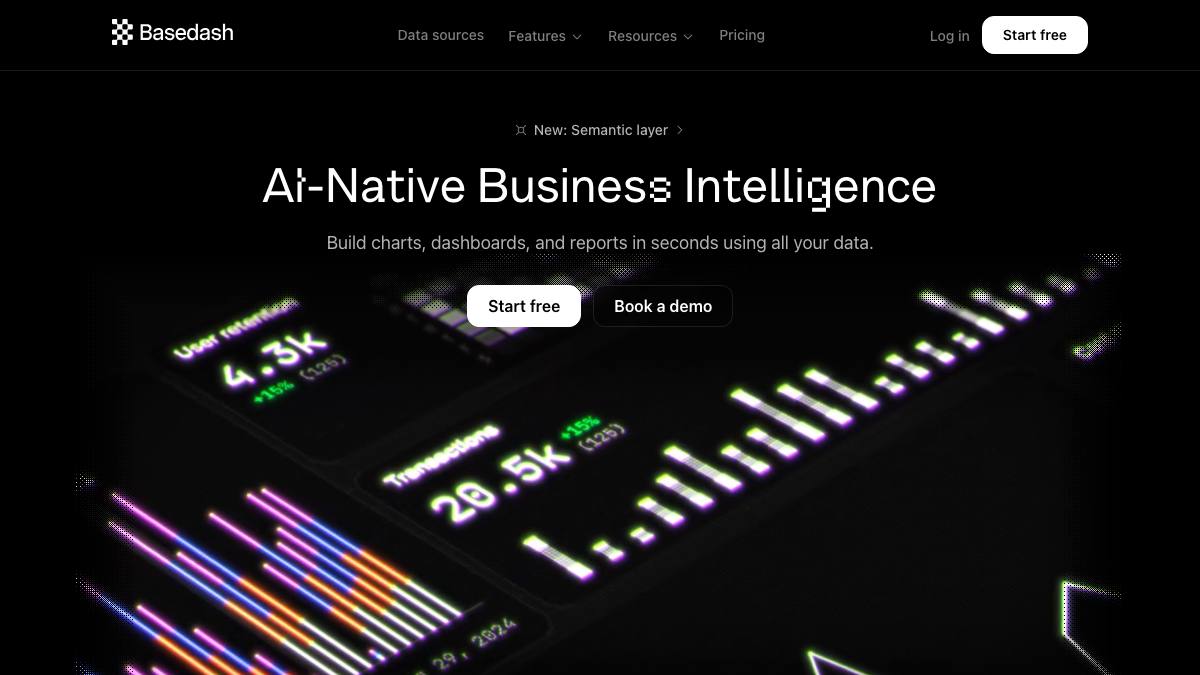
Basedash is an AI-native business intelligence platform. Users describe a chart, metric, or question in plain English and Basedash translates it into a structured query, validates and runs it against the connected database or warehouse, and renders dashboards and visualizations. Generated queries are inspectable and re-runnable, and a semantic layer lets teams define trusted, reusable metrics and feed the AI internal terms and KPIs for accuracy. Basedash positions itself as an AI data analyst, but it is a human-in-the-loop analytics tool: people ask, review the generated SQL, and act on the results. It connects to hundreds of databases, warehouses, and SaaS sources (Postgres, MySQL, Snowflake, BigQuery, plus SaaS apps), offers a SQL editor for technical users, and supports cloud, self-hosted, and VPC deployment for compliance-sensitive teams. It is SOC 2 Type II certified and states customer data is not used to train models.
What it can do
Answer data questions in natural language
AssistantTranslates plain-English questions into structured queries, validates them, and executes them directly against connected databases and warehouses.
sourceGenerate dashboards and visualizations from prompts
AssistantBuilds charts and dashboards from a description, with generated queries that can be reviewed and re-run for verification.
sourceDefine a semantic layer of trusted metrics
AssistantLets teams encode internal terms, vernacular, and KPIs into reusable metric definitions so the AI returns consistent, accurate results.
sourceEdit and version SQL directly
CopilotProvides a SQL editor with autocomplete, version history, and collaboration for technical users who want to refine generated queries.
source
Strengths
- +Generated SQL is inspectable and re-runnable, so answers can be verified
- +Semantic layer keeps metric definitions consistent across the team
- +Self-hosted and VPC options for compliance-sensitive deployments; SOC 2 Type II
Limitations
- −An analytics assistant, not an autonomous agent that acts on findings
- −Natural-language-to-SQL can still misread ambiguous schemas without a good semantic layer
- −Public pricing tiers are limited beyond a free trial
Overview
Basedash is an AI-native business intelligence platform. Describe a metric or question in plain English and it generates a validated query, runs it against your connected data, and builds dashboards and charts, with the underlying SQL kept inspectable.
What it does
Users ask questions conversationally; Basedash translates them into structured queries, validates them (the company emphasizes avoiding hallucinated tables or broken joins), executes them, and visualizes the result. A semantic layer encodes trusted metrics and internal vocabulary so answers stay consistent, and a SQL editor with version history serves technical users who want to refine queries directly.
Integrations & setup
Connects to a large catalog of databases, warehouses, and SaaS sources including PostgreSQL, MySQL, Snowflake, BigQuery, Salesforce, HubSpot, Stripe, and Google Analytics. Deploys in the cloud, self-hosted, or in a VPC; SOC 2 Type II certified with RBAC and encryption.
Pricing
Subscription with a 14-day free trial and full feature access; detailed tier pricing is not published on the homepage. Check the pricing page.
Best for / not for
Best for teams that want self-serve, natural-language analytics with verifiable SQL and a governed metric layer. Less suited to those wanting an agent that autonomously acts on insights rather than surfacing them.
Alternatives
Seek AI and Querio target natural-language warehouse analytics; Hex and Julius focus on notebook-style AI analysis; ThoughtSpot is the incumbent search-driven BI tool.
What people are saying
We aggregate real LinkedIn discussion into sentiment for the agents people search most. Basedash isn't tracked yet, want it added? Request tracking.
Used this agent?
Sign in to upvote, rate, follow, or leave a comment.
FAQ
Is Basedash an autonomous data agent?+
No. It is an AI-native BI assistant: people ask questions in plain English, review the generated and validated SQL, and act on the results. It does not take downstream actions on its own.
Can it run in our own environment?+
Yes. Basedash offers cloud, self-hosted, and VPC-based deployment for teams with tighter network or compliance requirements, and is SOC 2 Type II certified.
Sources
- Basedash (official site) · accessed 2026-06-19
- Basedash pricing · accessed 2026-06-19
- Top AI-native BI tools 2026 (Basedash blog) · accessed 2026-06-19
Last reviewed 2026-06-19