Julius AI
AI data analyst: connect data, ask in plain English, get analysis and charts
Last reviewed 2026-06-18
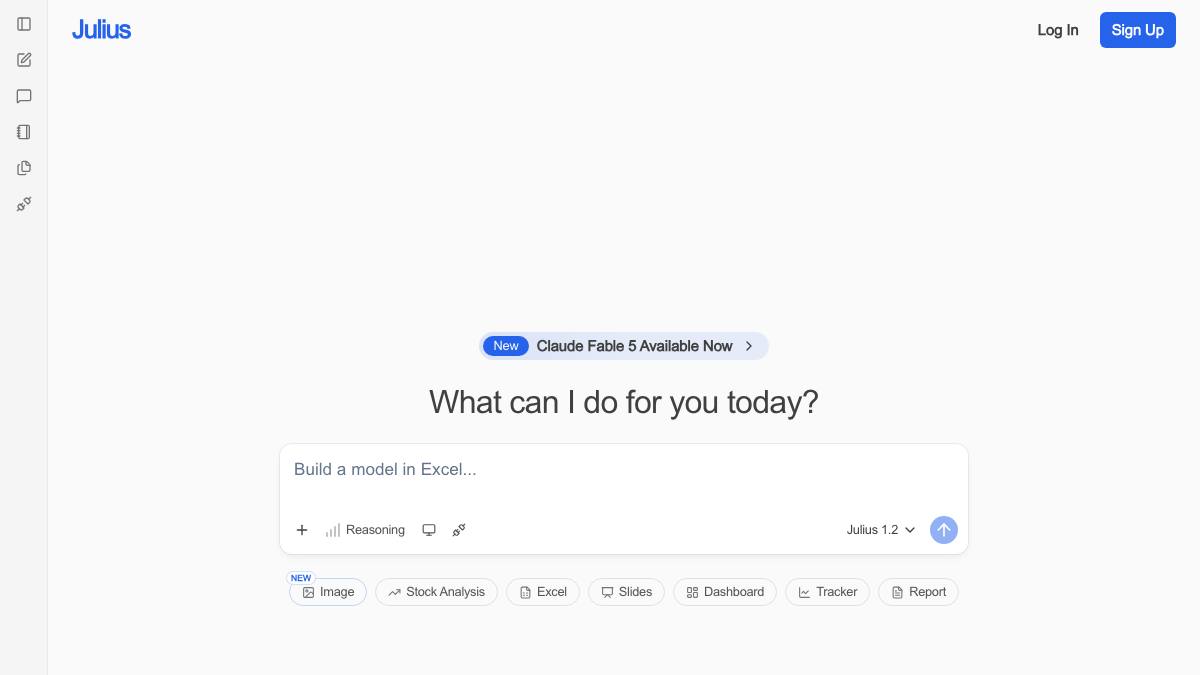
Julius AI is a chat-based data analysis product. You upload files or connect live databases and warehouses, ask a question in plain English, and Julius writes and runs Python or R behind the scenes to clean, analyze, visualize, model, and answer, optionally showing the code it ran. It produces charts, dashboards, slides, HTML artifacts, and reports, and handles forecasting, regression, statistical tests, and basic machine learning. It targets non-analyst knowledge workers (marketing, sales, finance, founders, researchers, students) who want answers from data without writing code, as well as data teams who want to move faster. The product layers on agent features (custom agents, a Slack agent, scheduled runs) and MCP tool use on top of the core analysis chat, so its agentic capability sits inside a broader product.
What it can do
Analyze data via natural-language chat
CopilotWrites and executes Python or R to answer plain-English questions about uploaded files or connected data, optionally exposing the code it ran. Runs multi-step analysis within a single turn but operates inside a user-driven chat loop.
sourceConnect live databases and warehouses
CopilotConnects directly to Postgres, MySQL, SQL Server, Snowflake, BigQuery, Databricks, Supabase, and Vertica, and builds a semantic layer over large schemas so users can query in plain English.
sourceGenerate visualizations, dashboards, and reports
SupervisedProduces charts, dashboards, HTML artifacts, slides, and reports, and supports scheduled runs that deliver recurring reports to Slack or email.
sourceExtend with MCP tools and custom agents
SupervisedConnects external tools over MCP (Notion, Stripe, GitHub, Zapier, Intercom, or a bring-your-own endpoint); user-built custom agents and a Slack agent auto-select tools to use.
source
Strengths
- +Low barrier: ask in plain English, it runs and shows the code, usable by non-analysts yet inspectable by technical users
- +Broad real-data connectivity (warehouses, files, ad platforms) plus MCP tool use
- +Model-agnostic with a model selector and large-file handling
Limitations
- −Credit-based pricing makes cost hard to predict, and the best models and features are gated to higher tiers
- −Overlaps heavily with general assistants' code interpreters (ChatGPT, Claude, Gemini); the moat is specialization plus connectors
- −Not hands-off autonomous: it works turn by turn and depends on user prompting
Overview
Julius AI is a chat-based data analysis product. You connect or upload data, ask a question in plain English, and it writes and runs Python or R to answer, visualize, and model, optionally showing the code. It is aimed at non-analyst knowledge workers as well as data teams who want to move faster.
What it does
Julius answers natural-language questions over uploaded files or connected databases and warehouses, generating charts, dashboards, slides, and reports along the way. It handles forecasting, regression, statistical tests, and basic machine learning. Newer agent features (custom agents, a Slack agent) and MCP tool use let it reach external tools, but the core experience remains a turn-by-turn analysis chat.
Integrations & setup
Connects to Snowflake, BigQuery, Databricks, Postgres, MySQL, SQL Server, Supabase, and Vertica, plus file sources like Google Drive. It supports MCP (HTTP) for connecting tools such as Notion, Stripe, GitHub, Zapier, and Intercom, and offers SSO/SAML on higher tiers.
Pricing
Freemium with a credit-based model. A paid Plus plan starts around $20/mo, with higher Pro, Max, and Ultra tiers and team and enterprise plans. The best models are gated to paid tiers.
Best for / not for
Best for people who want answers from data without writing code, and for analysts who want a faster first draft they can inspect. Less compelling for teams that already lean on a general assistant's code interpreter, where the differentiator is Julius's connectors and specialization.
Alternatives
Hex is the closest data-analytics competitor for technical teams.
What people are saying
We aggregate real LinkedIn discussion into sentiment for the agents people search most. Julius AI isn't tracked yet, want it added? Request tracking.
Used this agent?
Sign in to upvote, rate, follow, or leave a comment.
FAQ
Does Julius AI write its own code?+
Yes. It writes and runs Python or R to perform the analysis and can show you the code, so technical users can audit what it did while non-technical users can stay in plain English.
Is Julius AI autonomous?+
Not really. It runs multi-step analysis on its own within a turn, but it operates inside a user-driven chat loop where you ask, review, and iterate. Scheduled runs and custom agents add light automation but are user-configured.
Sources
- Julius AI pricing (official) · accessed 2026-06-18
- Julius AI funding announcement · accessed 2026-06-18
- Julius AI docs: data connectors · accessed 2026-06-18
- Julius AI docs: MCP · accessed 2026-06-18
- AI data analyst startup Julius nabs $10M seed round (TechCrunch) · accessed 2026-06-18
Last reviewed 2026-06-18