Zen7 Payment Agent


 中文版本
中文版本
Real-time progress updates can be viewed on page Real-time progress For support on the x402 protocol, please click here
Zen7 Payment Agent is the first practical implementation of DePA (Decentralized Payment Agent), pioneering the next generation of intelligent payment infrastructure. It not only fully implements the core functionalities of DePA but also successfully deploys innovative application cases in the agentic commerce domain.
As the first practical project in the DePA ecosystem, Zen7 implements several key features: automated encrypted payments between agents, a "permissionless authorization" mechanism, and LLM-driven intent recognition and interaction.
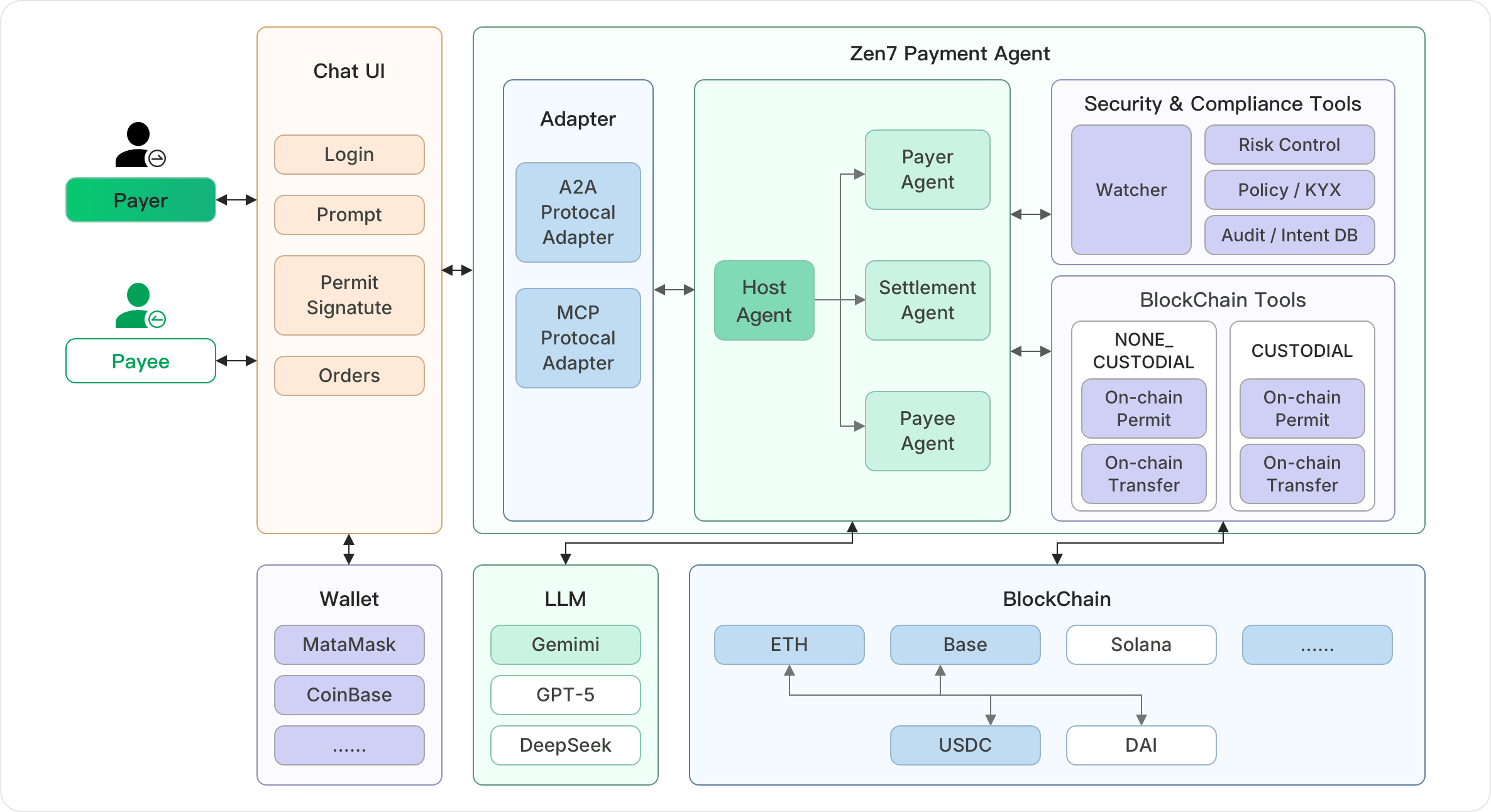
Zen7 Payment Agent adopts a multi-agent collaborative architecture, supporting both A2A and MCP protocols, as well as custodial and non-custodial payment models. It provides a comprehensive payment solution for AI Agents and native Dapp applications with multi-chain, multi-currency, multi-wallet support, high-frequency transactions, gasless operations, and passwordless authentication.
Navigating the Repository
This repository contains the complete implementation of Zen7 Payment Agent, showcasing the core components and architectural design based on the Zen7 Payment Agent (Decentralized Payment Agent) protocol.
Core Directory Structure
The core implementation of the project is located in the following key directories:
host_agent - The core implementation of the multi-agent collaborative architecture. The host agent uses the gemini-2.0-flash-lite model as the core coordinator, responsible for query understanding, state management, and response coordination. The sub-agent system (sub_agents/) contains five specialized agents: payer_agent handles order creation for the payer, EIP-712 signature generation, and wallet balance verification; settlement_agent focuses on the settlement process, confirming payment details, executing on-chain transactions, and monitoring transaction status; payee_agent handles payee-related operations, receiving settlement notifications, confirming order creation, and notifying payment completion; order_agent manages order processing and intent recognition, automatically routing to different agents; allowance_agent provides authorization quota query functionality, supporting multi-chain token authorization queries.
a2a_server & mcp_server - Protocol adaptation layer implementation, providing diverse integration methods. a2a_server implements Google's Agent-to-Agent protocol using the A2AStarletteApplication framework, exposing agent capabilities through AgentCard, supporting inter-agent collaborative communication, and running on port 10000 by default. mcp_server implements Model Context Protocol integration based on the FastMCP framework, encapsulating payment functionality as tool APIs, providing the core proceed_payment_and_settlement_detail_info tool, supporting SSE (Server-Sent Events) transport, and running on port 8015 by default.
dao - Data access layer implementation, integrating PostgreSQL + SQLModel for data persistence. Includes database model definitions (model.py), database connection management (database.py), and data access interfaces (app.py), supporting complete business data management for orders, payments, settlements, intents, and audit events.
task_manager - Task management layer implementation with factory pattern design. payment_service.py provides a unified interface for payment services, task_scoped_manager.py implements task scope management, ensuring isolation and lifecycle management for different payment tasks.
services - Complete blockchain service implementation. Signature services support both EVM chains (execute_sign.py) and Solana chain (execute_sign_solana.py), with EVM providing EIP-712 typed data signing and supporting permit signatures for USDC and DAI; transfer handlers adopt base class abstraction design (base_handler.py), divided into custodial/ mode (backend manages wallets to simplify user experience) and non_custodial/ mode (users control private keys for enhanced security), supporting both EVM (evm_transfer_handler.py) and Solana (solana_transfer_handler.py) blockchains; data service layer includes intent recording (intent.py), audit events (audit_event.py), settlement batches (settlement_batch.py), and settlement details (settlement_detail.py), enabling full transaction lifecycle tracking; constant configuration (constants.py) centrally manages blockchain network configurations, contract addresses, and chain IDs; permit execution (execute_permit.py) handles ERC-20 token authorization and permit execution.
Companion Console Demo Application
The companion console demo application is located in a separate Zen7-Console-Demo repository, providing users with a complete interactive interface and payment flow demonstration, allowing developers to intuitively experience the workflow of the entire payment system. It includes complete payment flows for both A2A and MCP clients in e-commerce scenarios.
- Shopping Agent Client demonstrates how to use payment agent services in e-commerce scenarios, implementing features such as product browsing, ordering, and payment.
Technology Stack and Compatibility
Supported Blockchain Networks:
- EVM Compatible Chains: Ethereum Sepolia, Base Sepolia, Polygon Amoy, BNB Chain Testnet
- Solana: Devnet, Testnet
Compatible Token Standards:
- EVM: USDC (Version 2), DAI (Version 1)
- Solana: SPL Token
Signature Standards:
- EVM: EIP-712 Typed Data Signing
- Solana: Ed25519 Signature
Wallet Integration: MetaMask, Coinbase Wallet, Phantom Wallet
Data Persistence: PostgreSQL + SQLModel ORM
This design provides developers with a flexible testing environment, supporting a complete payment solution with multi-chain and multi-currency capabilities, while ensuring good compatibility with mainstream wallets and blockchain networks.
Quick Start
- Quick Start Guide - Detailed project setup and running guide
Environment Setup
- Basic Environment Installation - Install Python 3.13+, uv tool, and Git
- Blockchain Environment Configuration - Blockchain environment setup and test wallet preparation
Development Guide
- Development Guide - Developer extension and customization guide
Security Considerations
- Private Key Security: Private keys in the test environment are only for development; use secure key management solutions in production
- Network Environment: Currently supports testnets; production environments require corresponding mainnet configurations
- Token Management: Ensure test wallets have sufficient test tokens for transactions
- API Security: Configure appropriate authentication and authorization mechanisms in production environments
Support
If you encounter issues or need help, please:
- Check the relevant guides in the documentation directory
- Submit issues on GitHub Issues
- Contact the development team
About Zen7 Labs
Zen7 Labs is dedicated to building the next generation of decentralized payment infrastructure, focusing on providing innovative payment solutions for Agentic Commerce. By simplifying blockchain payment experiences through AI agent technology, we are pioneering a new paradigm of payments in the agent economy era, making commercial interactions between agents more efficient, secure, and intelligent.
Citation
If you find Zen7 Payment Agent helpful in your research or project, please cite it as:
@misc{zen7paymentagent,
  author = {Zen7 Labs},
  title = {Zen7 Payment Agent: A Dedicated Payment Network for Every Intelligent Agent.},
  year = {2025},
  publisher = {GitHub},
  url = {https://github.com/Zen7-Labs/Zen7-Payment-Agent}
}
License
Apache License Version 2.0