TinyFish
by Tiny Fish, Inc.
Enterprise web agent infrastructure that runs web workflows at scale
Last reviewed 2026-06-19
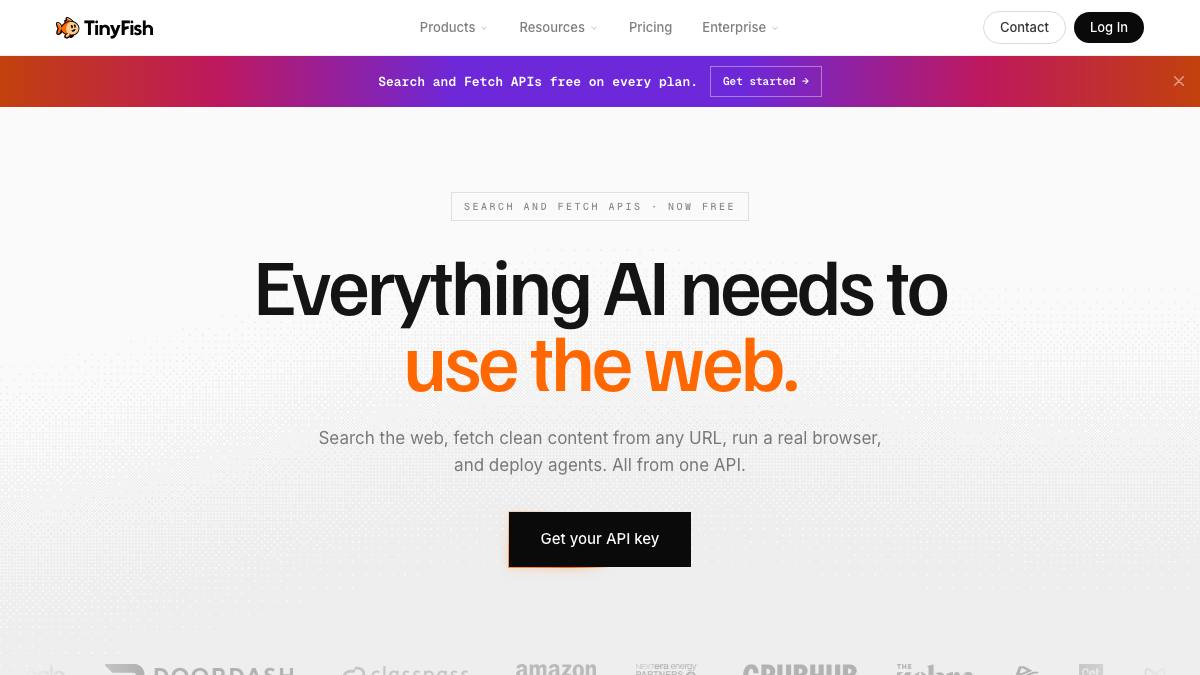
TinyFish is an enterprise web agent infrastructure company. Its agents navigate websites, extract structured data, and execute multi-step workflows across thousands of platforms at once, mapped to business outcomes like competitor price monitoring, inventory aggregation, and real-time market intelligence. The company emphasizes reliability, security, and compliance for large enterprises, and runs in production at Fortune 500 brands across hospitality, transportation, and e-commerce. TinyFish also maintains AgentQL, a developer-facing suite that connects LLMs and agents to the live web using an AI-powered, natural-language query language instead of brittle XPath or CSS selectors. AgentQL self-heals as page layouts change, works on authenticated and JavaScript-rendered pages, and ships as Python and JavaScript SDKs, a REST API, a browser debugger, and an MCP server. TinyFish launched publicly in August 2025 with a $47M Series A led by ICONIQ.
What it can do
Run enterprise web workflows at scale
SupervisedDeploys web agents that navigate sites, extract data, and trigger downstream processes across thousands of platforms simultaneously, mapped to defined business outcomes.
sourceExtract structured data with natural-language queries (AgentQL)
AssistantDevelopers describe wanted data in plain English; AgentQL uses AI-powered DOM analysis to return structured results, working on public, authenticated, and JS-rendered pages.
sourceSelf-heal selectors across site changes
SupervisedNatural-language selectors adapt automatically as page structure changes and can be reused across structurally similar sites, replacing brittle XPath and CSS selectors.
sourceGive agents live web access via MCP and SDKs
SupervisedExposes Search, Fetch, Browser, and Agent tools through one MCP endpoint plus Python/JS SDKs and a REST API so any MCP-compatible client can act on the live web.
source
Strengths
- +Built for production reliability and compliance on dynamic, authenticated pages at enterprise scale
- +AgentQL's natural-language, self-healing selectors cut the maintenance cost of traditional scrapers
- +MCP-native with SDKs and REST API, so it drops into existing agent stacks
Limitations
- −Enterprise platform side is contact-sales with no public self-serve pricing
- −Newly launched (2025) at the company level, so long-term production track record is still building
- −Heavy web automation can raise terms-of-service and compliance questions that buyers must own
Overview
TinyFish (legal name Tiny Fish, Inc.) is a Palo Alto company building enterprise web agent infrastructure. Its agents act like web workers that navigate sites, extract structured data, capture insights, and trigger downstream processes across thousands of platforms at once. It is positioned for large organizations that need this work done with reliability, security, and compliance rather than as a consumer browsing bot.
What it does
On the enterprise side, TinyFish runs production web workflows mapped to business outcomes: aggregating hotel inventory, collecting real-time rideshare pricing, monitoring competitor prices, and gathering market intelligence at scale. On the developer side, its AgentQL product lets you connect LLMs and agents to the live web with an AI-powered, natural-language query language. Instead of brittle XPath or CSS selectors, you describe the data you want; AgentQL analyzes the page structure, returns structured output, works on authenticated and JavaScript-rendered pages, and self-heals as layouts change. AgentQL ships as Python and JavaScript SDKs, a browserless REST API, a Chrome debugger extension, and an MCP server.
Integrations & setup
AgentQL integrates with Playwright and major agent frameworks (LangChain, LlamaIndex, LangFlow, Dify) plus Zapier and n8n. The TinyFish platform is MCP-native: one config change exposes Search, Fetch, Browser, and Agent tools to Claude, Cursor, or any MCP-compatible client, with a direct API for custom integrations.
Pricing
The enterprise platform is contact-sales. AgentQL offers developer plans; check its pricing page for current tiers.
Traction
TinyFish launched publicly in August 2025 with $47M in Series A funding led by ICONIQ, with USVP, Mango Capital, MongoDB Ventures, ASG, and Sandberg Bernthal Venture Partners participating. The company says agents are in production at Fortune 500 brands; named customers in its materials include DoorDash, Grubhub, ClassPass, and The Zebra.
Best for / not for
Best for enterprises that need reliable, compliant web automation across many platforms, and for developers who want robust live-web access for agents. Less suited to small teams wanting a cheap, self-serve scraper, where Firecrawl or lighter tools fit better.
Alternatives
Browserbase provides managed browsers for agents; Firecrawl focuses on web data extraction; Skyvern and Browser-Use target browser automation.
What people are saying
We aggregate real LinkedIn discussion into sentiment for the agents people search most. TinyFish isn't tracked yet, want it added? Request tracking.
Used this agent?
Sign in to upvote, rate, follow, or leave a comment.
FAQ
What is the difference between TinyFish and AgentQL?+
AgentQL is TinyFish's developer-facing query language and SDK suite for connecting LLMs and agents to the live web. TinyFish is the broader enterprise web agent platform and managed infrastructure built on top of that technology for running web workflows at scale.
Are TinyFish agents autonomous?+
They execute multi-step web workflows on their own once configured, which is genuinely agentic, but they run within enterprise-defined scopes and outcomes with human oversight, so in practice they operate as supervised agents.
Sources
- TinyFish (official site) · accessed 2026-06-19
- AgentQL (official site) · accessed 2026-06-19
- AgentQL GitHub (tinyfish-io/agentql) · accessed 2026-06-19
- TinyFish launches with $47M to define the era of enterprise web agents · accessed 2026-06-19
Last reviewed 2026-06-19