Roo Code
by Roo Code, Inc.
Open-source AI coding agent for VS Code (a Cline fork), now archived
Last reviewed 2026-06-20
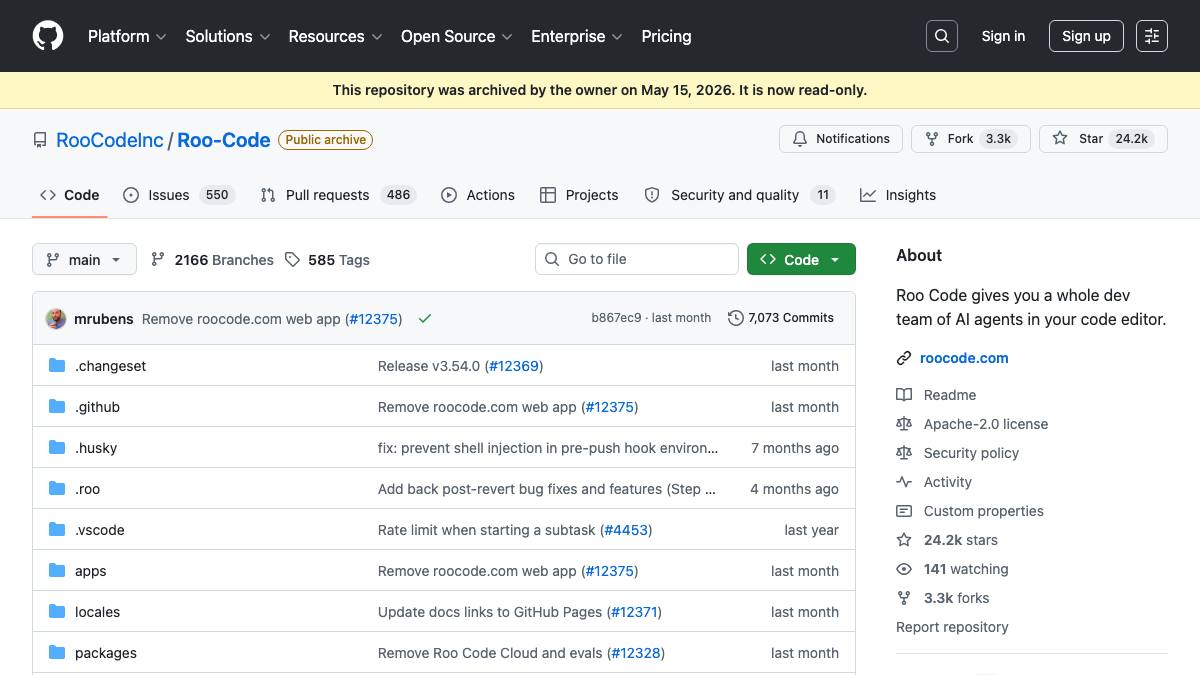
Roo Code was an open-source, model-agnostic AI coding agent that ran as an extension inside VS Code and compatible forks. It started as "Roo Cline," a fork of Cline, and grew into its own project with a multi-mode architecture (Architect, Code, Ask, Debug, and an Orchestrator mode that delegates subtasks), full file-system access, terminal control, MCP support, and per-action approval controls. It was bring-your-own-key: you connected API keys from dozens of model providers rather than paying Roo Code for inference. The project was popular (the GitHub repository reached 24.2k stars and the team reported 3M+ extension installs, citing use at companies like Apple, Netflix, and IBM) but was shut down on May 15, 2026. The maintainers archived the repository and pivoted the company to Roomote, a Slack-and-GitHub cloud agent, stating they no longer believe IDE extensions are the future of coding. They pointed users to Cline (Roo Code's origin) and to community forks such as Zoo Code and Kilo Code. This entry is retained as deprecated with sourced history.
What it can do
Generate, edit, and refactor code across files
SupervisedRead the codebase and create or edit files from natural-language instructions, with diffs the user reviews; risky actions required approval unless auto-approve was enabled.
sourceRun terminal commands and automate tasks
SupervisedExecuted terminal commands and reacted to their output as part of multi-step coding tasks, with an auto-approve setting to reduce per-action prompts.
sourceRole-specific modes including orchestration
SupervisedProvided Architect (read-only planning), Code, Ask, Debug, and custom modes, plus an Orchestrator mode that broke complex work into subtasks delegated to specialized modes.
sourceModel-agnostic, bring-your-own-key with MCP tools
SupervisedCompatible with dozens of providers and hundreds of models via your own API keys, and consumed MCP servers to extend its tool access.
source
Strengths
- +Open source and model-agnostic with no inference markup (bring your own keys)
- +Multi-mode architecture (Architect/Code/Debug/Ask/Orchestrator) with per-mode tool permissions
- +MCP support and customizable modes gave fine-grained control over the agent
Limitations
- −Shut down and archived on May 15, 2026; the extension is no longer maintained
- −Was VS Code-extension only, so it depended on your IDE and local environment
- −Auto-approve could run consequential commands without per-step review
Overview
Roo Code was an open-source AI coding agent that ran as an extension inside VS Code and compatible editors. It started as "Roo Cline," a fork of Cline, and grew its own identity around a multi-mode architecture and deep customization. The GitHub repository reached 24.2k stars and the team reported passing 3M extension installs before the project was shut down and archived on May 15, 2026.
What it does
While active, Roo Code read your codebase, created and edited files from natural-language instructions, ran terminal commands, and answered questions about a project. Its defining feature was role-specific modes: Architect (read-only planning), Code, Ask, and Debug each carried their own tool permissions, and an Orchestrator mode broke complex work into subtasks delegated to specialized modes. It required approval for risky actions, with an auto-approve setting for hands-off runs.
Integrations & setup
Roo Code was model-agnostic and bring-your-own-key: it connected to dozens of providers and hundreds of models (Anthropic, OpenAI, Google Gemini, OpenRouter, AWS Bedrock, and others) via your own API keys, taking no markup on inference. It consumed MCP servers to extend its tool access. It installed from the VS Code Marketplace and ran locally against your environment.
Pricing
The extension was free and open source; users paid their own model providers directly. The company also operated paid Roo Code Cloud and Router services, all of which were shut down on May 15, 2026, with unused balances refunded.
Best for / not for
This is a historical entry. Roo Code is no longer maintained, so it is not recommended for new projects. For an equivalent open, model-agnostic in-IDE agent, see Cline (its origin) or community forks such as Zoo Code and Kilo Code.
Alternatives
Cline is the direct origin and closest equivalent. Continue and Aider are other open-source coding agents; Cursor and Windsurf are AI-native IDEs. The Roo Code team itself recommended Cline and the Zoo Code fork at shutdown.
What people are saying
We aggregate real LinkedIn discussion into sentiment for the agents people search most. Roo Code isn't tracked yet, want it added? Request tracking.
Used this agent?
Sign in to upvote, rate, follow, or leave a comment.
FAQ
Is Roo Code still available?+
No. Roo Code shut down and archived its VS Code extension, cloud, and router on May 15, 2026. The company pivoted to Roomote, a cloud agent. The maintainers recommended Cline (Roo Code's origin) and community forks such as Zoo Code and Kilo Code.
How autonomous was Roo Code?+
It performed multi-step coding work but asked for approval on consequential actions by default, making it a supervised agent. An auto-approve setting allowed more hands-off runs at the user's discretion.
Was Roo Code a fork of Cline?+
Yes. It began as "Roo Cline," a fork of the open-source Cline project, then rebranded to Roo Code as it added multiple modes and deeper customization.
Sources
- RooCodeInc/Roo-Code (GitHub, archived May 15, 2026) · accessed 2026-06-20
- Roo Code Documentation (using modes) · accessed 2026-06-20
- Roomote (successor product by the Roo Code makers) · accessed 2026-06-20
- Roo Code Is Shutting Down on May 15, 2026 (Nerova) · accessed 2026-06-20
- Roo Code Review: Cline Fork for VS Code (Automation Switch) · accessed 2026-06-20
Last reviewed 2026-06-20