Regal
AI phone agents for enterprise inbound and outbound contact centers
Last reviewed 2026-06-19
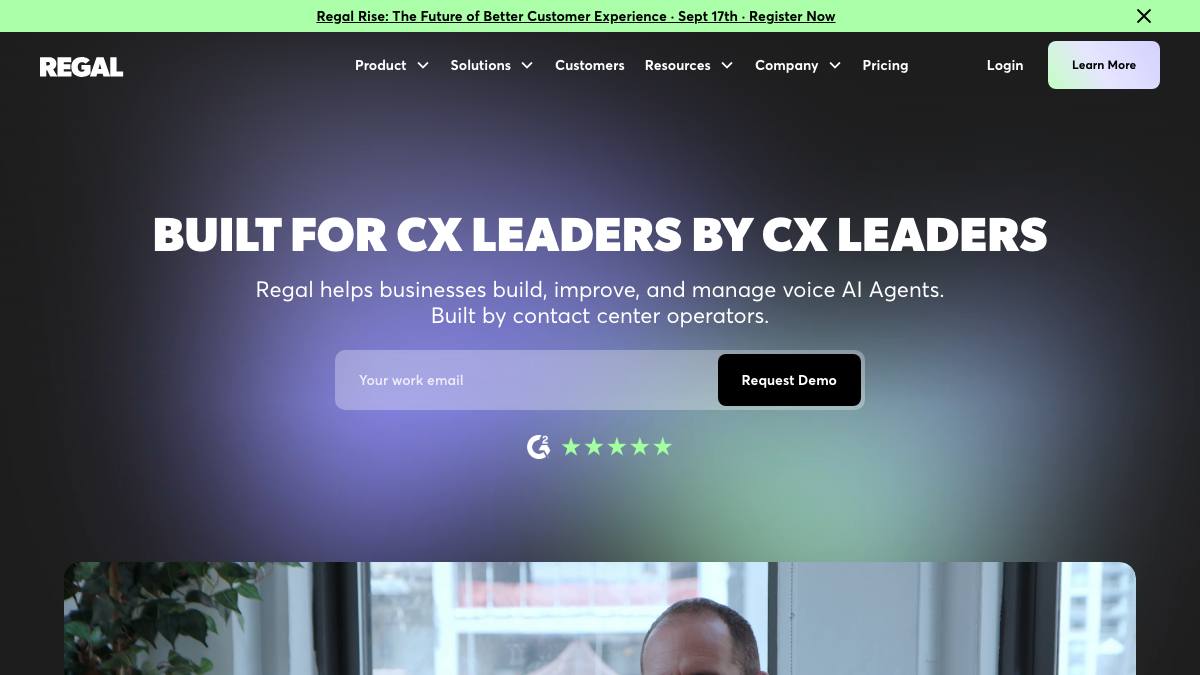
Regal is a contact-center platform whose AI phone agents handle inbound and outbound interactions that act human, blended with human agents. It automates multi-touch journeys for use cases like lead qualification, inbound routing, scheduling, reminders, and payment collection, and orchestrates across SMS/MMS, email, calls, ringless voicemail, video, and webchat. It provides drag-and-drop IVR and outbound journey builders, branded caller ID, a sales dialer, A/B testing, and in-app reporting. On a live call, Regal's AI agent acts end-to-end within its configuration (an autonomous agent for call handling), escalating to humans for complex cases, while building the journeys and agents is a supervised setup task. Regal raised a reported $40M in 2024 to bring AI phone agents to enterprise brands; containment and CSAT figures it cites are vendor-reported.
What it can do
Handle inbound and outbound calls
AutonomousAI agents autonomously handle inbound and outbound phone interactions, blended with human agents, for qualification, routing, scheduling, and reminders.
sourceOrchestrate omnichannel journeys
SupervisedCoordinates multi-touch journeys across SMS/MMS, email, calls, ringless voicemail, video, and webchat with drag-and-drop builders.
sourceCollect payments and recover accounts
AutonomousRuns payment collection and recovery flows as a structured use case for the AI agents.
sourceA/B test and report on interactions
AssistantProvides automatic A/B testing and in-app reporting to optimize journeys and agents.
source
Strengths
- +Handles inbound and outbound at enterprise scale, blending AI and human agents
- +Omnichannel journey orchestration with drag-and-drop builders and branded caller ID
- +Built-in A/B testing and reporting
Limitations
- −Enterprise-oriented with no public pricing
- −Containment and CSAT figures are vendor-reported
- −Setup of journeys and agents requires investment
Overview
Regal is a contact-center platform with AI phone agents for inbound and outbound interactions at enterprise scale. It targets brands that run high call volumes across sales and support.
What it does
Regal's AI agents handle inbound and outbound calls (qualification, routing, scheduling, reminders, collections) blended with human agents, and orchestrate omnichannel journeys across SMS, email, calls, ringless voicemail, video, and webchat. Drag-and-drop builders, branded caller ID, a sales dialer, A/B testing, and reporting round it out. On a live call the agent acts end-to-end within configuration; building journeys is supervised.
Integrations & setup
Connects to CRMs (Salesforce, HubSpot), telephony (Twilio), and data tools (Segment, Snowflake). Journeys and agents are built in the platform against connected data.
Pricing
Enterprise, sales-led, no public pricing.
Best for / not for
Best for mid-market and enterprise contact centers automating inbound and outbound. Less suited to small businesses needing a simple receptionist.
Traction
Regal raised a reported $40M in 2024 to bring AI phone agents to enterprise brands; that figure is from its own announcement. Containment and CSAT figures are vendor-reported.
Alternatives
PolyAI and Leaping AI target enterprise voice; Vapi, Bland, and Retell are developer voice platforms.
What people are saying
We aggregate real LinkedIn discussion into sentiment for the agents people search most. Regal isn't tracked yet, want it added? Request tracking.
Used this agent?
Sign in to upvote, rate, follow, or leave a comment.
FAQ
Is Regal inbound or outbound?+
Both. Its AI phone agents handle inbound triage and routing as well as outbound sales, qualification, scheduling, reminders, and collections, blended with human agents.
Are Regal's agents autonomous?+
On a live call they act end-to-end within configuration, escalating complex cases to humans. Designing the journeys and agents is a supervised setup task.
Sources
- Regal (official site) · accessed 2026-06-19
- Regal raises $40M for AI phone agents (Regal blog) · accessed 2026-06-19
- Regal features & pricing (SaaSworthy) · accessed 2026-06-19
Last reviewed 2026-06-19