Pinecone
by Pinecone Systems, Inc.
Managed vector database for semantic search, RAG, and AI agent memory
Last reviewed 2026-06-20
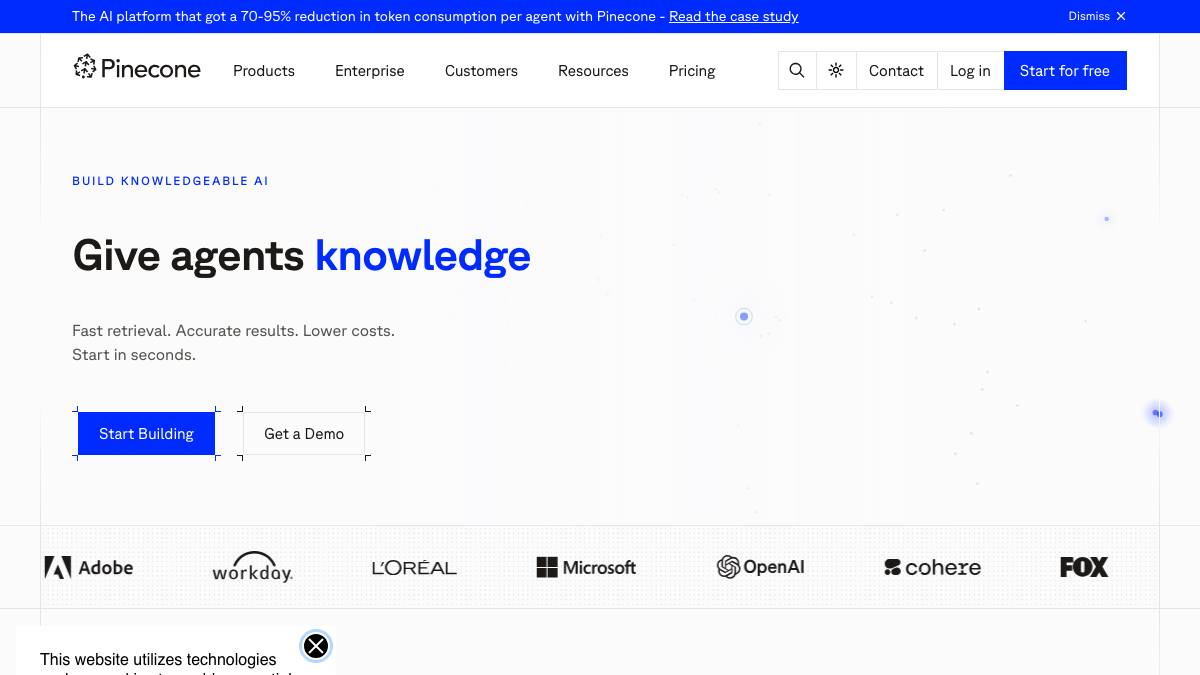
Pinecone is a fully managed vector database that stores and searches embeddings (numeric representations of text, images, and other data) so developers can build semantic search, recommendation, and retrieval-augmented generation (RAG) applications without running their own search infrastructure. Its serverless architecture separates storage from compute, scales automatically with request volume, and supports dense and sparse indexing, metadata filtering, hybrid (semantic plus keyword) search, and real-time updates across billions of vectors. The platform has expanded beyond a raw index into a broader knowledge layer for AI applications. Pinecone Assistant provides a managed RAG and retrieval service, hosted Pinecone Inference generates embeddings and reranks results in-platform, and Pinecone Nexus (announced May 2026) targets agentic retrieval with a declarative query language called KnowQL. Pinecone is aimed primarily at developers and engineering teams building production AI features. Founded in 2019 by Edo Liberty and headquartered in New York, it serves a reported 9,000+ customers.
What it can do
Managed serverless vector storage and search
AssistantStores and searches embeddings across billions of vectors via a simple API, with a serverless architecture that separates storage from compute and scales with request volume.
sourceDense, sparse, and hybrid retrieval with metadata filtering
AssistantSupports dense and sparse vector indexing, keyword/full-text search, hybrid retrieval, and metadata filtering across multi-tenant namespaces with real-time updates searchable within seconds.
sourcePinecone Assistant for RAG
AssistantA managed knowledge layer that handles chunking, embedding, retrieval, and answer generation so developers can build RAG chatbots and assistants without assembling the pipeline themselves.
sourceHosted inference (embedding and reranking)
AssistantPinecone Inference generates embeddings and reranks results in-platform, supporting models such as Pinecone's own sparse model and third-party embedding models, reducing pipeline complexity.
sourcePinecone Nexus knowledge engine for agents
SupervisedAnnounced May 2026, Nexus targets agentic retrieval via a declarative query language (KnowQL); Pinecone reports task-completion and latency gains for agents, figures that are vendor-stated and not independently verified.
sourceMCP server for agents and IDEs
SupervisedPinecone ships an MCP server so MCP-compatible LLM clients and coding agents can query indexes and documentation, exposing vector search to agent runtimes.
source
Strengths
- +Fully managed and serverless: no infrastructure to run, with automatic scaling and pay-per-use consumption
- +Mature, well-documented ecosystem with first-party LangChain, LlamaIndex, and Haystack integrations
- +Adds higher-level layers (Assistant, hosted Inference, Nexus) so teams can skip building a retrieval pipeline from scratch
Limitations
- −Usage-based reads/writes/storage plus minimum monthly commitments can make costs hard to predict and pricier than self-hosted open-source alternatives
- −A $50/mo minimum on the Standard plan (introduced in 2025) drew complaints from hobby and small-scale users
- −It is retrieval infrastructure, not an autonomous agent; the intelligence and orchestration live in the application built on top
Overview
Pinecone is a fully managed vector database: it stores embeddings (numeric representations of text, images, and other data) and lets developers search them for similar items in milliseconds. It is the retrieval/memory layer many semantic-search, recommendation, and RAG (retrieval-augmented generation) systems are built on. Founded in 2019 by Edo Liberty and based in New York, Pinecone reports more than 9,000 customers.
What it does
The core product is a serverless index that separates storage from compute and scales with request volume, supporting dense and sparse vectors, hybrid (semantic plus keyword) search, metadata filtering, and real-time updates across billions of vectors and millions of namespaces. On top of the index sit higher-level products: Pinecone Assistant handles the full RAG pipeline (chunking, embedding, retrieval, answer generation); Pinecone Inference generates embeddings and reranks results in-platform; and Pinecone Nexus (announced May 2026) targets agentic retrieval with a declarative query language called KnowQL. Pinecone reports large task-completion and latency gains for Nexus, but those are vendor-stated figures and not independently verified. Pinecone is infrastructure, not an agent: it answers retrieval queries and does not plan or act on its own, so its autonomy is assistant-level.
Integrations & setup
Pinecone exposes REST APIs and SDKs in multiple languages, plus an MCP server so MCP-compatible clients and coding agents can query indexes. It has first-party integrations with LangChain, LlamaIndex, and Haystack for RAG orchestration, and runs on AWS, Google Cloud, and Azure, with a Bring Your Own Cloud (BYOC) option for customer-managed accounts. Hosted Inference supports first- and third-party embedding and reranking models, so teams can keep embedding and storage in one platform.
Pricing
Freemium with usage-based scaling. The Starter tier is free with capped storage and read/write units. Builder is a flat $20/month with higher limits. Standard carries a $50/month minimum plus pay-as-you-go (storage at $0.33/GB/month, with reads and writes metered per million units) and adds Dedicated Read Nodes, backup/restore, RBAC, and SSO. Enterprise starts at a $500/month minimum with a 99.95% uptime SLA and private networking. The 2025 introduction of the $50/month Standard minimum drew pushback from small-scale users.
Best for / not for
Best for developers and engineering teams that want a managed, scalable retrieval layer for RAG, semantic search, or agent memory without operating their own search infrastructure. Less suited to hobbyists or very small workloads sensitive to the monthly minimums, or to teams that prefer to self-host an open-source vector store (Weaviate, Qdrant, Chroma, Milvus) for cost or control reasons.
Alternatives
Weaviate, Qdrant, Chroma, and Milvus are the main vector-database alternatives, each offering self-hosted and managed options. LangChain and LlamaIndex are not competitors but the orchestration frameworks most commonly used alongside Pinecone.
What people are saying
We aggregate real LinkedIn discussion into sentiment for the agents people search most. Pinecone isn't tracked yet, want it added? Request tracking.
Used this agent?
Sign in to upvote, rate, follow, or leave a comment.
FAQ
Is Pinecone an AI agent?+
No. Pinecone is a managed vector database and retrieval platform. It supplies the knowledge/memory layer (semantic search, RAG, and agent retrieval via Nexus) that AI agents and applications call, but it does not itself plan or take actions. Its core function is best described as an assistant-level retrieval tool.
What is Pinecone used for?+
Storing and searching vector embeddings to power semantic search, recommendations, and retrieval-augmented generation (RAG). Developers use it to give LLM applications and agents fast, filtered access to domain-specific or up-to-date data.
How much does Pinecone cost?+
Pinecone is freemium. There is a free Starter tier, a Builder tier at $20/month, a Standard plan with a $50/month minimum plus usage, and an Enterprise plan starting around a $500/month minimum, with custom Bring Your Own Cloud (BYOC) pricing. Paid usage is metered per read unit, write unit, and gigabyte of storage.
Sources
- Pinecone (official site) · accessed 2026-06-20
- Pinecone pricing · accessed 2026-06-20
- Pinecone RAG solution · accessed 2026-06-20
- Pinecone Nexus: The Knowledge Engine for Agents · accessed 2026-06-20
- Pinecone raises $100M Series B (newsroom) · accessed 2026-06-20
Last reviewed 2026-06-20