Pieces
by Mesh Intelligent Technologies, Inc.
On-device AI long-term memory and copilot for developers
Last reviewed 2026-06-20
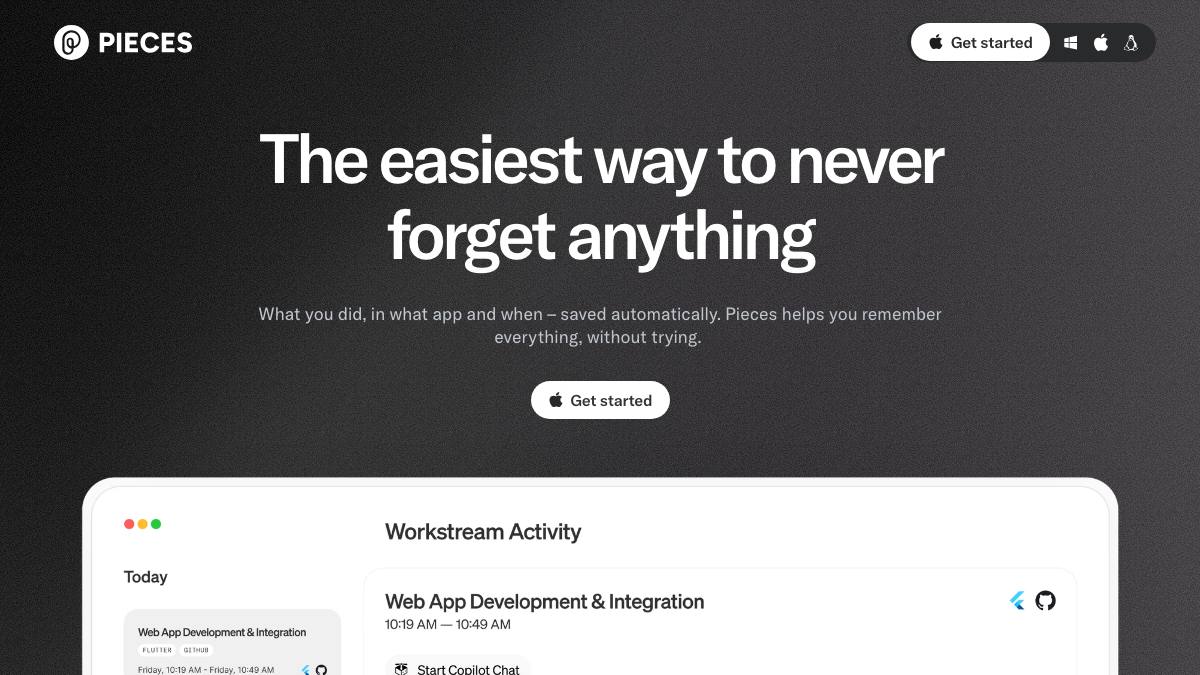
Pieces (Pieces for Developers) is a desktop AI tool that gives developers an on-device long-term memory of their workflow. A background engine the company calls LTM-2 captures context from the apps you use (IDEs, browsers, terminals, and chat tools), keeps a rolling window of roughly nine months, and lets you query it in natural language, including time-based prompts like asking what you were working on last week. A built-in copilot answers questions, drafts and explains code, and can ground its responses in that captured context. Pieces runs locally and is marketed as air-gapped from the cloud by default: capture and storage happen on-device, context is encrypted, and the vendor says it filters out API keys and personally identifiable information. It works offline with local models and can also use cloud models when you opt in. Pieces also exposes its local memory to other AI clients (Cursor, Claude Desktop, GitHub Copilot, and others) through a Model Context Protocol (MCP) server. The product is free for individual developers, with a paid Teams plan. The company, legally Mesh Intelligent Technologies, Inc., is based in Cincinnati, Ohio.
What it can do
Capture workflow context on-device
CopilotA background engine the vendor calls LTM-2 captures context at the OS level from IDEs, browsers, terminals, and chat apps, processing and storing it locally. The vendor says no screenshots are saved and that it only captures while running.
sourceRecall a rolling long-term memory
CopilotLets developers query roughly nine months of captured activity in natural language, including time-based queries such as a summary of what you worked on in the last seven days, and retrieve links or documents seen months earlier.
sourceAnswer and draft code with a copilot
CopilotA conversational copilot answers questions, explains and generates code, and grounds responses in captured context; the developer reviews and applies suggestions.
sourceManage and reuse code snippets
AssistantSaves, enriches, tags, and searches code snippets and other materials so they can be reused across tools.
sourceExpose local memory to other AI clients via MCP
CopilotShips an MCP server so external clients (Cursor, Claude Desktop, GitHub Copilot, Goose, Codex CLI) can access Pieces' local long-term memory as context.
source
Strengths
- +Local, on-device processing positioned as air-gapped and privacy-first (encrypted, with PII and API-key filtering per the vendor)
- +Cross-tool memory that spans IDEs, browsers, terminals, and chat apps, not just one editor
- +Works offline with local models and is model-agnostic (local Llama, plus GPT, Claude, Gemini)
- +Free for individual developers, and exposes its memory to other AI clients via MCP
Limitations
- −Memory only captures while the app is running and is capped at a rolling ~9-month window
- −Copilot assists and recalls; it does not take autonomous actions on your behalf
- −Public pricing for the Teams plan is contact-sales only
- −Broad OS-level capture may raise data-governance questions in some organizations
Overview
Pieces (Pieces for Developers) is a desktop tool that gives developers an on-device long-term memory plus a copilot. Its background engine, which the vendor calls LTM-2, captures context from the tools you already use, keeps a rolling window of about nine months, and lets you ask questions about your own past work in natural language. The company, legally Mesh Intelligent Technologies, Inc., is based in Cincinnati, Ohio, and was founded in 2020.
What it does
Three things sit at the core. First, capture: a background engine records context at the OS level from IDEs, browsers, terminals, and chat apps, processing and storing it locally (the vendor says no screenshots are saved and capture only happens while it is running). Second, recall: you can query that memory conversationally, including time-based prompts such as a summary of the last seven days, or retrieve a page you looked at months ago. Third, the copilot: it answers questions, explains and generates code, and grounds answers in the captured context, with the developer reviewing and applying suggestions. It also manages and enriches saved code snippets. Autonomy is copilot-level throughout: it assists and recalls, it does not take autonomous actions.
Integrations & setup
Pieces installs as a desktop app on Windows, macOS, and Linux, with plugins for VS Code, JetBrains IDEs, the Chrome browser, JupyterLab, Obsidian, and more. It is model-agnostic: you can run local models (for example Llama) fully offline, or opt into cloud models from OpenAI, Anthropic, and Google. It ships a Model Context Protocol (MCP) server, so external clients like Cursor, Claude Desktop, GitHub Copilot, Goose, and Codex CLI can pull Pieces' local memory in as context.
Pricing
Pieces is free for individual developers (nine months of individual context, basic copilot, desktop app). A paid Teams plan adds team-wide context, the option to bring your own model or pick a preferred LLM, and priority support; its price is contact-sales only as of this review.
Best for / not for
Best for individual developers and small teams who want a private, local memory layer across their whole toolchain and a copilot that knows what they have been working on, especially where on-device and offline processing matters. Less suited to anyone wanting a fully autonomous coding agent that edits and ships code on its own, or to organizations uncomfortable with broad OS-level capture without a clear governance review.
Alternatives
Closest active alternatives include GitHub Copilot, Sourcegraph Cody, Continue, and Tabnine as in-IDE assistants, though Pieces' differentiator is the cross-tool, on-device long-term memory rather than completion alone.
What people are saying
We aggregate real LinkedIn discussion into sentiment for the agents people search most. Pieces isn't tracked yet, want it added? Request tracking.
Used this agent?
Sign in to upvote, rate, follow, or leave a comment.
FAQ
Does Pieces run locally or in the cloud?+
It runs locally. The vendor describes it as on-device and air-gapped from the cloud by default: capture and storage happen on your machine, context is encrypted, and cloud models are only used when you opt in. It can run fully offline with local models.
Is Pieces an autonomous agent?+
No. Pieces is a copilot and a memory layer. It captures context, recalls it on request, and drafts or explains code, but the developer reviews and applies its output; it does not act end-to-end without approval.
What does the long-term memory actually remember?+
Roughly nine months of your workflow context captured while Pieces is running: code, notes, links, documents, and conversations across IDEs, browsers, terminals, and chat apps. It cannot recall anything from before installation or while memory is paused.
Is Pieces free?+
It is free for individual developers. There is a paid Teams plan with team-wide context and priority support, priced via contact sales as of this review.
Sources
- Pieces (official site) · accessed 2026-06-20
- Pieces Long-Term Memory feature · accessed 2026-06-20
- Pieces AI Memory Assistant (long-term memory details) · accessed 2026-06-20
- Pieces pricing · accessed 2026-06-20
- Pieces on GitHub · accessed 2026-06-20
Last reviewed 2026-06-20