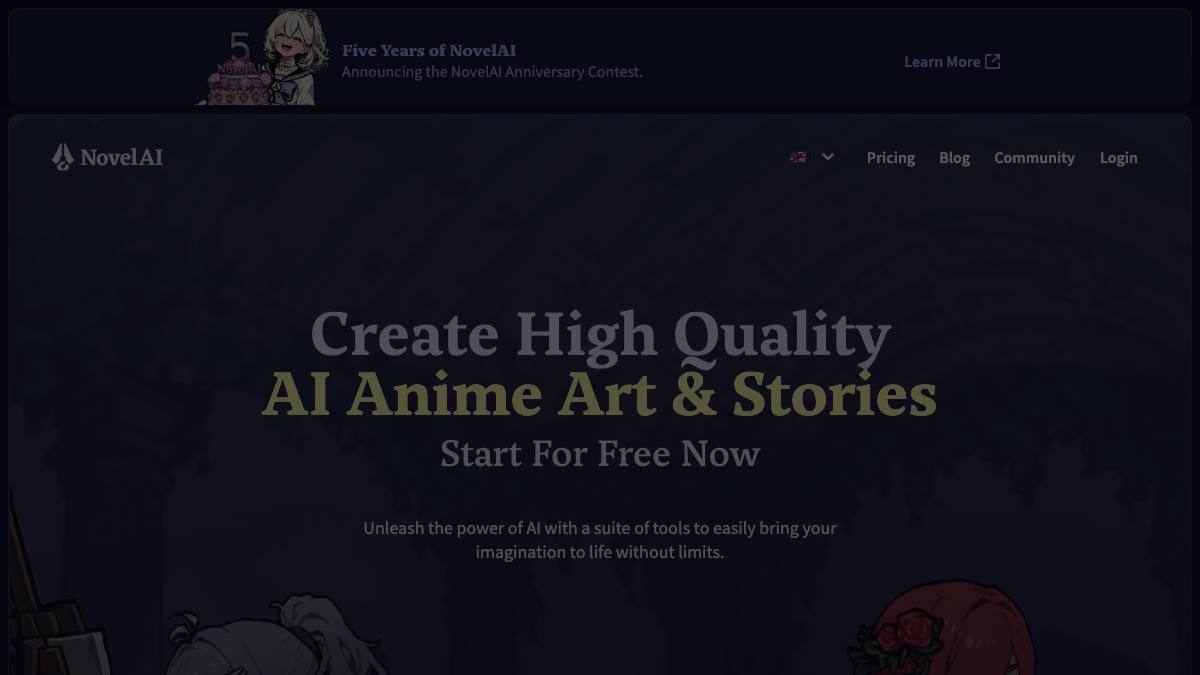
NovelAI
by Anlatan
Subscription AI for anime image generation and collaborative story writing
Last reviewed 2026-06-20
NovelAI is a subscription web app for AI-assisted creative writing and anime-style image generation, run by Anlatan. On the text side, a person writes prose and the model continues the story on request; users steer it with a memory field, author's note, and a Lorebook (structured character, location, and worldbuilding entries the model pulls in for consistency). Its current high-end text model, Erato, is based on Meta's Llama 3 70B and was released in September 2024. On the image side, NovelAI Diffusion (a custom Stable Diffusion derivative, latest V4.5) generates anime and illustration-style images from text prompts, with image-to-image, inpainting, vibe transfer, and a built-in canvas editor. NovelAI is a creative tool, not an autonomous agent: every output is generated when the user asks and is then curated, re-rolled, or edited by hand. It is popular with hobbyist fiction writers, roleplayers, and anime-art enthusiasts, partly because it imposes few content restrictions and emphasizes privacy (encrypted text storage, generated images not retained on its servers). Anlatan is a Delaware-registered company; NovelAI launched in 2021, added image generation in October 2022, and suffered a source-code leak that same month. It has drawn criticism for training its image model on the Danbooru dataset without artist consent.
What it can do
Continue stories from user prose
AssistantThe text editor generates the next passage of a story on demand, steered by a memory field, author's note, and module presets; the writer accepts, edits, or re-rolls each output. The high-end model is Erato, based on Llama 3 70B (released September 2024).
sourceMaintain story consistency with Lorebook
AssistantUsers create structured Lorebook entries (characters, locations, worldbuilding rules) that the model automatically references when relevant keywords appear, keeping details consistent across a long story.
sourceGenerate anime-style images from prompts
AssistantNovelAI Diffusion (a custom Stable Diffusion derivative, latest V4.5) creates anime and illustration-style images from text prompts, with multi-character prompting, image-to-image, and up to 1024x1024 resolution on lower tiers.
sourceEdit and refine generated images
AssistantA purpose-built canvas supports inpainting, image-to-image adjustment, vibe transfer (pulling aesthetics from a reference generation), and post-generation tools such as background removal, line art, colorize, and emotion, all under direct human control.
sourceRead text aloud (TTS)
AssistantA customizable AI voice narrates user input and generated story text aloud; availability and generation counts vary by tier, with a limited number included on the free trial.
source
Strengths
- +Strong tooling for long-form fiction: Lorebook, memory, author's note, and modules keep characters and world details consistent
- +Well-regarded anime and illustration image generation (NovelAI Diffusion V4.5) with inpainting, vibe transfer, and a built-in canvas editor
- +Few content restrictions and a privacy-first stance (encrypted text storage; generated images reportedly not retained on its servers)
Limitations
- −An assistant, not an autonomous agent: the user prompts, curates, and edits every story passage and image
- −Image generation is metered by Anlas credits on most plans, and the strongest text model (Erato) is gated to higher tiers
- −Its image model was trained on the Danbooru dataset without artist consent, and the platform can produce content many find objectionable
Overview
NovelAI is a subscription web app for AI-assisted creative writing and anime-style image generation, made by Anlatan (a Delaware-registered company). It launched in 2021 as a text-generation tool for collaborative fiction and added image generation in October 2022. It is popular with hobbyist writers, roleplayers, and anime-art enthusiasts, in part because it imposes few content restrictions and leans on a privacy-first message (encrypted text storage, generated images reportedly not kept on its servers).
What it does
On the text side, the writer enters prose and the model continues the story on request. Output is steered by a memory field, an author's note, module presets, and a Lorebook: structured entries for characters, locations, and worldbuilding rules that the model automatically pulls in for consistency across a long story. The current high-end text model is Erato, based on Meta's Llama 3 70B and released in September 2024, alongside older in-house models. On the image side, NovelAI Diffusion (a custom Stable Diffusion derivative, latest V4.5) generates anime and illustration-style images from text prompts, with multi-character prompting, image-to-image, inpainting, vibe transfer, and post-generation tools (background removal, line art, colorize, emotion) on a purpose-built canvas. A customizable text-to-speech voice can narrate stories aloud. Throughout, the human prompts and curates: NovelAI is an assistant, not an autonomous agent.
Integrations & setup
NovelAI runs as a hosted web app at novelai.net with no setup beyond an account. It is not designed to embed into other products and does not advertise a marketplace of integrations; an unofficial REST API exists and community Python SDKs wrap it, but there is no broad first-party integration ecosystem. It runs on Anlatan's own hosted models (the Erato text model derived from Llama 3, and the NovelAI Diffusion image models).
Pricing
Freemium. A free Paper trial grants a fixed number of text, image, and text-to-speech generations. Paid tiers are Tablet ($10/month), Scroll ($15/month), and Opus ($25/month). Higher tiers add larger context sizes (Opus advertises up to 28,672 tokens), more monthly Anlas (the credit consumed by image generation: 1,000 on Tablet and Scroll, 10,000 on Opus), access to better text models, and, on Opus, free generation of normal-sized images under certain limits. Annual billing is discounted.
Best for / not for
Best for hobbyist fiction writers, interactive-fiction and roleplay users, and anime-art creators who want strong long-form story tooling (Lorebook, memory, modules) plus capable anime image generation with few content limits. Less suited to teams wanting marketing-copy workflows or brand controls (see Jasper or Copy.ai), to anyone needing a deep integration ecosystem or business deployment, or to users uncomfortable with image models trained on scraped art (NovelAI Diffusion was trained on the Danbooru dataset without artist consent).
Alternatives
Character.AI is a closer fit for conversational roleplay; Midjourney and Leonardo.Ai are general-purpose image generators (Midjourney is more painterly, NovelAI more anime-specialized); Jasper targets marketing copy rather than fiction.
What people are saying
We aggregate real LinkedIn discussion into sentiment for the agents people search most. NovelAI isn't tracked yet, want it added? Request tracking.
Used this agent?
Sign in to upvote, rate, follow, or leave a comment.
FAQ
Is NovelAI an AI agent?+
No. It is a creative generation tool for stories and anime images. A person writes or prompts, the model produces a passage or image, and the user then curates, edits, or re-rolls it. It operates at the assistant level with no independent multi-step action.
What models does NovelAI use?+
For text, its high-end model is Erato (released September 2024), based on Meta's Llama 3 70B and finetuned on NovelAI's storytelling dataset, alongside older in-house models. For images, it uses NovelAI Diffusion (latest V4.5), a custom Stable Diffusion derivative trained for anime and illustration styles.
How much does NovelAI cost and is there a free tier?+
There is a free Paper trial (a fixed number of text, image, and TTS generations). Paid plans are Tablet ($10/month), Scroll ($15/month), and Opus ($25/month), with larger context sizes, more Anlas image credits, and access to better models at higher tiers; annual billing is discounted.
Sources
- NovelAI (official site) · accessed 2026-06-20
- NovelAI (Wikipedia) · accessed 2026-06-20
- NovelAI Text Models documentation · accessed 2026-06-20
- NovelAI Subscription documentation · accessed 2026-06-20
- NovelAI Image Generation documentation · accessed 2026-06-20
Last reviewed 2026-06-20