LangSmith
by LangChain, Inc.
Framework-agnostic platform to trace, evaluate, and deploy LLM agents
Last reviewed 2026-06-20
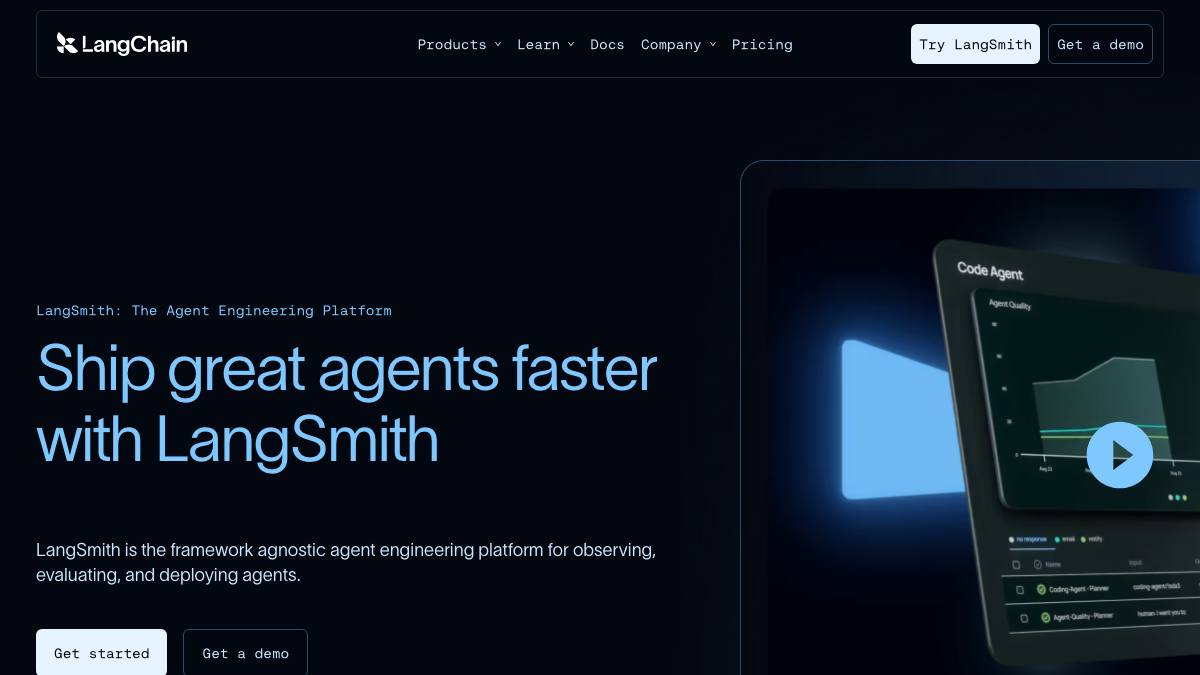
LangSmith is an observability, evaluation, and deployment platform for LLM applications and agents, built by the team behind LangChain. It captures detailed traces of every model call, tool use, and agent step, then surfaces cost, latency, error, and quality metrics so teams can debug failures and catch regressions before they reach users. Although it integrates tightly with LangChain and LangGraph, it is framework-agnostic: you can instrument any stack via its Python, TypeScript, Go, and Java SDKs or by sending OpenTelemetry traces to its endpoint. Beyond tracing, LangSmith offers evaluation tooling (LLM-as-judge and code-based evaluators, dataset runs, side-by-side comparisons, and human annotation), prompt management, monitoring dashboards, and managed deployment for serving agents in production with human-in-the-loop approvals. It is developer tooling, not an end-user agent: it observes and tests the agents you build, and the deployment layer runs them, but the autonomy of any agent depends on what the developer designs.
What it can do
Trace LLM and agent runs
AssistantCaptures full traces of model calls, tool calls, retrieval steps, and multi-step agent loops, with cost, latency, and error metrics. Works with LangChain/LangGraph natively or any framework via SDKs and OpenTelemetry ingestion.
sourceEvaluate agent quality
AssistantRuns LLM-as-judge and code-based evaluators against datasets, supports side-by-side comparisons, and lets subject-matter experts annotate traces to catch regressions before release.
sourceManage prompts and experiments
AssistantProvides a prompt playground, versioning, and experiment tracking so teams can iterate on prompts and compare runs.
sourceDeploy and serve agents
SupervisedManaged deployment runs agents in production with human-in-the-loop approvals, background agents, and horizontal scaling; the deployment layer runs developer-built agents rather than acting on its own.
source
Strengths
- +Framework-agnostic tracing via SDKs and OpenTelemetry, not locked to LangChain
- +Combines observability and evaluation in one platform with dataset-based regression testing
- +Self-hosted and hybrid (BYOC) deployment for data-residency and compliance needs
Limitations
- −Usage-based trace pricing can grow quickly at production volume
- −Deepest integration is with LangChain/LangGraph; other stacks need OTEL or SDK setup
- −Developer tooling, not an end-user product: value depends on the agent you build
Overview
LangSmith is an observability, evaluation, and deployment platform for LLM applications and agents, built by LangChain, Inc. It reached general availability with paid plans in July 2024. It is developer tooling that observes, tests, and runs the agents you build rather than an end-user agent itself.
What it does
LangSmith captures full traces of model calls, tool calls, retrieval steps, and multi-step agent loops, with cost, latency, and error metrics for debugging and monitoring. Its evaluation suite runs LLM-as-judge and code-based evaluators against datasets, supports side-by-side comparisons, and lets subject-matter experts annotate traces to catch regressions before release. It also provides prompt management and experiment tracking, plus a managed deployment layer that serves agents in production with human-in-the-loop approvals, background agents, and horizontal scaling.
Integrations & setup
LangSmith integrates natively with LangChain and LangGraph, but is framework-agnostic: you can instrument any stack with its Python, TypeScript, Go, and Java SDKs, or point an OpenTelemetry-compatible exporter at its OTEL endpoint to ingest traces. It supports MCP, A2A, and Agent Protocol for agent communication, and offers enterprise controls including SSO/SAML, SCIM, RBAC/ABAC, audit logs, and HIPAA/GDPR compliance.
Pricing
Freemium. The Developer tier is $0 per seat with up to 5,000 base traces per month then pay-as-you-go (1 seat). Plus is $39 per seat per month with up to 10,000 base traces, then pay-as-you-go (base traces are $2.50 per 1,000, with extended 400-day-retention traces at $5.00 per 1,000). Enterprise is custom-priced and unlocks hybrid/self-hosted hosting, custom SSO/RBAC, and SLAs. Pricing reflects the published pricing page as of the review date.
Best for / not for
Best for engineering teams building LLM apps and agents who need production tracing, evaluation, and regression testing in one place, especially LangChain/LangGraph users and teams needing self-hosted or BYOC deployment. Less suited to non-developers or anyone wanting a turnkey end-user agent; very high trace volumes should model usage-based costs.
Alternatives
Langfuse is an open-source LLM observability alternative; Braintrust focuses on eval-first workflows; Helicone offers lightweight proxy-based observability; Arize Phoenix targets ML/LLM observability and tracing.
What people are saying
We aggregate real LinkedIn discussion into sentiment for the agents people search most. LangSmith isn't tracked yet, want it added? Request tracking.
Used this agent?
Sign in to upvote, rate, follow, or leave a comment.
FAQ
Is LangSmith only for LangChain users?+
No. LangSmith is framework-agnostic. It integrates natively with LangChain and LangGraph, but you can trace any stack via its Python, TypeScript, Go, and Java SDKs or by sending OpenTelemetry traces to its endpoint.
Is LangSmith free?+
It is freemium. The Developer tier is $0 per seat with up to 5,000 base traces per month and then pay-as-you-go; the Plus tier is $39 per seat per month, and Enterprise is custom-priced.
Can LangSmith be self-hosted?+
Yes. It offers managed SaaS (with US and EU data residency), hybrid/bring-your-own-cloud, and fully self-hosted deployment, typically under Enterprise plans for teams with data-residency requirements.
Sources
- LangSmith: AI Agent & LLM Observability and Evals Platform (official) · accessed 2026-06-20
- LangSmith pricing · accessed 2026-06-20
- LangSmith Observability docs · accessed 2026-06-20
- Introducing OpenTelemetry support for LangSmith (LangChain blog) · accessed 2026-06-20
Last reviewed 2026-06-20