Hedra
Omnimodal studio for talking, singing AI character videos plus a creative agent
Last reviewed 2026-06-20
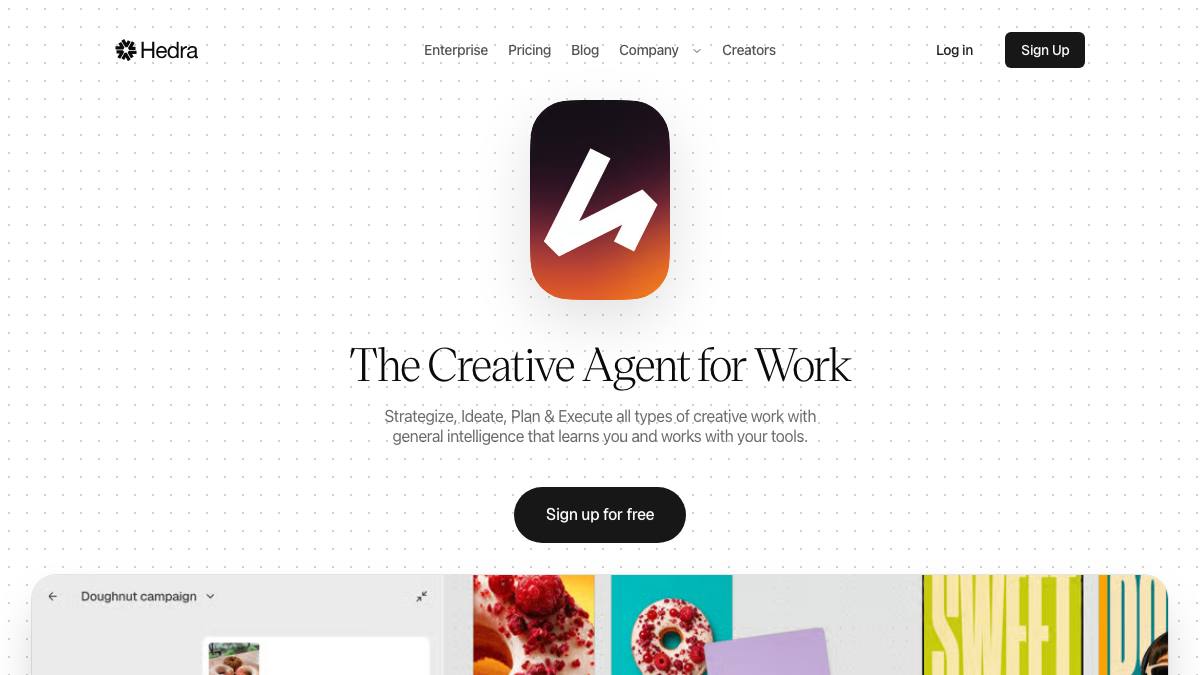
Hedra is a generative-media platform for character-driven video, built around Character-3, its proprietary omnimodal model that fuses image, text, and audio to produce talking, singing, and rapping characters with lip-sync, micro-expressions, and full-body motion from a single still image. Alongside its own model it integrates third-party generators (Kling, Google Veo, Nano Banana) and adds image, voice, and real-time Live Avatars in one credit-shared studio, aimed at creators, marketers, and developers via an API. Historically a prompt-and-render generation tool (a human supplies a script, image, or audio and the model produces a clip), Hedra has more recently positioned itself as a "creative agent for work" that plans and executes multi-step creative workflows across models, learns user preferences, and reuses brand elements. That agent layer is supervised: a human sets up and reviews the creative output rather than the system shipping campaigns end-to-end on its own.
What it can do
Generate talking and singing character videos (Character-3)
AssistantCharacter-3, described as the first omnimodal model in production, fuses image, text, and audio to animate a single still image into a talking, singing, or rapping character with lip-sync, micro-expressions, eye movement, and full-body motion.
sourceReal-time Live Avatars
SupervisedLive Avatars stream a character speaking in real time in response to live spoken or typed input, with the vendor citing sub-100ms latency; developers can pair any LLM and TTS engine (via LiveKit Agents) to build visual AI agents that look and speak as a consistent character.
sourceMulti-model creative studio
AssistantOne credit-shared studio runs Hedra's Character-3 alongside integrated third-party models including Kling (video), Google Veo (video), and Nano Banana (image), so users can generate image, video, and voice without separate subscriptions.
sourceCreative agent that plans and orchestrates workflows
SupervisedHedra markets a creative agent that strategizes, ideates, plans, and executes creative work across models, learns user preferences, reuses brand elements, and can do web search and skill creation; the human sets up and reviews the output, so it operates as a supervised assistant rather than acting end-to-end.
sourceCharacter-3 video API for developers
AssistantA REST API exposes character generation (and Live Avatars) so developers can build Hedra video into their own apps; it requires a paid account, an API key, and purchased API credits.
source
Strengths
- +Character-3 produces strong talking and singing lip-sync with expressive faces and full-body motion from a single image
- +One studio with shared credits spanning Hedra's model plus integrated Kling, Veo, and Nano Banana for image, video, and voice
- +Real-time Live Avatars and a developer API (model-agnostic LLM/TTS via LiveKit) for building visual AI agents
Limitations
- −Core experience is prompt-and-render generation, not hands-off autonomy, despite the newer 'creative agent' framing
- −Credit-based plans do not roll over month to month, which can pinch heavy users
- −AI character output can still read as synthetic for high-end brand or film work
Overview
Hedra (founded 2023, San Francisco; founder/CEO Michael Lingelbach) is a generative-media platform for character-driven video. Its core is Character-3, a proprietary omnimodal model that the company describes as the first in production to fuse image, text, and audio at once, turning a single still image into a talking, singing, or rapping character. Hedra raised a $32M Series A led by a16z Infrastructure in May 2025 (around $44M total, with Index Ventures, Abstract, a16z Speedrun, and the Amazon Alexa Fund). The homepage cites use by over 125k businesses; treat that as company-stated, not independently audited.
What it does
Character-3 generates expressive talking and singing avatars with lip-sync, micro-expressions, eye movement, and full-body motion from one image plus audio or a script. Around that, Hedra runs a multi-model studio: a single, credit-shared workspace that also calls integrated third-party generators including Kling (video), Google Veo (video), and Nano Banana (image), plus image and voice generation. Live Avatars (launched July 2025) stream a character speaking in real time in response to live input, with the vendor citing sub-100ms latency; developers can pair any LLM and TTS engine through the LiveKit Agents framework to build visual AI agents. More recently Hedra has positioned itself as a "creative agent for work" that plans and executes creative workflows across models, learns user preferences, and reuses brand elements.
Integrations & setup
Self-serve web studio plus a REST API. The studio bundles Hedra's own model with Kling, Veo, and Nano Banana under shared credits, so there are no separate per-model subscriptions. The API exposes Character-3 generation and Live Avatars and requires a paid account, an API key, and purchased API credits. Live Avatars integrate with LiveKit Agents and are model-agnostic on the LLM/TTS side (OpenAI, Gemini, Claude, etc.).
Pricing
Freemium. Paid individual plans (monthly) run Basic $15/mo (1500 credits), Creator $30/mo (5400 credits), and Professional $75/mo (14400 credits); Teams is $75/mo and Enterprise is custom (dedicated support, private deployments, SSO). Subscription credits do not roll over between cycles, but purchased credit packs do not expire, and commercial use is permitted on paid tiers. Live Avatars have been cited at around $0.05/minute.
Best for / not for
Best for creators, marketers, and developers who want expressive talking or singing character videos from a single image, a multi-model studio under one credit pool, or real-time visual AI agents via an API. Less suited to teams needing fully hands-off, end-to-end autonomy, or to high-end brand film where synthetic tells still matter.
Alternatives
D-ID and HeyGen are the closest avatar-video competitors; Creatify overlaps on AI character marketing video. For the underlying clip generators Hedra integrates, see Kling and Google Veo.
What people are saying
We aggregate real LinkedIn discussion into sentiment for the agents people search most. Hedra isn't tracked yet, want it added? Request tracking.
Used this agent?
Sign in to upvote, rate, follow, or leave a comment.
FAQ
What is Hedra's Character-3?+
Character-3 is Hedra's proprietary omnimodal video model. It fuses image, text, and audio to animate a single still image into a talking, singing, or rapping character with lip-sync, micro-expressions, and full-body motion.
Is Hedra an autonomous agent?+
Not really. The core product is a prompt-and-render generation studio (an assistant), and even the newer 'creative agent' layer that plans and executes creative work is supervised: a human sets it up and reviews the output rather than the system shipping work end-to-end on its own.
Does Hedra offer real-time avatars and an API?+
Yes. Live Avatars stream a character speaking in real time (vendor cites sub-100ms latency) and can pair any LLM and TTS engine via LiveKit Agents. A REST API exposes Character-3 generation and Live Avatars; it needs a paid account, an API key, and API credits.
How much does Hedra cost?+
Hedra is freemium. Paid individual plans start at $15/mo (Basic, 1500 credits), with Creator at $30/mo and Professional at $75/mo; Teams is $75/mo and Enterprise is custom. Subscription credits do not roll over, though purchased credit packs do not expire.
Sources
- Hedra (official site) · accessed 2026-06-20
- Hedra Models (official) · accessed 2026-06-20
- Hedra pricing (official) · accessed 2026-06-20
- Hedra Character-3 API Profile (official) · accessed 2026-06-20
- Hedra documentation (official) · accessed 2026-06-20
- Hedra raises $32M from a16z (TechCrunch) · accessed 2026-06-20
- Hedra raises $32M (GlobeNewswire) · accessed 2026-06-20
Last reviewed 2026-06-20