Factory
by Factory AI
Agent-native software development platform with autonomous coding Droids
Last reviewed 2026-06-18
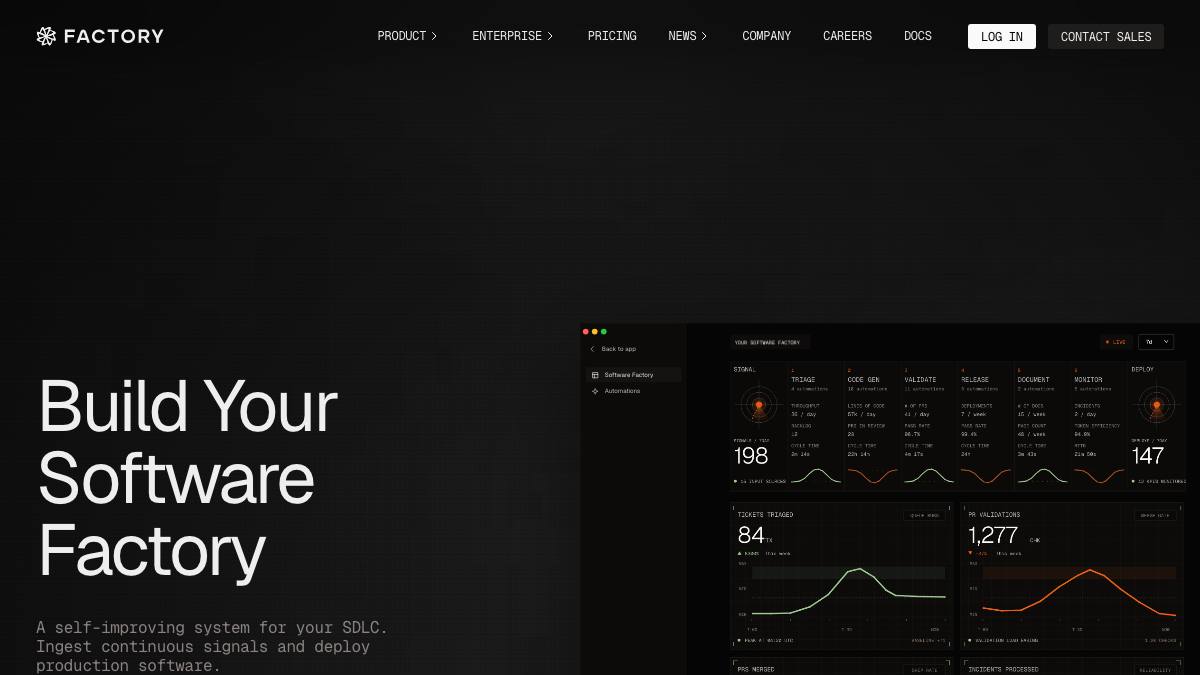
Factory is an agent-native software development platform built around AI coding agents called Droids. A developer gives a Droid a natural-language task and it plans, writes, tests, and ships code from prompt to pull request across terminal, VS Code, JetBrains, Vim, browser, and Slack, or non-interactively in CI/CD via Droid Exec. It is model-agnostic, routing across Claude, GPT, and Gemini per task with no lock-in. Beyond code generation it targets triage, planning, PR validation, releases, docs, and incident response across the SDLC. Factory sells primarily to enterprise engineering organizations and offers SaaS, hybrid, on-prem, and air-gapped deployments with SSO, SCIM, audit logging, and zero-data-retention options. Efficiency metrics it cites are company-reported.
What it can do
Generate code from a task (prompt to PR)
SupervisedA Droid plans, writes, and tests code from a natural-language task and opens a pull request a human reviews, under an explicit permission model.
sourceExecute multi-file migrations and refactors
SupervisedRuns large mechanical migrations and refactors across a codebase; Factory cites large efficiency gains as company-reported figures.
sourceRun headless in CI/CD (Droid Exec)
SupervisedExecutes scoped tasks non-interactively inside CI/CD pipelines, the least human-gated mode.
sourceTriage signals and respond to incidents
SupervisedIngests signals across the SDLC for on-call triage and incident response, with humans in the loop.
source
Strengths
- +Model-agnostic with no lock-in (Claude, GPT, Gemini per task)
- +Strong enterprise deployment story: on-prem, air-gapped, SSO, SCIM, audit logging, zero-data-retention
- +Whole-repo primitives plus headless CI/CD automation via Droid Exec
Limitations
- −Autonomy is marketing-forward but supervised in practice; you review every modification before it touches the codebase
- −Efficiency metrics are company-reported with no public methodology
- −Usage tiers are described relatively, making cost hard to predict, and there is no free tier
Overview
Factory is an agent-native software development platform built around coding agents called Droids that span the SDLC across CLI, IDE, browser, Slack, and CI/CD. It targets enterprise engineering organizations.
What it does
A Droid takes a natural-language task and plans, writes, tests, and ships code from prompt to pull request, with an explicit permission model so a human reviews changes. It also handles migrations, refactors, PR validation, releases, docs, and incident response. Droid Exec runs scoped tasks headlessly in CI/CD.
Integrations & setup
Connects to GitHub, GitLab, Jira, Linear, and Slack, with IDE support across VS Code, JetBrains, Vim, and Zed, plus a CLI and desktop app. It fully supports MCP and offers SaaS, hybrid, on-prem, and air-gapped deployments.
Pricing
Per-seat subscription starting at a Pro tier around $20/mo, up to custom Teams and Enterprise, with usage rate limits.
Best for / not for
Best for enterprise engineering orgs that want governed, model-agnostic coding agents with strong deployment controls. Less suited to individuals wanting a free, simple in-IDE assistant.
Alternatives
Cognition's Devin is the closest delegated-agent competitor; Cursor targets in-IDE work; Cosine and Sweep are adjacent coding agents.
What people are saying
We aggregate real LinkedIn discussion into sentiment for the agents people search most. Factory isn't tracked yet, want it added? Request tracking.
Used this agent?
Sign in to upvote, rate, follow, or leave a comment.
FAQ
Are Factory's Droids fully autonomous?+
No. Factory's own framing describes an explicit permission model where you review every modification before it touches your codebase. Droid Exec in CI/CD runs scoped tasks with the least human gating, but the headline workflow is supervised.
Does Factory lock me into one model?+
No. It is model-agnostic, routing across Claude, GPT, and Gemini per task, and has no proprietary foundation model.
Sources
- Factory (official site) · accessed 2026-06-18
- Factory Droids · accessed 2026-06-18
- Factory Series B announcement · accessed 2026-06-18
- Factory documentation · accessed 2026-06-18
- Factory hits $1.5B valuation to build AI coding for enterprises (TechCrunch) · accessed 2026-06-18
Last reviewed 2026-06-18