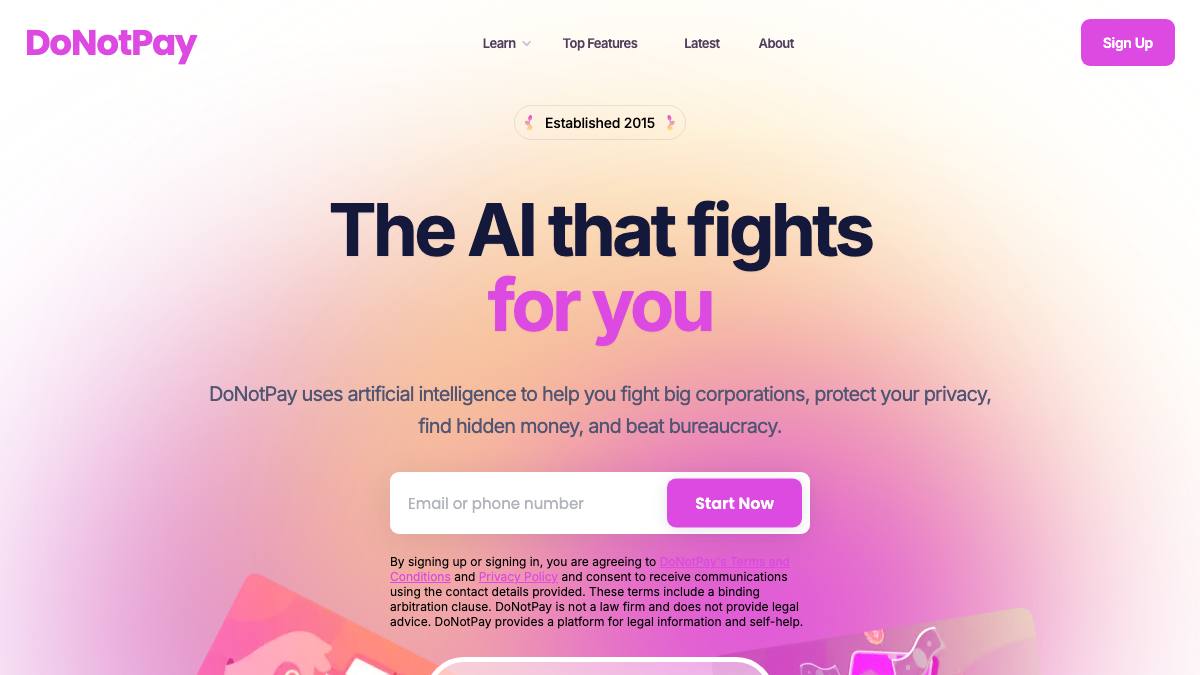
DoNotPay
by DoNotPay, Inc.
Consumer self-service AI that drafts disputes, cancels subscriptions, and chases refunds
Last reviewed 2026-06-20
DoNotPay is a consumer-facing AI service that markets itself as the "world's first robot lawyer." It automates everyday consumer tasks: the user describes a situation (a parking ticket, an unwanted subscription, a bill, a refund request, a chargeback, a small-claims filing) and DoNotPay generates and, for many use cases, mails or submits the relevant letters, forms, and appeals. It advertises 100+ tools spanning consumer rights, bill negotiation, privacy (burner phone numbers, a virtual "Free Trial Card"), and bureaucracy (DMV appointments, FOIA requests). Founded by Joshua Browder in 2015 and powered in part by OpenAI's GPT models (per third-party reporting), DoNotPay reached consumers via web and app. In September 2024 the U.S. Federal Trade Commission charged the company with deceptively claiming its "AI lawyer" was an adequate substitute for a human attorney; the FTC found DoNotPay had not tested the legal accuracy of its chatbot and had not retained attorneys to verify its law-related features. The finalized 2025 order required $193,000 in monetary relief, notice to 2021-2023 subscribers, and a ban on substitute-for-a-professional claims made without evidence. Treat all DoNotPay output as unverified self-service automation, not legal advice.
What it can do
Draft and submit dispute letters
SupervisedGenerates personalized letters and appeals (parking tickets, refunds, chargebacks, warranties) from user-supplied case details, and for many use cases mails or submits them to the relevant authority on the user's behalf.
sourceCancel subscriptions and negotiate bills
SupervisedIdentifies and cancels recurring charges and attempts to lower bills, framed as automated actions taken after the user provides account information.
sourceGenerate legal documents and small-claims filings
CopilotProduces demand letters and small-claims court documents from templates and GPT-based generation. Per the FTC, the company did not test these outputs for legal accuracy, so they require independent review.
sourcePrivacy tools (virtual card, burner numbers, spam control)
AssistantProvides a "Free Trial Card" virtual card that auto-declines charges after a trial, burner phone numbers, and spam/robocall handling to protect the user during signups and disputes.
source
Strengths
- +Covers a very broad range (100+) of everyday consumer disputes and admin tasks in one subscription
- +Automates tedious paperwork: drafts and, for many use cases, files or mails letters from a short questionnaire
- +Useful privacy primitives (virtual trial card, burner numbers) bundled in
Limitations
- −The FTC found DoNotPay never tested the legal accuracy of its chatbot and required it to stop claiming it substitutes for a human lawyer; output is not legal advice
- −Settled FTC charges in 2025 ($193,000 in relief, notice to 2021-2023 subscribers) over deceptive "AI lawyer" marketing
- −History of billing complaints (reports of continued charges after users were told accounts were closed)
- −No transparency into success rates; results vary by jurisdiction and use case
Overview
DoNotPay is a consumer-facing AI service that brands itself as the "world's first robot lawyer." Founded by Joshua Browder in 2015, it started as a tool to contest parking tickets and expanded to 100+ tools for canceling subscriptions, chasing refunds, negotiating bills, filing small-claims documents, finding unclaimed money, and handling bureaucracy (DMV, FOIA, notarization). Per third-party reporting, most services are powered by OpenAI's GPT models.
What it does
The user answers a short questionnaire about their situation, and DoNotPay generates the relevant letter, appeal, or form. For many consumer use cases it goes further than drafting and will mail or submit the document on the user's behalf, which is why it sits at the supervised-agent level rather than a pure assistant. It also bundles privacy tools: a "Free Trial Card" virtual card that auto-declines charges after a trial, burner phone numbers, and spam handling.
Important honesty note: in September 2024 the FTC charged DoNotPay with deceptively claiming its AI was an adequate substitute for a human lawyer. The complaint stated the company never tested the legal accuracy of the chatbot's answers and did not retain attorneys to verify its law-related features. The finalized 2025 order imposed $193,000 in monetary relief, required notice to subscribers from 2021-2023, and prohibited substitute-for-a-professional claims without evidence.
Integrations & setup
DoNotPay is a self-serve web and app product aimed at individual consumers; no public developer API, MCP server, or third-party integrations were documented at this review. Setup is signing up and selecting a tool.
Pricing
Flat subscription. Third-party sources report approximately $36 every two months for access to all tools (up sharply from an earlier ~$3/month). Pricing is not prominently shown on the homepage, so confirm at signup.
Best for / not for
Best for individual consumers who want help automating small, tedious disputes (a parking ticket, a stuck refund, an unwanted subscription) and are comfortable reviewing the output themselves. Not for anything requiring actual legal judgment or a binding legal opinion: per the FTC, its output was not tested for legal accuracy and must not be treated as a lawyer's advice.
Alternatives
DoNotPay is unusual in targeting consumers directly; most legal AI is built for lawyers and firms (Harvey, Spellbook, Robin AI) rather than end consumers automating their own disputes.
What people are saying
We aggregate real LinkedIn discussion into sentiment for the agents people search most. DoNotPay isn't tracked yet, want it added? Request tracking.
Used this agent?
Sign in to upvote, rate, follow, or leave a comment.
FAQ
Is DoNotPay actually a lawyer?+
No. DoNotPay is a consumer software service, not a law firm. In 2024-2025 the U.S. FTC charged and settled with the company over its "robot lawyer" claims, finding it had not tested the legal accuracy of its chatbot and barring it from claiming to substitute for a human professional without evidence. Its output is self-service automation, not legal advice.
Is DoNotPay autonomous?+
It operates as a supervised agent for its core tasks: the user supplies case details and reviews, and DoNotPay drafts and (for many use cases) submits letters and appeals on the user's behalf. It does not act end-to-end without the user providing inputs and account access, and legal-document generation in particular needs independent review.
What does DoNotPay cost?+
DoNotPay uses a flat subscription. Third-party sources report roughly $36 every two months for access to all tools; the company does not prominently publish pricing on its homepage, so confirm current pricing at signup.
Sources
- DoNotPay (official site) · accessed 2026-06-20
- FTC announces crackdown on deceptive AI claims and schemes (DoNotPay charge) · accessed 2026-06-20
- FTC finalizes order with DoNotPay prohibiting deceptive 'AI lawyer' claims · accessed 2026-06-20
- DoNotPay (Wikipedia) · accessed 2026-06-20
- DoNotPay business breakdown (Contrary Research) · accessed 2026-06-20
Last reviewed 2026-06-20