Consensus
AI search engine that finds and synthesizes scientific evidence
Last reviewed 2026-06-19
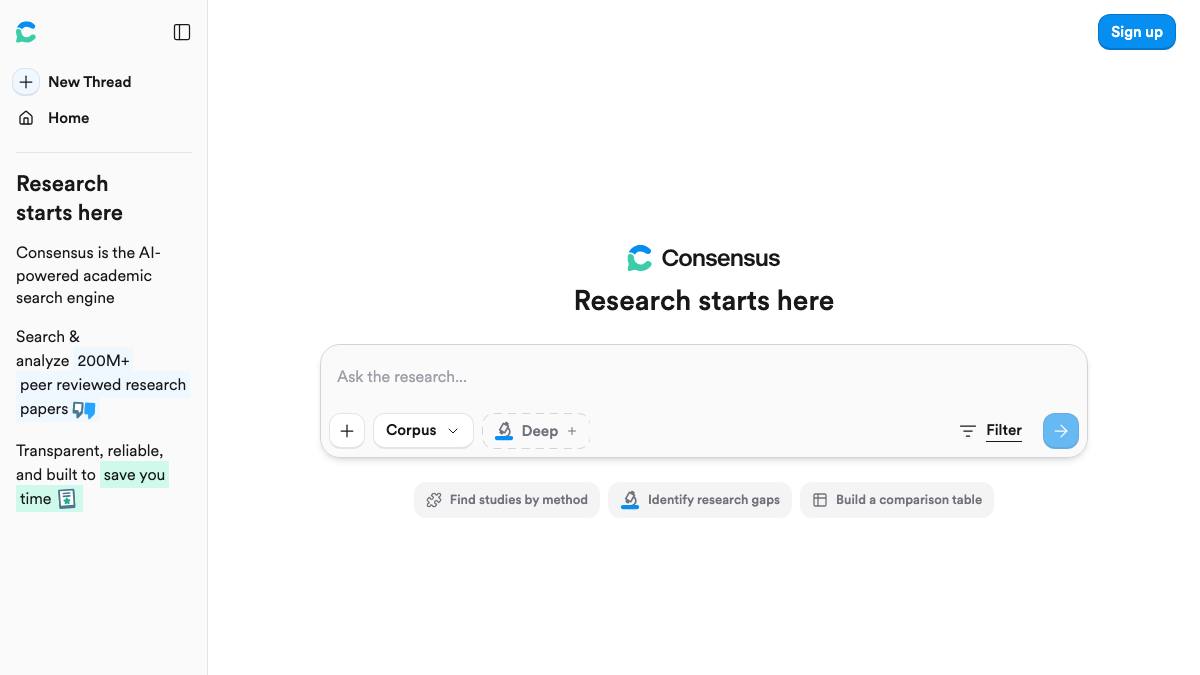
Consensus (consensus.app) is an AI-powered academic search engine that distills insights from over 200 million peer-reviewed papers, drawing on Semantic Scholar and other databases. You ask a research question in natural language and it returns the most relevant papers with AI-generated plain-language summaries, a Consensus Meter that aggregates whether the literature says yes, no, possibly, or mixed on yes/no questions, plus Study Snapshots, a Copilot, and Pro Analysis / Deep Search for deeper synthesized answers. Founded in 2022 by Eric Olson and Christian Salem, Consensus partnered with OpenAI early and uses OpenAI's latest models (via the Responses API) for synthesis, so it is OpenAI-centric rather than broadly model-agnostic. It targets researchers, students, clinicians, and enterprises that need evidence-grounded answers. Its core search and summarize loop is assistant-level; Pro Analysis and Deep Search are multi-step, user-initiated synthesis.
What it can do
Search papers by natural-language question
AssistantSearches 200M+ papers and ranks them by AI relevance for a research question.
sourceAggregate consensus on yes/no questions
AssistantThe Consensus Meter aggregates whether the literature says yes, no, possibly, or mixed.
sourceSummarize studies
AssistantProduces per-paper Study Snapshots and plain-language summaries.
sourceSynthesize multi-paper answers (Pro Analysis / Deep Search)
SupervisedReads selected papers and generates synthesized answers; Deep Search runs deeper multi-step analysis, user-initiated.
source
Strengths
- +The Consensus Meter is a genuinely useful at-a-glance evidence aggregator
- +Huge corpus (200M+ papers) with credible search infrastructure and OpenAI synthesis
- +Generous free tier plus student and clinician discounts
Limitations
- −Locked to OpenAI models; less flexible than model-agnostic rivals
- −The Consensus Meter is best for binary questions and weaker on nuanced topics
- −Public pricing varies across secondary sources; confirm current tiers on-site
Overview
Consensus (consensus.app) is an AI-powered academic search engine over 200 million-plus scientific papers, drawing on Semantic Scholar and other databases.
What it does
You ask a research question in natural language and Consensus returns relevant papers with AI summaries, a Consensus Meter that aggregates the literature's yes/no/possibly/mixed verdict, Study Snapshots, a Copilot, and Pro Analysis / Deep Search for deeper synthesized answers. It uses OpenAI's latest models via the Responses API for synthesis.
Integrations & setup
Draws on Semantic Scholar and academic databases on the backend and historically offered a ChatGPT integration. It is OpenAI-centric rather than model-agnostic.
Pricing
Freemium: a generous free tier, Premium at roughly $8.99/mo, a Pro tier adding Deep Searches, and a custom Enterprise tier, with student and clinician discounts. Exact figures vary across secondary sources; confirm on-site.
Best for / not for
Best for researchers, students, and clinicians who want fast, evidence-grounded answers. Less suited to nuanced, qualitative questions where the Consensus Meter is weaker.
Traction
Consensus raised a reported $11.5M Series A in August 2024 led by Union Square Ventures, with investors including Nat Friedman and Daniel Gross.
Alternatives
Elicit is the closest research-assistant alternative; Perplexity is the closest general AI-search alternative.
What people are saying
We aggregate real LinkedIn discussion into sentiment for the agents people search most. Consensus isn't tracked yet, want it added? Request tracking.
Used this agent?
Sign in to upvote, rate, follow, or leave a comment.
FAQ
Which Consensus is this?+
This entry covers consensus.app, the AI search engine for scientific research. It is not goconsensus.com, the unrelated B2B sales-demo automation platform.
Is Consensus an autonomous agent?+
Its core search and summarize loop is assistant-level. Pro Analysis and Deep Search are multi-step, user-initiated synthesis the researcher reviews, so those are supervised-agent behaviors.
Sources
- Consensus (official site) · accessed 2026-06-19
- Consensus blog · accessed 2026-06-19
- Consensus raises $11.5M Series A (VentureBeat / PRWeb) · accessed 2026-06-19
Last reviewed 2026-06-19